Difference

The difference between clever and cunning.
Showing posts with label Review. Show all posts

Monday, August 13, 2012

Legend of Grimrock Review


Computer RPG’s have changed dramatically since they first emerged in the eighties. The first entries in signature series like Wizardry, and Dungeon Master were shaped as much by technical limitations as by design choices.  These games were classics in their own time and are fondly remembered today, but unfortunately they have not aged particularly well. For better or worse game design and player expectations have changed dramatically, and the hardware limits that shaped the industry at its birth have long been exceeded. The brutal difficulty and obtuse design decisions of early RPG’s make them inaccessible to most modern audiences.

Wayback Machine

Legend of Grimrock is the first game released by Finnish indie studio Almost Human. Grimrock successfully embraces both the style and spirit of those earliest RPG’s while being highly playable. The game is a triumph of accessibility, retaining what made old school dungeon crawlers fun while presenting an interface and difficulty curve in line with the best of modern gaming conventions. 

Grimrock takes place entirely within the confines of the cloud piercing titular Mt. Grimrock. Periodically small groups of prisoners are given a royal pardon, taken to the top by airship, and tossed down a pit into the monster infested, trap riddled labyrinth below. None are ever seen again, and your little band is next.

Dungeon Crawling Fools

Character creation is quick, painless, and more or less intuitive. You create a party of four from a handful of options like burly minotaurs, sneaky lizard men, and the classic triumvirate of fighter/mage/thief.  After a brief and beautifully illustrated intro sequence your party is dumped into the upper levels of the mountain with nothing to lose but their lives and nowhere to go but down. 

It's not an RPG without animated skeletons in it somewhere.

The mountain’s dungeons are built along a grid pattern a la Dungeon Master and other similar classics. You can even turn off the handy automap and chart the levels yourself with graph paper, if you’re so inclined.  Movement is by discrete squares, one square at a time. Your understandably anxious party sticks together in a two by two formation that occupies a single square, which you control from a slightly abstract first person perspective. The characters in front can attack with short range melee weapons while those in the rear are free to sling spells and arrows from relative safety.

The interface is intuitive and almost entirely mouse driven. Everything happens in real time, including combat. When some horrible beastie comes scuttling out of the dark you right click on your characters equipped weapons to attack while maneuvering the entire party around with the keyboard. You can toss and place any object you can pick up. Sadly there are no landmines, but any object can be flung at foes and heavier ones will do damage. 

Short Rations

Grimrock is pleasingly challenging but never unfair. It will never, for example, trap you in a room full of poison gas with no way out because you missed a hidden switch two levels ago. Food, light, and carrying capacity are all limited and must be carefully considered and constantly managed. Given that you’re trapped deep in the bowels of a hellish murder-mountain there are no shops, towns, or friendly NPC’s to be found so scavenging is a must. If you're willing search your environment and use your brain you can find what you need and more.

Voices in your dreams guide you ever downward.

Early on your band of prisoners must rely on rocks and fists just to defend themselves. The rusting swords and rotting leather armor you’d throw away in other games is desperately needed survival gear inside Grimrock. Most enemies only drop chunks of edible monster flesh if they leave behind anything useful at all. You’ll be glad when you can finally equip everyone with a pair of raggedy pants, much less magic swords and plate mail.

The game’s narrative is spare but effective. There are no info-dumps or exposition laden cutscenes. Notes left by previous explorers and a mysterious voice that visits you in dreams of grinding gears draw you deeper and deeper into the mountain. 

Sound design is likewise lean but well designed. Aside from the main menu there is very little music. The ambient background sounds of the dungeon are delightfully spooky, punctuated by what sound like distant howls, faint whispering, and the hum of hidden machinery. You can usually hear monsters moving around long before you run into them, and the click of panels or grinding sound of a wall sliding back heralds the discovery of a new secret or a dangerous ambush. 

Crab Battle Shuffle

Combat is a savage but oddly formal dance. Like your own party monsters are restricted to grid-based movement and cannot move or attack diagonally. Mobility is essential. Ranged attacks can and should be dodged simply by side-stepping out of the way. Armor and defensive skills and spells help, but Grimrock is built around the expectation that the player will be moving the party around to minimize the number of hits they take. Just standing toe to toe with the tougher monsters and bashing away will get everyone killed in a hurry. 

Ice spells freeze enemies like this Cave Crab solid.

Sometimes monsters are polite enough to file down a narrow corridor into the blades of your armored front rank warriors but you can’t depend on it. Bigger fights are frantic brawls that have you dodging, spinning, and hacking away, desperately trying to land hits and dodge attacks while not getting flanked or surrounded. It’s critical to avoid exposing your more vulnerable rear support characters to monster teeth and claws. 

All characters require a short rest after attacking, varying by weapon speed and skills. This creates a natural rhythm of darting in to make attacks and leaping away to avoid retaliation. If you need to swap weapons, chug a healing potion, or change ammo types you’ll do it while the monsters are still gnawing away at you. Anyone clamoring for hotkeys or a turn-based combat mode is missing the point. The challenge of Grimrock’s combat comes from juggling attacks, movement, spell casting, and inventory management all at once, all in real time. 

Spell casting requires punching in a specific combination of runes on a simple 3x3 grid. It’s a workable system and it’s fairly intuitive to figure out the combination of new spells as you unlock them. Some sort of spell book that recorded the combinations you’ve already discovered wouldn’t have gone amiss, but you can always note them down by hand and any one mage isn’t going to unlock more than a handful spells over the course of the game. 

Something's always scuttling out of the dark to turn you inside-out.
Few combat spells require more than two runes but casting still requires more mouse clicks and attention than just swinging a weapon. The correct combination must be punched in every time single time you want to cast a spell. The mechanics mean it’s difficult to play effectively with more than one mage in your party. Spells are potentially very powerful though, so this isn’t unreasonable from a balance standpoint.

Devices in the Dark

Puzzles are the finely crafted core of the game’s challenge. The developers continually come up with interesting ways to use and combine the basic elements at their disposal. Buttons, switches, pressure pads, and teleporters are all put to good use. The puzzles are less in the abstract vein of Myst and more along the lines of the tactile challenges of Portal. Disarming a trap or unlocking a door isn’t a matter of having a thief with the right skills. You, the human player, need to find that hidden button or throw those switches into the right combination. 

Grimrock does a good job of slowly teaching you the rules that it operates by and sticking to them over the course of the game. A combination of careful exploration, observation, and logic usually get you through, and it’s immensely rewarding when everything finally “clicks” and the way forward slides open.  I’d encourage you to resist the temptation to use a walk-through, although I’m forced to admit I got stuck once or twice and needed a hint. 

Even with it's limited tile set Grimrock manages a desolate and spooky atmosphere.

There are also dozens of optional secret areas hidden throughout the mountain, full of valuable food, weapons, and other supplies. Few of them are ever accessed the same way twice. You’ll need a sharp eye and a keen mind to find them all, plus the patience to check hundreds of wall segments for hidden buttons.
Last Torch

Grimrock’s gameplay elements are deliberate and mostly carefully considered, but there are a few missteps.  Most of these are oddities related to character development. For example in Grimrock ranged attacks, be they arrows, spells, or flung rocks, always hit whatever is in front of the party. You can’t miss with a bow unless the monster steps out of the way. Strength boosts both melee and ranged damage while Dexterity, the traditional ranged attacker attribute, affects only melee accuracy and defense. 

Each class only has a few skills, but points to improve them must be spent with care.

Why is it then that dumping points into the archery skill improves Dexterity, a stat that archers counter intuitively have almost no use for? It feels like someone missed a memo somewhere. Of course Grimrock isn’t the kind of game that requires perfectly optimized characters to survive. Victory in combat is at least as dependent on the player’s manual skill and what weapons and supplies they’ve wrested from the dungeon. 

I feel like a bit of a jerk for even raising this point, but Grimrock is also a strictly linear game without a lot of replay value. This is less a flaw and more the game’s own meticulously put together and never randomized nature. It’s important to understand that Grimrock is not a “Roguelike”, and will always be laid out the same each time. Once you’ve solved the dungeons cleverly constructed puzzles, survived its traps, and uncovered its secrets once they’re unlikely to be as absorbing a second time around. 

This accusation feels unfair, not the least because Grimrock offers at least a strong 10-15 hours of high quality gameplay at a more than reasonable indie game price. It’s unlikely that the average player will find all the secrets and goodies in a single play-through and there are plenty of valid party builds to try. There’s also a neat unlockable easter egg mode that can make for an interesting and challenging replay. 

Release the Kraken!

Finally the developers are hard at work on a very cool looking level editor which they plan to release for free. This is an excellent decision and will do wonders for the game’s longevity and community. The engine is rock solid and perfectly suited for its intended purpose of dungeon crawling. I’m already looking forward to seeing what sort of deathtraps the fan community is able to create. 

Reasons to play: Smoothly and enjoyably meshes old school design with modern hardware and sensibilities. Clever, satisfying puzzles. Challenging but absolutely fair. 

Reasons to pass: A few odd systemic choices for character attributes and skills. Very linear, with low replayability.

Articles copyright James Cousar, games and images copyright their respective owners.

Tuesday, July 10, 2012

Skyrim Review

Hey folks. It's been awhile since my last post, and I apologize for my prolonged absence. I've been busy with classes and other responsibilities. To make up for it here's an epic length review of a massive game.


Skyrim is the latest installment in the “Elder Scrolls” series, a long running collection of single player RPGs nearing the end of its second decade.  Series signatures include massive, content packed worlds, character progression that breaks from the usual XP/Level system, and (unfortunately) loads of bugs. On a more positive note Elder Scrolls games are also renowned for their high level of fun, immersion, and mod-ability. 

The Orc with no name

Like all Elder Scrolls games Skyrim starts with your anonymous character imprisoned and, this time around, moments from execution. As this would make for an extremely short game it’s no surprise that a massive dragon interrupts the headsman and allows you to make a break for freedom. Dragons may be ubiquitous in many RPG settings, but in Skyrim they’ve been mercifully gone for a great many lifetimes. One showing up from out of the blue is unexpected, to say the least.

Skyrim's wilds range from rolling tundra to icy wastes.

The introductory sequence also integrates character creation, which has been vastly simplified from earlier Elder Scrolls games. There are no stat points to assign and no fussing with class or skill packages.  You chose your name, appearance, and race and you’re ready to play. 

Race is the only choice at character creation with real impact on gameplay. You can choose from the usual spread of human and elf subtypes, along with a few more exotic options like lizard and cat people. Your choice gives you some largely inconsequential skill bonuses and a unique ability or two.

While a few racial abilities are more useful than others any race can ultimately thrive at any play style. If you really want to break type and play a Nord (Viking) thief or Khajiit (cat person) mage it’s entirely possible to do so and thrive at it. Since you’ll be staring at your character for a great many hours to come there’s nothing wrong with simply choosing a character that looks as cool as possible and plunging boldly ahead.

Brave New World

After dodging dragon fire and finishing a brief tutorial dungeon Skyrim finally kicks you out into a beautiful high-mountain meadow, hands you a lead for the main quest, and tells you to go do whatever you please. It’s an intoxicating moment, and usually the time you notice that great gods of graphics cards this game is pretty. The world has a vast, open, semi-realistic design that’s a huge step up from the series of corridors disguised as canyons that so many games pass off as outdoors. If you can see a place on the horizon you can likely get there, although you may need to get creative with the jump key to get up some of the geometry.

To give you a sense of the game I’ll briefly describe my opening experiences:

So there I was, a wanted criminal stranded alone in a harsh land. My skills and weapons were meager and my supplies sparse. A civil war was brewing between the native Stormcloaks and Skyrim’s longtime Imperial occupiers that threatened to tear the province apart.  Supposedly extinct draconic death-machines could strike from the sky at any moment. Danger lurked around every corner and my chances of survival seemed slim.

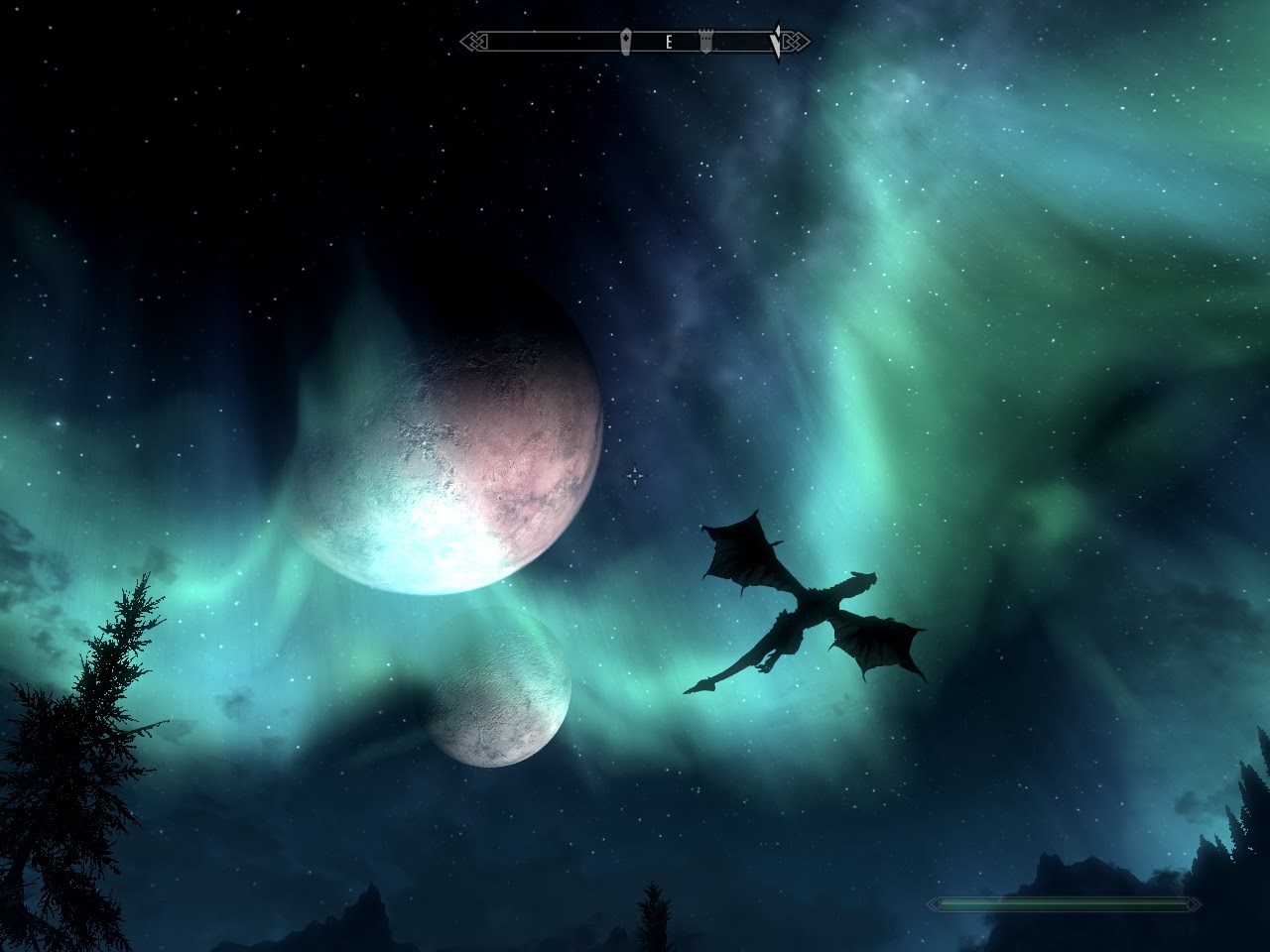
Northern Lights

I elected to do the only logical thing and chase butterflies in the sunlight. I was happy to find I could both loot and eat them, and spent some time checking the meadows flora and fauna to see if they were poisonous enough to kill me. A wolf pack that wandered by proved aggressive but flammable.

I eventually stumbled across a hunter with a small camp. I tried to sell him my fine selection of charred wolf pelts and random insects and plants, but he kept taking them from my inventory without actually paying me for them. (This turned out to be a game bug, not robbery.) Sadly he then mysteriously burst into flames while I heroically rescued his few valuables. Still in search of a working merchant I decided to swim a rushing mountain river down to the plains below, grabbing and eating live salmon from the waters and fending off alpine crab attacks the entire way.

At this point I realized several hours had passed, I’d already encountered a couple of bugs, and I’d made no notable progress on the main quest or any other. I was also having a tremendous amount of fun. Skyrim is a game of constant distraction. Ending the draconic menace can wait, and wait it will. You can take as much time as you like to explore, make giant piles of dead guards, experiment with alchemy, and sneak into people’s houses while they’re sleeping and replace all their earthly possessions with cheese wheels. 

The sheer size and scope of the world can be a little intimidating, but it has a node based fast travel system like Fallout 3’s. Any place you’ve been before you can easily return to, and handy carriages will take you to any major city for a modest fee. One of Skyrim’s many pleasures is simply picking a random direction and hiking off into the wilds to see what you can find. (Usually angry bears.) The ability to put down your own map notes and waypoints would have been nice, but the system works well enough.

Nordal Kombat

While a stealthy character is extremely viable and a high speech skill can save you a certain number of fights eventually you’re going to want and need to murder someone. When that time comes you’ll quickly discover that the beating heart of Skyrim’s combat engine is two fisted. You can hold a weapon, shield, or spell in either hand and make use of both with the left and right mouse buttons. It’s a great system, and quickly becomes second nature.

Bows and big weapons obviously take two hands to use, but there’s a lot of fun to be found trying unconventional combinations. I found a shield and an offensive spell surprisingly viable. The bold can always simply wade in with a sword or fireball in either hand.

Summoned creatures help even the odds nicely.

Health, mana, and stamina all regenerate naturally, slowly in combat and rapidly when nobody’s trying to kill you. As a mage many early fights boiled down to me emptying my mana at an enemy and then running away until it recharged. Natural regeneration won’t save you from repeated hammer blows to the face, but you rarely need to micromanage your basic resources between fights. If you can survive an encounter you’ll be back at 100% by the time the next one rolls around. 

If you are getting savagely beaten you can always pause the game and chug as much healing potions and food as you want. I like to imagine this translates to your character holding up one hand for a time out while stuffing whole cabbages into their mouth with the other.  This can have some weird effects on combat pacing and difficulty.  Tough fights take on a stutter-stop feel as you constantly pause the action to root through your inventory and replenish yourself. So long as you have a decent stock of consumables and the enemy can’t kill you with a single hit you rarely need worry about death. 

Dragon Slayer

Dragons are usually endgame enemies, but in Skyrim you’re dealing with them from Day One, 8:00 AM. These beautifully animated battles are epic in scope and easily one of the highlights of the game. Nearby guards and even bandits and monsters tend to drop whatever they’re doing and join in. It’s not unusual to come across an attack already in progress, burning corpses and all.  A tremendous amount of effort was clearly put into making sure you feel like you’re trying to bring down something appropriately big, mobile, and dangerous. 

Now this is what RPGs are all about.
 
Dragons fully exploit their ability to fly, and grounding one down requires judicious use of arrows or spells. Their bat-like body structure makes them slightly more awkward on the ground, but they can still grab humanoids in their jaws and toss them around like ragdolls. It’s hilarious when they’re gobbling down guards and terrifying when you’re the one between their jaws.

Designing fights against giant creatures that don’t just feel like you’re stabbing at their toes has always been tricky. Skyrim succeeds brilliantly.  When the epic theme music kicks in and you hear that distinctive roar you’ve got to fight.

Battle Cries

As the plot quickly reveals your character is the “Dhovakin”, the only one able to slay a dragon permanently and absorb its soul. Dragon souls are then spent to unlock the “Dragon Shouts” you find carved on ancient rune walls scattered across the world. Dragon Shouts are discrete from normal magic and useable by any character. They represent a goodie bag of fun and powerful abilities that nicely reward both dungeon crawling to learn new Shouts and slaughtering dragons to unlock them.

The now meme-worthy  “Fus-Ro-Dah” (Force-Balance-Push) Shout hurls people bodily through the air, and need only be combined with a high place for instant hilarity. Other Shouts encase enemies in ice, send them fleeing in fear, or do otherwise unique things like clearing the sky of rain and snow.

You equip and use Shouts independent of your normal weapons and spells (because you’re shouting them, not holding or casting them with your hands, see?) and  all Shouts share a collective cool down,  so knowing which Shout to ready and when to hurl it is an important tactical consideration.
You can recruit a host of different followers, but only one at a time. Backup in combat is always handy but they seem to have trouble spotting traps and make sneaking difficult. Once killed they can’t be resurrected (save as a zombie, if you’ve got the appropriate spells) so I elected to leave them at home most of the time and use expendable summoned demons for my dirty work.

There's no shortage of dirty work that needs doing. Skyrim is crammed with content. The main quest line is actually one of the weaker parts of the game, but if you run through it at a dead sprint you’re doing Elder Scrolls wrong. Indeed I challenge anyone to focus on any one thing for any length of time in this game. 


Aside from the main quest there’s an entirely optional Civil War to sort out, four major guilds with their own extensive quest lines, and hundreds upon hundreds of side quests. Many are procedurally generated and basically just exist to point you to some dungeon or another, but you really can’t expect to ever complain about running out of things to do. 

Underground barrows teem with treasure, the undead, and spooky ambiance.
The land is sprinkled with scores of caves, forts, ruins, magic outhouses, and so on. You’re constantly tripping over them as you wander through the countryside, tempting you to explore as you pass. Each of these scenic lairs is invariably infested with bandits, vampires, C.H.U.D’s, trolls, evil mages, giant spiders, undead Vikings, and other undesirables. Each offers a nicely self contained 20-40 minutes of adventure, combat, and worry free pillaging, with the occasional light puzzle solving. 

There’s obviously a lot of art and asset re-use, but almost every dungeon manages to have a unique layout and most have interesting story or game play elements. While generally linear each dungeon also dumps you back out near the entrance after you plunder the cache of loot at the end. This is not realistic, but it is good game design.  

Learning by doing (bad things to people)

Like previous Elder Scrolls games Skyrim dispenses with experience points and has you improve by doing. Shoot a bunch of guys with bows and you’ll get better with bows. Cast a bunch of healing spells and get better at healing magic. Pick a bunch of pockets and get better at putting your hands down the pants of strange Orcs. With no class or statistical restrictions every character has access to every skill, so if you want to be a master magician who also picks locks or wears heavy armor go for it. 

If you play normally the system makes character growth feel organic, but it does lend itself to a certain amount of abuse and blatant grinding. The most efficient rout to ultimate power is not necessarily plundering ancient crypts or battling fearsome foes, but standing in a muddy streambed letting a large crab pinch your toes, healing yourself with one hand and blocking its attacks with the other. Why? Because you’re leveling your armor, block, and healing skills, that’s why. 

A few fan favorite characters return, like the ever lovable Lord of Madness.
 
Any character can max out any skill, although some skills (especially primary combat skills, which require live enemies) are more difficult to improve than others. True character customization and growth comes from sinking your Perk points (earned at a rate of one per level) into the skill’s unique Perk tree. Perks are game changers that open up new abilities and define your play style, like zoom and slow-mo with a bow, a rushing shield bash, or improved damage with fire spells. 

The absence of experience points also means that most quests simply award gold and/or loot. If you’re an obsessive looter (like me) then gold is a non-issue for most of the game, and this all makes quests a bit less rewarding. There aren’t a lot of cash sinks in Skyrim, partially because the game’s streamlined out some of the RPG busywork. 

Weapons and armor require no care or maintenance, and health and mana all recover quickly on their own.  Aside from more skill training and spells I didn’t find much worth buying that wasn’t already lying around free to take. Players less likely to end up on A&E’s Hoarder’s might find quest rewards more useful. 

Running to stand still

One quirk of the leveling system is that as you level up, many parts of the world scale up in difficulty along with you. It’s not nearly as jarring as in earlier games but it is noticeable. Plain old vanilla Bandits start to be accompanied by, say, Bandit Facebreakers, and eventually Bandit Murderkings. Weaker enemies never disappear entirely so you do get a sense of progression, but most of the major enemy types come in several distinct tiers. Higher end foes start to sport truly ridiculous health pools.

The appearance of tougher enemies is based on your overall level, not your combat abilities. It’s important to keep this in mind, because it means that while you’re honing your lock-picking and practicing your alchemy your enemies are getting better at beating you to a pulp. If you haven’t been keeping up your combat skills tight dungeon corridors and linear design can still turn these areas into grueling slugfests.  Characters will likely want to focus on at least one primary combat skill to ensure survival. Remember, the Draugr are training.

Any character can pick up and use any item, so quest rewards and loot scale based on your level as well. You can’t simply memorize the location of the Kill-everybody sword and run there thirty minutes after starting a new game, which was entirely possible in earlier games. More powerful equipment won’t even start to appear until you’ve reached a sufficient level. 

Giants are tough. Even this dragon should think twice before pressing his attack.

All this can make for an unwieldy difficulty curve. I was able to steamroll most early encounters, but by the midgame I was spending a lot of time playing keep-away from foes who took several minutes to kill and could drop me in one or two hits. In a classic Elder Scrolls moment I dug into the pile of raw materials I had stashed, churned out a few hundred iron daggers, and then burned up several dozen of the cheapest soul gems to enchant each of them.

The point of all this was to max out my blacksmithing and enchanting skills, and then swap my flimsy mage robes for a set of custom crafted magic armor so powerful I never replaced it for the rest of the 40+ hours I spent in Skyrim. If I had wanted to be truly abusive I could have made entire schools of magic free to cast, made weapons that paralyzed enemies while healing me, and other brokenly powerful stuff. For all I’ve harped on the difficulty curve it’s possible to use the crafting skills to break the game over your knee. It could be argued that this is what the Elder Scrolls series has always been about. 

Trouble in Valhalla

Skyrim is an amazing and absorbing game, but it does have some considerable design flaws. Chief amongst these is that inventory management is pure hell. The default UI is clearly designed to accommodate console users and is agonizing for anyone using a mouse and keyboard. Everything you own is dumped into a long alphabetized list of names with limited filtering. You’re forced to scroll through the whole thing, starting at letter A, every time you want to change gear, use a potion, ready a spell, or otherwise get any goddamn thing done. 

There are limited hotkeys, but they were so poorly explained I had to check YouTube to figure out how to use them and they don’t really work with dual wielding or casting. After the hundredth time pausing the game to scroll through dozens of names I would have cheerfully killed for a grid and mouse based inventory.

Characters are also fairly restricted in the amount of weight they can haul around, especially in the early game. As a compulsive looter and scavenger I had to spend a disproportionate amount of time grappling with the horrible inventory interface to sort, stow, and toss junk. Even I was forced to admit I probably didn’t need to be carrying that many brooms and potatoes and start paying attention to the value/weight ratio of stuff. To exacerbate the problem most merchants only keep a limited amount of gold on hand. Liquidating your loot can require a tour of the entire province. 


Skyrim, very much in character for the Elder Scrolls series, is also a buggy game. Playing months and a good number of major patches after release I was still encountering broken quests, weird NPC behavior, and in one case a mob of un-killable guys with the same name all standing waist deep in the ground. There’s nothing game-breaking and performance was generally stable, but be prepared for a constant stream of oddities, minor annoyances, and general weirdness.  

World without End

Once you acclimatize to this Skyrim is a world that’s packed with flavor and life. NPC’s follow regular schedules and chat with one another. The wilds are full of wandering ambient life and events already in progress when you ride by. Dozens of surprisingly well written in-game books flesh out the world and provide optional back-story. Most importantly people heckle you if you’re running around naked, which is always nice touch.

It’s not quite total freedom. A lot of the plot critical NPCs can’t actually be killed before their time. Your ability to enforce permanent change on the world is limited. You can’t, for example, clear a fort of bandits and then hire soldiers and workers to repair it into your personal fortress. Even completing the civil war just changes the uniforms of the guards in half the towns.  

When you’re tired of being a roving heavily armed murder-hobo you can settle down, buy a house, and even get married. None of this is crucial, but it’s a great touch and provides some worthwhile benefits. As a compulsive hoarder my home quickly became crammed with junk which my spouse dutifully tolerated, kicking her way through the piles of discarded shields, books, and dragon bones to get around. Amusingly any marriageable NPC can be convinced to fall for you regardless of gender. Make sure you’re ready to spend the rest of your life with that particular elf though, because Skyrim doesn’t allow divorce or re-marriage.

Sometimes you just need to stop and admire the view.

Finally, do yourself a favor and play this game on a PC. If you don’t own a machine that can run it, wait till you do. Why? Mods.

Like Morrowind and Oblivion before it Skyrim hosts a huge and thriving mod community. A few of my favorite include Sky UI, which totally revamps the inventory into something actually useable, a giant compilation of fan made bug fixes, and  a mod that lets you spend Dragon Souls as an alternative to perk points. While there are certainly a lot of junk and borderline creepy mods out there the community is generally good about up-voting the coolest and most useful ones, and Steam makes installing them a snap. Collectively they afford Skyrim a degree of flexibility, utility, and constant free new content rarely seen.

Ultimately I’ve sunk far, far too many hours into Skyrim not to honestly recommend it. It’s the kind of game you can play for months, if not years, and never truly finish. Anyone who enjoys RPGs and games in general should strongly consider getting it, if they haven’t already.

Reasons to play: Massive, beautiful, expansive world. Tons of content. Dragon battles. Shout people over cliffs. 

Reasons to pass: Awful inventory UI. Loads of minor bugs and general weirdness. Character progression system can create awkward difficulty curve.

Note: I played on the fourth most challenging out of five difficulty levels. The difficulty curve issues I’ve noted are likely much less notable at lower levels. 

Articles copyright James Cousar, games and images copyright their respective owners.

Thursday, May 3, 2012

Bulletstorm Review

 
Bulletstorm is a high action FPS from Polish based developer “People Can Fly”, perhaps best known for its old school shooter Painkiller and the work they did on the PC version of Gears of War. Bulletstorm takes more after the Painkiller school of gameplay than Microsoft’s cover based shooter, bringing a frantic energy to the increasingly stale conventions of the modern linear, cinematic shooter. The game is a lively, gore-spattered, obscenity riddled thrill ride with tremendously satisfying combat mechanics and a breakneck pace that rarely lets up. 

Made for TV


Bulletstorm’s story is straight from a Sci-Fi channel movie, but the strength is in the telling rather than what’s being told. You play as Grayson Hunt, member of a futuristic and morally suspect special-ops team called Dead Echo. The game doesn’t just tell you these things however. It doesn’t even show you. It has you do.

When sent to kill a man who turns out to be an innocent reporter documenting Dead Echo atrocities the game doesn’t just show via passive cut-scene. The game has you, the player, walking down the side of a skyscraper in gravity boots and pulling the trigger yourself. Flashing forward 10 years to Grayson as a drunken pirate the game doesn’t just tell you that Grayson is now a hunted man, but has you physically booting a bounty hunter into the airlock and flushing the luckless lowlife out into space. 

This game has really pretty backdrops.

When Grayson spots the much more powerful ship of his former commander, the deliciously foul mouthed and repugnant general Sarrano, you don’t just watch a cinematic space battle. You get an up close view manning the turrets as Grayson’s suicidal attack run cripples both ships and sends them crashing to the desolate planet below. 

The strength of games as a medium has always been their level of immersion and interactivity. This goes double for FPS games, which can achieve a level of direct intimacy that’s hard to beat. Like the Half-Life series before it Bulletstorm recognizes this and capitalizes on it to plunge you neck deep into the action. After all, why just show the player something when you can let them do it themselves?

I mean flat-out gorgeous.

The planet Grayson finds himself stranded on proves to have once been a holiday resort for the rich and powerful.  Today it’s a hellish but still beautiful place crawling with murderous gangs, feral mutants, and giant carnivorous plants battling one another through the gaudy ruins. Fortunately combat is one of Bulletstorm’s greatest strengths.

Whipping it good


This is the kind of game where simply shooting your enemies to death in center mass is not only ineffective but creatively bankrupt. Grayson, while not able to leap or climb outside of scripted sequences, is fast, resilient, and highly mobile. Success in combat comes from capitalizing on your abilities and weapons to move yourself out of harm’s way while flinging your enemies into it. 

Grayson’s a formidable man without even needing to pull a trigger, possessing a powerful melee kick that sends enemies hurtling backwards and a ridiculously fun ground-eating slide maneuver. Early on you also gain access to a sort of “energy whip” that can grab people and objects and yank them through the air towards you. Anyone hit by whip, boot, or slide becomes trapped in slow motion and surrounded by a distinctive blue glow for several seconds, giving plenty of time to line up precision shots or redirect them into one of the many, many hazards that litter Bulletstorm’s battlefields.

He'll be fine. The ground will break his fall.

And what hazards they are, from the classic explosive barrels and lethal falls to impaling cacti and spores whose fumes trigger indiscriminant berserker rage. The world around you is easily as lethal a weapon as the gun in your hand, if not more so. Combat is not a deliberate, tactical skirmish but a savage, highly kinetic brawl. Using the environment and your abilities to creatively and messily dispose of enemies is immensely satisfying, and a good way to save ammo too. 

Grayson is such amobile, and resilient character that hiding behind cover feels like a waste. It’s more effective to slide around dodging fire, especially if most of your enemies are flying through the air themselves from a case of boot-to-the-face. Health regeneration feels just right, allowing you to throw yourself into the thick of combat but not to be careless.

Fwzaaapppp!

The gloriously destructive “Thumper” ability deserves special mention, snapping every nearby enemy into the air to splatter against the ceiling or hang helplessly suspended. It’s tremendous fun to use and a great way to even the odds in the larger and more frantic fights. Thumper charges are appropriately expensive for their power, but have the potential to earn back their cost and more if used skillfully.

Skill Kill Kult


You see Bulletstorm awards points on every kill. These points are then spent at “Dropkits” scattered across the planet on an assortment of ammo types and weapon unlocks. Simply shooting an enemy to death provides a piddling bonus but performing a “Skillshot”, or killing an enemy in a challenging or creative way, earns you significant rewards. The game encourages you to continuously try new weapons, tactics, and techniques in combat, rewarding you for being awesome and skillful.

Some Skillshots are environmental based, like kicking an enemy into a fire or off a cliff. Impaling a thug on a giant cactus spine nets you the “Pricked” Skillshot. Others are dependent on stunts with a particular weapon, firing mode, or enemy. Shooting a howling mutant in the groin and then the head earns you the “Mercy” Skillshot. (And gives you an idea of Bulletstorm’s juvenile but still entertaining humor.) 

Skillshots pay the bills.


Not every Skillpoint comes from combat. First person games have grappled with getting the player to look where they want them for ages. There’s no point in putting a lot of effort into a detailed set piece if you can’t guarantee the player won’t be off in the corner grubbing for ammo when it plays out. That’s why so many FPS games just use cutscenes or lock your view in place for certain sequences. 

Bulletstorm deals with this particular problem in a clever and rewarding way. When something dramatic is about to happen the game gives you a quicktime prompt. Hitting the button locks your view onto whatever is exploding, on fire, or coming to kill you (or all three). The faster you react, the more free Skillpoints you’re awarded. Bulletstorm literally pays you to pay attention.

There are dozens of possible Skillshots, ranging from the very easy to the highly tricky and situational. You’ll discover a lot of them just through luck and chance but the reward for pulling off a new one makes them well worthwhile. You don’t need to obsessively try to unlock every single Skillshot to succeed, (indeed you can generally scrape by with the ammo enemies drop and the rare supply crate) but most of the really fun alternate fire ammo charges require a steady stream of points to afford. In turn they allow for some lucrative Skillshots themselves, making for a gory positive feedback loop.
Why yes, that is a giant Murdersaw bearing down on us.

The weapons you’ll use to make those Skillshots are powerful and a cut more exotic than the classic FPS load-out, firing bouncing bombs, explosive bolos, and heat-seeking drills. Even the traditional shotgun has a ridiculous four barrels, sawing mutants in half at point blank range. As mentioned above all weapons have an explosive and deadly alternate fire mode that can clear a room and rack up some serious Skillshots to justify their cost. You’re restricted to only three guns at a time, including the default assault rifle, but you can change your load out at any of the ubiquitous Dropkits. A few weapons are introduced so late you don’t get to spend much time with them, but they’re all fun to use. 

Ain’t got time to breath


Bulletstorm sets a breakneck pace. Grayson and company move from one precarious scenario to the next with barely a pause for breath. Set piece after set piece places you in increasingly improbably and hilariously dangerous situations and balls remain firmly attached to the wall for the entire game. You’re continually crashing, fleeing, and watching everything explode around you.

One moment you’re fighting atop a massive hydroelectric dam as battle damage and millions of tons of water pressure tear it apart. The next you’re sprinting through a fallen skyscraper that bridges a bottomless chasm, trying to cross before the building gives way and slides into the abyss. A particularly memorable segment has you aboard a train trying to outrun a giant spinning buzz-saw of doom. Many sections include a visible timer counting down to horrific death and destruction, spurring you to fight harder and move faster to stay alive. These sections are frantic, but when you’re inevitably a hair too slow you needn’t replay too much content.

Other set pieces are just bizarre fun. Bulletstorm is packed with awesome moments, from mowing down gyrocopters with a mini-gun to battling gangers on the dance floor of a still functioning disco. One of the highlights puts you briefly in control of a death-spewing robot dinosaur and lets you turn it loose of a mob of hapless mutants. There’s almost always something cool and memorable going on. There is one oddly out of place traditional boss fight against a giant plant, but it’s quickly out of the way.

Always nice to see Piranha Plant is still getting work outside the Mario series.

The graphics are sharp and solid design keeps most levels feeling a lot larger and more open than they actually are. What really stand out are the backdrops. Bulletstorm has gorgeous backgrounds that also give you a great sense of progression and place in the world. A city glimpsed in the distance during the early levels grows steadily larger and more detailed as you fight your way towards it. 

Worst Family Fun Vacation Ever


Bulletstorm’s tone is that of constant giddy hyperkinetic violence, with traces of seriousness whenever there’s a pause for air. The game has a juvenile but genuinely funny sense of humor. Much of it comes from the interplay between Grayson and his grimly serious cyberneticly enhanced buddy Ishi, who acts as the straight man to Grayson’s clowning and the ongoing carnage filled lunacy constantly erupting around the duo. 

Grayson himself comes across as a not particularly mature or clever but fundamentally good natured fighting man. His constant stream of expletives feels less out of malice and more simply his default mode of expression. By contrast everything the relentlessly hateful antagonist Sarrano says seems calculated to tick off and hurt whomever he’s talking too as much as possible.

A motley and foul mouthed crew, but no babysitting required.

You’re never without at least one ally fighting alongside, usually Ishi. Their constant chatter adds flavor and humor and they’re quick to point out the way forward if your progress stalls. Bulletstorm avoids some of the cardinal sins of game design in that your companions can’t be killed, never get lost, and are useful in combat but not enough to upstage you. I point these things out because companion AI can be done wrong so many ways it deserves a mention whenever a developer makes it painless. 

 As goofy and juvenile as a lot of Bulletstorm is it manages the occasional clever moment. One escape sequence cuts you off repeatedly, toying with the player’s expectation that the game won’t leave them to die. One of the last encounters in the game pits you against an opponent equipped with the same energy whip and gravity boots as you, forcing you to experience first-hand what you’ve already done to scores of enemies.

Final Echoes


For all its many strengths Bulletstorm is still as linear and highly scripted as the Call of Duty and Halo series that it mocks in its commercials. (http://www.youtube.com/watch?v=TfLDz6Y31rc) There’s very little in the way of exploration, and most of the few puzzles actually solve themselves via explosion if you don’t figure them out fast enough. You just don’t get the Skillpoint reward.  That’s fine, because a linear and cinematic thrill ride is clearly what the designers set out to create and succeeded brilliantly in doing. 

Walking's fer sissies. Real men power-slide to get around.

Aside from the more than satisfactory single player campaign Bulletstorm features “Anarchy Mode” as its sole multiplayer option. Anarchy Mode takes the now ubiquitous Gears-of-War style Horde mode and adds the welcome twist of team based Skillshots. Leashing, kicking, and blasting mooks back and forth between players is the best way to keep the points rolling in and secure a high score. There’s no deathmatch style gameplay to be found, which is unsurprising because trying to balance elements like the whip and slide-boot for PvP gameplay would have been tricky and distracting at best.

Finally “Echo” mode lets you enjoy Bulletstorm in its purest form, replaying five minute sections of the best of the single-player campaign without any story or dialog to get in the way of the carnage. You can chase online leader-board scores if that’s your idea of a good time, but for the most part it’s just a great way to get a quick adrenalin booster shot of action.

It’s impossible not to recommend Bulletstorm to anyone who even remotely enjoys action and shooter games. It’s a welcome break from trudging through dreary realistic settings, shooting people from other countries with the same handful of real world weapons. 

Reasons to Play: Unrelenting onslaught of awesome set pieces. Creative weapons and over the top combat mechanics. Rewarding Skillshot system. Everything on fire, exploding, or both.

Reasons to Pass: Highly linear and scripted. Lack of a traditional multiplayer shooter mode. Some may find the constant swearing excessively and goofy. You possess a strong aversion to fun. 

Articles copyright James Cousar, games and images copyright their respective owners.

Saturday, January 28, 2012

RAGE Review

 
A History of Violence

Id Software has a well deserved reputation as an industry leading FPS developer. After all, these are the guys who brought us Doom and Quake, as the box of their latest offering is quick to remind us. RAGE takes the bold step of moving away from the established design of Id’s previous games and adding elements like a more open world, vehicles for racing and combat, and crafting. Let's take a look at how it comes together.

RAGE suffers from a weak beginning. There’s nothing wrong with the setup. Post-Apocalyptic is a gaming staple, and at least it’s not another nuclear war. A giant asteroid is about to hammer the earth and your character is one of the select elites stashed underground in cryogenic “Arks” to wait out the worst of the impact. 

The trains no longer run on time. Or at all really.

The problem is that the game never really gives you any sort of involvement or investment. Your character’s Ark is damaged somehow and so wakes you up early, but it’s never explained what did so or what killed everyone else inside. You stumble outside and are menaced by hobos bandits, who are in turn shot by a passing stranger. He then hands you a moderately dangerous pistol and asks you, a man he’s never seen before with no idea what’s going on, to please go kill more people he dislikes. That’s pretty much it. Taken individually the game’s missions are enjoyable, but they’re connected by the very flimsiest of narrative threads. 

After the Boom

On a macro level the game is looks good. The skyscapes and outdoor horizons are impressive, and stuff blows up real good when blowing up is called for. When seen from a reasonable distance objects and environments look convincingly battered and worn. My computer is mid-range these days, but performance was smooth and load times were reasonable.

Do comet strikes create mesas or are we in Utah? Good looking sky though.

Up close many textures have an unfortunate muddy appearance. By far the strangest graphical quirk is that RAGE seems to load in textures on a second by second basis, unloading them the moment you look away. Simply look to the side and you’ll watch textures fill in on the fly. Perhaps it was done for performance reasons, but it’s visually distracting at best and just plain weird given ID’s normally rock solid reputation for engine performance and graphical pizzazz.

This is a world with a lot of trash, rubble, and dust. Armor and vehicles have the cobbled together Mad Max look you would expect. There are a lot of guys wandering around looking for a matching shoulder-pad. Some of the junk art the various bandit tribes leave around to mark their territory is downright fascinating.

The "Talk to the hand" tribe is justly feared across the wasteland.
  
RAGE draws from the school of level design that builds an intact structure, and then knocks out enough walls and doors to force you to take a long winding path through the place. The levels are quite linear, but most manage to be visually interesting; especially the ones that take place outdoors. Even the usual run of underground subway tunnels and bunkers avoid looking sterile or dull.

Dangerous Toys

It’s fortunate that the environments aren’t dull, because you’ll want to comb them thoroughly for loot. There’s ammo and junk to sell, but more importantly you can find all sorts of components and spare parts that can be taped together into useful stuff. This just consists of going to the appropriate screen and hitting a button, but it’s the only reliable source of some of the most fun and powerful items. Crafting makes exploration and secret hunting worthwhile and adds some welcome character and a bit of depth. 

I'm just a boy and his murderbot. And his shotgun. I've love enough for both.

It’s entirely possible to slug through RAGE with just the stock shotgun/machine gun, but that would be a waste. The wealth of ammo types and auxiliary items mean you have some cool tactical options at your disposal. Many of these, like the signature head seeking boomerangs and remote control bomb cars, can end a fight in a hurry. Turrets and spider bots help even the odds in larger fights.  Some of the more exotic items, like the mind control and dynamite bolts for the crossbow, are just fun to play around with. 

Places to Go, People to Kill

RAGE’s missions are self-contained 20-30 minute shots of high quality FPS action, and definitely the game’s strongest point. Weapons feel solid and sound satisfyingly powerful. Enemies buckle and thrash when shot, losing helmets and limbs and falling back in panic when enough of them perish. Combat is generally forgiving, especially if you’re willing to make basic use of cover, but still a lot of fun. Shooter veterans should consider choosing hard for their first play-through. 

Health regenerates and you can always instantly heal yourself by slapping on a cheap and plentiful bandage. A bladed boomerang will handily decapitate the bulk of enemy types if you feel seriously threatened. For those moments when you do take too many bullets your character has a sort of high tech defibrillator that triggers a quicktime event. Success sees you springing back to your feet with full health and nearby enemies convulsing from electric shock. The defibrillator takes some time to recharge so you can’t be careless, but it’s still a lot more interesting than hammering the quick-load key. 

I have no idea what this is but I intend to punch it.

Human opponents mostly make use of cover nodes, popping out to take shots at you and flinging the odd grenade. Rare heavier troopers stomp relentlessly forward, trying to bring massive weapons to bear on you until you finally blast off enough of their armor to put them down for good. As mentioned before, enemies give a satisfying amount of feedback in combat. Better protected foes even sound different when shot with weaker ammo types, hinting the need to switch to something more armor piercing or explosive.

Humans are willing to fall back and give ground, but the swarming goblinoid mutants simply rush you in an ill tempered pack. They’re not particularly smart, but they are nicely animated and give you an excuse to break out the shotgun. Occasional bigger specimens provide more of a threat and serve as mini-boss fights.

While the individual maps and missions are fun the game gets a LOT of use out of them. Almost every optional mission sends you back to an area you’ve already cleared to do much the same thing all over again. Most of the co-op multiplayer levels are heavily recycled maps as well.  If you ignore all the extra racing and side missions and mini-games RAGE isn’t that long of a game. Perhaps five or six hours at most. A bit disconcerting for a game that takes three DVDs to install. 

For the Discerning Gunman

It’s worth noting that the special “Anarchy” edition includes some content that changes the early game. The damage upgrade to the basic fists makes them so effective that many encounters become another exciting tale in the Adventures of Doc Punchington and his Marvelous Fisticuffs. (Which would make a great game, but we’re veering off track.) RAGE isn’t a melee-centric game, but when a single blow to the face drops any mutant or unarmored bandit it’s hard to justify plinking around with the pistol. 

Mutant crawling out of the sewers. While already in the sewers.
There’s an armor upgrade that’s powerful and useful, but by its own superiority removes the single interesting character choice found in the game. Aside from a double barreled shotgun and a more durable car the Anarchy edition has a set of bonus missions located in that most scenic of FPS locations, post-apocalyptic sewers. These generally offer about ten minutes of uninspired mutant punching and some decent loot for compulsive scavengers and collectors. As bonus content goes it’s not actually bad, but you’re not missing anything particularly memorable. I did like the spiked knuckle fists though. 

Driving While Angry

Racing and vehicular combat is a major gameplay element, but feels sectioned off from the rest of RAGE. You need a vehicle to get from place to place as the distances between towns and missions are quite far. Facing bandit patrols on foot is suicide. There’s little reason to hop out of the car in any area where you can drive, and no way bring a car inside a mission. If you were hoping for a fluid combination of driving and fighting, a la Halo or Red Faction: Guerilla, you’ll be disappointed. Driving and FPS shooting are discrete experiences with very little crossover between them.

You need a vehicle to get around in post-apocalyptia.

You queue up for races inside major cities, and victory is the major source of vehicle upgrade currency. No items, ammo, or health carry over but the destruction of your vehicle just sets you back a few seconds. The vehicles themselves are forgiving and enjoyably arcady. Racing is an amusing enough diversion, though I found the “rally” mode where everyone races for checkpoints that appear all over the map frustratingly random. Out in the wasteland vehicular combat mostly boils down to firing off homing missiles while moving continuously and popping a shield or repair item when the enemy returns fire. 

Stuff to do When Everyone’s Dead

There’s a lot of peripheral content to be found here. The towns are crammed with mini-games and side missions. Most of its pretty simple luck or reflex based gambling, but I found the Magic-esc collectable card game surprisingly fun. The timed delivery missions were annoying, but the self contained sniper sequences that had you defending distant targets were a nice change of pace. The only reward for most of this is cash, which is certainly handy for kitting yourself out but not indispensable. If the extra content doesn’t interest you it’s entirely possible to get by with what you loot and scavenge during missions. 

Just to clear any possible confusion, RAGE isn’t an RPG like Fallout or Deus Ex. Anyone expecting an experience along those lines will be disappointed. RAGE is a nugget of pure FPS with a lot of garnish. You manage an inventory (with thankfully unlimited space) accept side missions and buy stuff at venders, but there are no character development choices, leveling up, or dialog trees. At one point you get to choose from a few different types of armor that offer various perks, but as mentioned the collector’s edition just says to heck with it and gives you a suit that has all the advantages combined.

Frothing at the Mouth

(This turns into a bit of a rant and a digression from actual gameplay, so feel free to jump ahead)

John Carmack, ID’s tech director and a man I have nothing but respect for, is famously quoted as saying: “Story in a game is like a story in a porn movie. It’s expected to be there, but it’s not that important.” That’s fine, but even in pornography there’s usually what can loosely be termed a buildup and a climax to the action. (You in the back of the class, stop giggling.)   

This is the only real boss. You shoot him three times in the brain to win.

RAGE’s story has little direction, little buildup, and absolutely no payoff. You move from mission to mission with barely a hint of a central narrative and no real objective to guide you for most of the game. As I said before the individual missions are good, but you’re rarely given the sense that anything is at stake beyond the few hundred bucks you’ve been promised for killing this bunch of squatters or mutants. 

This problem extends to the game’s ending. There’s a bit of a buildup to an attack on the bad guy main base, but once you finally get there nothing actually happens. You fight a marginally interesting new enemy type, hit some switches, and the credits roll. I didn’t even realize I was in the middle of the final encounter until I’d completed it. There’s no showdown, no conclusion, and no sense of resolution.  The game just sputters to a halt.

Fear and Loathing

The characters play up the vaguely techo-fascist Authority, but they take a long time to actually make an appearance and don’t make much of an impression when they do. As much as the game tells you they’re a terrible threat you never really actually see them doing anything evil. We hear a lot about it, but we never actually see anything worth mentioning. When they finally make an appearance they come off more as moderately incompetent Fun Police, loitering around town warning you to keep your distance when you’ve just gotten back from blowing up their prison and murdering dozens of them. 

It’s not that hard to make entertaining villains, even if all you have to work with is yet another bunch of futuristic mooks/mercenaries/soldiers. At the very least they should be someone or something I can love to hate, especially if I’m going to be shooting them in the face for hours on end.  People muttering about folks going missing and complaining that the Authority wants to shut down racing and gambling isn’t going to cut it.

"Derp."

At the beginning of the game have the Authority break into my Ark and mow down the character who’s frantically trying to revive me from stasis while I watch helplessly. Have their little spy drones call in a deadly artillery barrage or dangerous patrol when they spot my car tooling around in the wastes. When I get back from a mission, show them executing people in the street, because the town was helping me. When one character tries to sell me out to save his friends and family have them shoot the poor bastard anyway. Make me feel like they, as the plot weakly hints, are out to get me personally. Make me want to hurt them.

Nothing of this nature happens. At least the different bandit clans have traces of personality, though most of it comes down to different silly costumes and accents. Even the little mutants manage a certain surly defiance as they rush you, clubs waving. For what are supposed to be primary antagonists and the driving force behind the plot the Authority couldn’t be more tepid and nonthreatening.

Least it seem like I’m laying into Id for what has never been their strength or the focus of their games, well, they’ve proven they can do better. DOOM 3, while hardly Shakespeare, had a gripping outbreak sequence, a constant level of tension, and a climax against an iconic and memorable foe. The story wasn’t deep or smart, but it managed to invest you in your own fight to not get eaten by demons if nothing else. 

Head to Head, Back to Back

Once you polish off the single player campaign you’re left with some very strange choices for multiplayer. There are a few vehicular racing and combat modes, which play like simplified versions of games like the Twisted Metal series. They’re fine for a bit of aracdy fun, but not really deep enough to hold interest for an extended time.  

On the FPS end of the spectrum there are about a dozen short two-player co-op missions. I’m a fan of co-op games myself, and enjoyed blasting through the missions, but they don’t have a lot of replay-value. It’s truly puzzling that the company that arguably put multiplayer PC gaming on the map didn’t include at least a basic deathmatch mode.

There's not really a stealth mechanic, but you can still catch people by surprise occasionally.

On one hand I feel like Id should be applauded for trying to broaden and deepen their stock gameplay. On the other it really shows when they try to step outside their core strengths, and not necessarily for the better. I can’t help but wonder what RAGE would have been like if they’d focused on the pure shooter aspects and at least taken another pass at the story and flow.

At the end of the day we’re forced to ask the all important question: Is this game worth $60? Well… no. There’s just not enough of RAGE’s strongest ingredient, the entertaining FPS missions, to justify that kind of a beefy price tag. If you’re a single player FPS fan with a powerful machine, and spot it for $30 or even $40, I’d say snap it up. Otherwise you may be disappointed.

Reasons to Play: Attractive landscapes and macro level graphics. Satisfying FPS shooting. Plenty of fun items and ammo types to play with. 

Reasons to Pass: Weak story and dull ending. Weird and distracting texture loading issue. Lack of a deathmatch option or Multiplayer mode with real longevity.

Articles copyright James Cousar, games and images copyright their respective owners