Difference

The difference between clever and cunning.

Saturday, January 28, 2012

RAGE Review

 
A History of Violence

Id Software has a well deserved reputation as an industry leading FPS developer. After all, these are the guys who brought us Doom and Quake, as the box of their latest offering is quick to remind us. RAGE takes the bold step of moving away from the established design of Id’s previous games and adding elements like a more open world, vehicles for racing and combat, and crafting. Let's take a look at how it comes together.

RAGE suffers from a weak beginning. There’s nothing wrong with the setup. Post-Apocalyptic is a gaming staple, and at least it’s not another nuclear war. A giant asteroid is about to hammer the earth and your character is one of the select elites stashed underground in cryogenic “Arks” to wait out the worst of the impact. 

The trains no longer run on time. Or at all really.

The problem is that the game never really gives you any sort of involvement or investment. Your character’s Ark is damaged somehow and so wakes you up early, but it’s never explained what did so or what killed everyone else inside. You stumble outside and are menaced by hobos bandits, who are in turn shot by a passing stranger. He then hands you a moderately dangerous pistol and asks you, a man he’s never seen before with no idea what’s going on, to please go kill more people he dislikes. That’s pretty much it. Taken individually the game’s missions are enjoyable, but they’re connected by the very flimsiest of narrative threads. 

After the Boom

On a macro level the game is looks good. The skyscapes and outdoor horizons are impressive, and stuff blows up real good when blowing up is called for. When seen from a reasonable distance objects and environments look convincingly battered and worn. My computer is mid-range these days, but performance was smooth and load times were reasonable.

Do comet strikes create mesas or are we in Utah? Good looking sky though.

Up close many textures have an unfortunate muddy appearance. By far the strangest graphical quirk is that RAGE seems to load in textures on a second by second basis, unloading them the moment you look away. Simply look to the side and you’ll watch textures fill in on the fly. Perhaps it was done for performance reasons, but it’s visually distracting at best and just plain weird given ID’s normally rock solid reputation for engine performance and graphical pizzazz.

This is a world with a lot of trash, rubble, and dust. Armor and vehicles have the cobbled together Mad Max look you would expect. There are a lot of guys wandering around looking for a matching shoulder-pad. Some of the junk art the various bandit tribes leave around to mark their territory is downright fascinating.

The "Talk to the hand" tribe is justly feared across the wasteland.
  
RAGE draws from the school of level design that builds an intact structure, and then knocks out enough walls and doors to force you to take a long winding path through the place. The levels are quite linear, but most manage to be visually interesting; especially the ones that take place outdoors. Even the usual run of underground subway tunnels and bunkers avoid looking sterile or dull.

Dangerous Toys

It’s fortunate that the environments aren’t dull, because you’ll want to comb them thoroughly for loot. There’s ammo and junk to sell, but more importantly you can find all sorts of components and spare parts that can be taped together into useful stuff. This just consists of going to the appropriate screen and hitting a button, but it’s the only reliable source of some of the most fun and powerful items. Crafting makes exploration and secret hunting worthwhile and adds some welcome character and a bit of depth. 

I'm just a boy and his murderbot. And his shotgun. I've love enough for both.

It’s entirely possible to slug through RAGE with just the stock shotgun/machine gun, but that would be a waste. The wealth of ammo types and auxiliary items mean you have some cool tactical options at your disposal. Many of these, like the signature head seeking boomerangs and remote control bomb cars, can end a fight in a hurry. Turrets and spider bots help even the odds in larger fights.  Some of the more exotic items, like the mind control and dynamite bolts for the crossbow, are just fun to play around with. 

Places to Go, People to Kill

RAGE’s missions are self-contained 20-30 minute shots of high quality FPS action, and definitely the game’s strongest point. Weapons feel solid and sound satisfyingly powerful. Enemies buckle and thrash when shot, losing helmets and limbs and falling back in panic when enough of them perish. Combat is generally forgiving, especially if you’re willing to make basic use of cover, but still a lot of fun. Shooter veterans should consider choosing hard for their first play-through. 

Health regenerates and you can always instantly heal yourself by slapping on a cheap and plentiful bandage. A bladed boomerang will handily decapitate the bulk of enemy types if you feel seriously threatened. For those moments when you do take too many bullets your character has a sort of high tech defibrillator that triggers a quicktime event. Success sees you springing back to your feet with full health and nearby enemies convulsing from electric shock. The defibrillator takes some time to recharge so you can’t be careless, but it’s still a lot more interesting than hammering the quick-load key. 

I have no idea what this is but I intend to punch it.

Human opponents mostly make use of cover nodes, popping out to take shots at you and flinging the odd grenade. Rare heavier troopers stomp relentlessly forward, trying to bring massive weapons to bear on you until you finally blast off enough of their armor to put them down for good. As mentioned before, enemies give a satisfying amount of feedback in combat. Better protected foes even sound different when shot with weaker ammo types, hinting the need to switch to something more armor piercing or explosive.

Humans are willing to fall back and give ground, but the swarming goblinoid mutants simply rush you in an ill tempered pack. They’re not particularly smart, but they are nicely animated and give you an excuse to break out the shotgun. Occasional bigger specimens provide more of a threat and serve as mini-boss fights.

While the individual maps and missions are fun the game gets a LOT of use out of them. Almost every optional mission sends you back to an area you’ve already cleared to do much the same thing all over again. Most of the co-op multiplayer levels are heavily recycled maps as well.  If you ignore all the extra racing and side missions and mini-games RAGE isn’t that long of a game. Perhaps five or six hours at most. A bit disconcerting for a game that takes three DVDs to install. 

For the Discerning Gunman

It’s worth noting that the special “Anarchy” edition includes some content that changes the early game. The damage upgrade to the basic fists makes them so effective that many encounters become another exciting tale in the Adventures of Doc Punchington and his Marvelous Fisticuffs. (Which would make a great game, but we’re veering off track.) RAGE isn’t a melee-centric game, but when a single blow to the face drops any mutant or unarmored bandit it’s hard to justify plinking around with the pistol. 

Mutant crawling out of the sewers. While already in the sewers.
There’s an armor upgrade that’s powerful and useful, but by its own superiority removes the single interesting character choice found in the game. Aside from a double barreled shotgun and a more durable car the Anarchy edition has a set of bonus missions located in that most scenic of FPS locations, post-apocalyptic sewers. These generally offer about ten minutes of uninspired mutant punching and some decent loot for compulsive scavengers and collectors. As bonus content goes it’s not actually bad, but you’re not missing anything particularly memorable. I did like the spiked knuckle fists though. 

Driving While Angry

Racing and vehicular combat is a major gameplay element, but feels sectioned off from the rest of RAGE. You need a vehicle to get from place to place as the distances between towns and missions are quite far. Facing bandit patrols on foot is suicide. There’s little reason to hop out of the car in any area where you can drive, and no way bring a car inside a mission. If you were hoping for a fluid combination of driving and fighting, a la Halo or Red Faction: Guerilla, you’ll be disappointed. Driving and FPS shooting are discrete experiences with very little crossover between them.

You need a vehicle to get around in post-apocalyptia.

You queue up for races inside major cities, and victory is the major source of vehicle upgrade currency. No items, ammo, or health carry over but the destruction of your vehicle just sets you back a few seconds. The vehicles themselves are forgiving and enjoyably arcady. Racing is an amusing enough diversion, though I found the “rally” mode where everyone races for checkpoints that appear all over the map frustratingly random. Out in the wasteland vehicular combat mostly boils down to firing off homing missiles while moving continuously and popping a shield or repair item when the enemy returns fire. 

Stuff to do When Everyone’s Dead

There’s a lot of peripheral content to be found here. The towns are crammed with mini-games and side missions. Most of its pretty simple luck or reflex based gambling, but I found the Magic-esc collectable card game surprisingly fun. The timed delivery missions were annoying, but the self contained sniper sequences that had you defending distant targets were a nice change of pace. The only reward for most of this is cash, which is certainly handy for kitting yourself out but not indispensable. If the extra content doesn’t interest you it’s entirely possible to get by with what you loot and scavenge during missions. 

Just to clear any possible confusion, RAGE isn’t an RPG like Fallout or Deus Ex. Anyone expecting an experience along those lines will be disappointed. RAGE is a nugget of pure FPS with a lot of garnish. You manage an inventory (with thankfully unlimited space) accept side missions and buy stuff at venders, but there are no character development choices, leveling up, or dialog trees. At one point you get to choose from a few different types of armor that offer various perks, but as mentioned the collector’s edition just says to heck with it and gives you a suit that has all the advantages combined.

Frothing at the Mouth

(This turns into a bit of a rant and a digression from actual gameplay, so feel free to jump ahead)

John Carmack, ID’s tech director and a man I have nothing but respect for, is famously quoted as saying: “Story in a game is like a story in a porn movie. It’s expected to be there, but it’s not that important.” That’s fine, but even in pornography there’s usually what can loosely be termed a buildup and a climax to the action. (You in the back of the class, stop giggling.)   

This is the only real boss. You shoot him three times in the brain to win.

RAGE’s story has little direction, little buildup, and absolutely no payoff. You move from mission to mission with barely a hint of a central narrative and no real objective to guide you for most of the game. As I said before the individual missions are good, but you’re rarely given the sense that anything is at stake beyond the few hundred bucks you’ve been promised for killing this bunch of squatters or mutants. 

This problem extends to the game’s ending. There’s a bit of a buildup to an attack on the bad guy main base, but once you finally get there nothing actually happens. You fight a marginally interesting new enemy type, hit some switches, and the credits roll. I didn’t even realize I was in the middle of the final encounter until I’d completed it. There’s no showdown, no conclusion, and no sense of resolution.  The game just sputters to a halt.

Fear and Loathing

The characters play up the vaguely techo-fascist Authority, but they take a long time to actually make an appearance and don’t make much of an impression when they do. As much as the game tells you they’re a terrible threat you never really actually see them doing anything evil. We hear a lot about it, but we never actually see anything worth mentioning. When they finally make an appearance they come off more as moderately incompetent Fun Police, loitering around town warning you to keep your distance when you’ve just gotten back from blowing up their prison and murdering dozens of them. 

It’s not that hard to make entertaining villains, even if all you have to work with is yet another bunch of futuristic mooks/mercenaries/soldiers. At the very least they should be someone or something I can love to hate, especially if I’m going to be shooting them in the face for hours on end.  People muttering about folks going missing and complaining that the Authority wants to shut down racing and gambling isn’t going to cut it.

"Derp."

At the beginning of the game have the Authority break into my Ark and mow down the character who’s frantically trying to revive me from stasis while I watch helplessly. Have their little spy drones call in a deadly artillery barrage or dangerous patrol when they spot my car tooling around in the wastes. When I get back from a mission, show them executing people in the street, because the town was helping me. When one character tries to sell me out to save his friends and family have them shoot the poor bastard anyway. Make me feel like they, as the plot weakly hints, are out to get me personally. Make me want to hurt them.

Nothing of this nature happens. At least the different bandit clans have traces of personality, though most of it comes down to different silly costumes and accents. Even the little mutants manage a certain surly defiance as they rush you, clubs waving. For what are supposed to be primary antagonists and the driving force behind the plot the Authority couldn’t be more tepid and nonthreatening.

Least it seem like I’m laying into Id for what has never been their strength or the focus of their games, well, they’ve proven they can do better. DOOM 3, while hardly Shakespeare, had a gripping outbreak sequence, a constant level of tension, and a climax against an iconic and memorable foe. The story wasn’t deep or smart, but it managed to invest you in your own fight to not get eaten by demons if nothing else. 

Head to Head, Back to Back

Once you polish off the single player campaign you’re left with some very strange choices for multiplayer. There are a few vehicular racing and combat modes, which play like simplified versions of games like the Twisted Metal series. They’re fine for a bit of aracdy fun, but not really deep enough to hold interest for an extended time.  

On the FPS end of the spectrum there are about a dozen short two-player co-op missions. I’m a fan of co-op games myself, and enjoyed blasting through the missions, but they don’t have a lot of replay-value. It’s truly puzzling that the company that arguably put multiplayer PC gaming on the map didn’t include at least a basic deathmatch mode.

There's not really a stealth mechanic, but you can still catch people by surprise occasionally.

On one hand I feel like Id should be applauded for trying to broaden and deepen their stock gameplay. On the other it really shows when they try to step outside their core strengths, and not necessarily for the better. I can’t help but wonder what RAGE would have been like if they’d focused on the pure shooter aspects and at least taken another pass at the story and flow.

At the end of the day we’re forced to ask the all important question: Is this game worth $60? Well… no. There’s just not enough of RAGE’s strongest ingredient, the entertaining FPS missions, to justify that kind of a beefy price tag. If you’re a single player FPS fan with a powerful machine, and spot it for $30 or even $40, I’d say snap it up. Otherwise you may be disappointed.

Reasons to Play: Attractive landscapes and macro level graphics. Satisfying FPS shooting. Plenty of fun items and ammo types to play with. 

Reasons to Pass: Weak story and dull ending. Weird and distracting texture loading issue. Lack of a deathmatch option or Multiplayer mode with real longevity.

Articles copyright James Cousar, games and images copyright their respective owners

Thursday, January 5, 2012

Core Design Concepts: Risk VS Reward


We’ve been doing a lot of reviews lately, so lets start the New Year by branching out a bit. Lets talk about basic gameplay mechanics. Not just “move” or “shoot”, but the bone and tissue of what makes games absorbing, compelling, and (in the best case scenario) actually Fun. Indeed it’s sometimes healthy to remind yourself that fun is the ultimate goal of gaming. If you're spending your limited time on this earth playing a game and not enjoying it, then its time to stop for a moment and at least ask why

One concept that pops up over and over in gaming is that of Risk VS Reward. This goes hand in hand with its close cousin, randomization. If a player knows exactly what will result from every action they take, its not going to make for compelling gameplay. Even in the most mechanically predicable games, like chess and solitaire, much of the fun comes from not knowing what will happen next. The opposing player could choose from a host of viable moves and the random shuffling of the deck means you could draw any card. 

Take a risk...
If a player can’t exactly predict the outcome of the choices they’re making then you, as the designer, are asking for them to take a risk. That creates tension, which is engaging for the player. It’s the same principle that makes gambling so compelling, for better or worse. 

...get a reward! (Note: Do not actually get in strange vans.)
One of the easiest places to see this relationship at work is with “high skill” FPS weapons. Weapons that have the potential to do tremendous damage or instantly kill opponents, but require high accuracy and skill with a low margin of error to be effective. More or less every sniper rifle ever coded would be the iconic example. After all, a single sniper head-shot is far more satisfying and challenging to pull off than peppering an enemy to death with full clip of SMG bullets.

High risk/high reward weapons and powers are more interesting and satisfying to use. DOOM 2’s signature double-barreled shotgun delivered a tremendous offensive punch, but you had to be at close range for it to be effective and the weapon’s lengthy reload left you vulnerable. The reward of inflicting heavy damage on the enemy was balanced by the risk required to get close enough and the skill needed to shoot straight enough to be effective.

BOOM!...cha-ka-click
 The result was a beloved weapon that’s instantly recognizable to anyone who played the game. Contrast this to say, the chain-gun. Low damage per individual bullet with a high rate of fire. Low risk/low reward. Not a bad weapon and at times tactically useful, just not particularly interesting to use. Certainly not the gun most people think of first when it comes to the DOOM series.

For those of you still playing Minecraft its new enchanting system is another perfect example of what we’re discussing. Killing creatures garners XP and levels, which can then be spent to enchant items for random useful effects. Better enchants cost more levels, levels become progressively harder to earn the more you have, and you lose all your levels if you die.

Minecraft enchanting table: A magic, highly pixelated slot machine.
As you’ve likely already picked up the gambling principle works perfectly here. The higher the player’s level, the greater the potential reward when they decide to “cash out” and spend those levels. Of course the higher the player’s level the more they have the potential to lose when they die. Deciding when, what, and if to enchant is a constant ongoing tactical choice, and a choice that makes the game that much more engaging.  

It’s important to understand that taking a risk should still be a choice that the player is empowered to take or not. If the only options available to the player are unreliable and unpredictable then the game can quickly become frustrating. There’s nothing wrong with using the reliable, dependable Assault Rifle/ Hydralisk army/ balanced mid-weight character, etc… The fact that the choice exists at all is what makes it meaningful and interesting to the player. 

A good Zerg rush can be fun if not original. Kekeke and all that.
Balance is tricky. Players will shy away from options with too much risk for not enough reward. You'll find those same players swarming around the rout that carries a high reward for little risk. (Just listen for the mewling cries of "Overpowered!") Balancing the risk/reward ratio can be time consuming and aggravating, but any game will be left the stronger and more playable for it.

Invite your player to take risks, but don’t force them too. The potential rewards for taking those risks, be they XP, loot, points, damage, kills, or whatever, should be all the prodding the player needs. 

We’ll periodically break from reviews and interviews in the future to discuss more game design theory and elements. Please feel free to share your own thoughts as well.


Articles copyright James Cousar, games and images copyright their respective owners.

Tuesday, December 20, 2011

Deus Ex: Human Revolution Review


A Brief History of the Future

Before we start this review let me clear the air and admit that I’m a huge Deus Ex fan-boy.  The original 2000 FPS/RPG stands out as one of my all time favorite games. It’s one of the few I’ve played that manages to combine a largely linear story with a tremendous feeling of both freedom and consequence to everything the player does.  If you were willing to look hard enough there was always more than one way around an obstacle, and it was entirely possible to reach the credits without ever firing a weapon. 

Deus Ex was also a member of that special category of game that gives you the power to be a real jerk. I still have fond memories of hunting the citizens of Paris through the streets with a crossbow. Things get hazy around the point where I re-programmed the 15 foot combat robot to target all organic life while shouting that the Machine-War was upon us. 

Barely contained sociopathic tendencies aside, the original Deus Ex did have some issues of note.  It wasn’t an easy game to get into, firmly putting its worst foot forward. The early levels were the least interesting, both visually and in terms of gameplay. While your character was supposed to be a super soldier/secret agent it could be many hours before your augmentations and skills built up to the point where they were really useful. The already aging Unreal engine barely held together at times, the combat and weapons were wildly imbalanced, and the AI could be just plain dumb. 

It's funny because it's true.
Recognizing these flaws the game was, and still is, an amazing accomplishment. The 2003 sequel, Deus Ex: Invisible War, was not. While not, technically speaking, a bad game Invisible War failed to recapture the feel of its predecessor, dumbing down too many elements and hacking its levels apart into tiny chunks that took too long to load between. It was a major disappointment, and one of the reasons I’m skeptical about games being developed for both console and PC simultaneously. (Though there were certainly other factors at work.)

It was with some trepidation then that I approached Human Revolution, the third entry in the Deus Ex series and the one we’re actually here to review. Set before the events of the first Deus Ex and in the believably near future Human Revolution casts you as Adam Jensen, ex-SWAT and able to really rock a pair of shades. You’re the new head of security for Sarif Industries, developer and manufacturer of cutting edge human augmentations. 

Steel and Flesh

It’s worth noting that in the previous Deus Ex games augmentations were mostly in the form of nanotech. Augmented characters basically had superpowers and occasionally unusual eyes or glowing tattoos with few downsides. Not so in the world of Human Revolution. The products Sarif makes are sleek and streamlined, but blatantly mechanical in nature. An augmented arm might be stronger than the original, but no one will ever mistake the owner for anything other than a cyborg. Still, augs make people stronger, faster and more formidable in every way.

The game drives this home in the opening sequence, when a handful of heavily augmented mercenaries storm the Sarif labs. Try as you might they’re simply to powerful for the normal human Adam to stop. They lay waste to the building, apparently kill Adam’s ex-girlfriend and top Sarif scientist, and leave Adam broken and maimed. Fortunately Adam’s boss uses the technology the company develops to not only save his life, but load him up with robot arms and retractable shades before sending him back into the fray. (After six months of healing and intensive physical and mental therapy, of course.)

Adam has trouble expressing affection appropriately. Surprise hug!
Human Revolution understands the problems that gave the original Deus Ex a high barrier to entry and works to ease the player into the game. Helpful tutorial videos pop up every time a new game element is encountered, and they can be reviewed at any time. There’s plenty of in-game documentation available for stuff like the hacking and upgrade systems. It’s a neat example of how developer and player expectations about accessibility have changed over the last decade or so.

As in the original actions and choices have real consequences to story and gameplay. Once back in control of the newly augmented Adam I chose to ignore the message from my boss to come speak with him and instead explore the Sarif building lobby. After a few increasingly urgent calls I learned that the hostage situation Adam had been brought in to deal with had worsened.  People were now dead because I was rooting through my co-workers offices for snacks and loose change instead of doing my job. Whoops. 

World of Tomorrow

The visuals and ambience of Human Revolution are beautiful. What appears, at first glance, to be a lot of brown is actually a visual theme filled with a gentle golden glow and an infinitely fractal triangular pattern. The music pulses with tension when you’re hidden and dramatic energy when your enemies are closing in. The background hum of the game, the radio broadcasts, TV news, NPC conversations, and incidental e-mails, all come together to create a convincing image of a near future world on the edge of inescapable and dramatic change. 

The game’s central theme is human augmentation, and it treats the issue with a convincing level of ambiguity and moral complexity. There’s no denying that Adam’s augments saved his life and give him amazing powers (not to mention making for great gameplay.) We’ve always looked for ways to enhance and improve ourselves. If you have access to a computer and are able to read this then the chances that you could be considered a “natural human” are very low. If that doesn’t seem obvious just consider how many people you know have benefited from glasses, dental work, or vaccines. 

On the other hand Human Revolution shows many people understandably disturbed by the thought of replacing organic body parts with dead metal and ceramics. Augmented characters are dependent on a lifelong regime of expensive drugs to keep their bodies from painfully and lethally rejecting their implants. And really, who would feel comfortable with profit driven international company writing the software drivers that keep your eyes and legs working? The full range of viewpoints is given fair treatment, even as you use Adam’s robot arms to punch through a wall and neck-snap the goon loitering on the other side. 

Not quite Neo-Tokyo, the cities look good and hide many secrets.
The environments are complex and detailed, with plenty of alternate routes, optional flavor, and useful secrets tucked away for those willing to look. The sprawling city hub levels have a cool Blade-Runner vibe and are great fun to explore and cause trouble in. There are only really two hubs, but you revisit each several times and they change as the story progresses.  

The writing and voice acting is excellent. I particularly enjoyed the back and forth between Adam and his caustic, geeky mission handler. Other standouts include the anti-augmentation activist Bill Taggart and Adams boss, David Sarif. Adam’s own quiet growl is appropriately tired and menacing by turns. The major characters have some depth to them (especially if you’re willing to go digging through their e-mails) and all are believable.

Multiple Choice

The core gameplay holds that you will always have options about how to tackle any given situation, be it by stealth, force, social skills, hacking, special augmentations, or any combination thereof. If you’re willing to hack a few doors and can make it through some toxic gas you can enter a target building unseen through the sewers. Pick up the right ID card beforehand and the guards will wave you through. 

And while you’re there why not add some excitement to their lives by hacking the turret behind them and setting it to kill anyone who isn’t you? Heck, if you have the right strength upgrades you can pick the turret up and carry it around as your personal murder-pet. You’re never at a loss for options, and while some might be more difficult all are completely valid. 

There’s an excellent and intuitive cover mechanic that helps with both sneaking around and not getting shot during firefights. The camera seamlessly snaps between first and third person when you take cover or perform a takedown. You built-in radar makes it easy to keep track of where your enemies are and where they’re looking. You have plenty of tools at your disposal for dealing with foes in both lethal and non-lethal fashion, from hand tazers and stun grenades to the classic FPS brace of pistol/shotgun/machine-gun, etc.

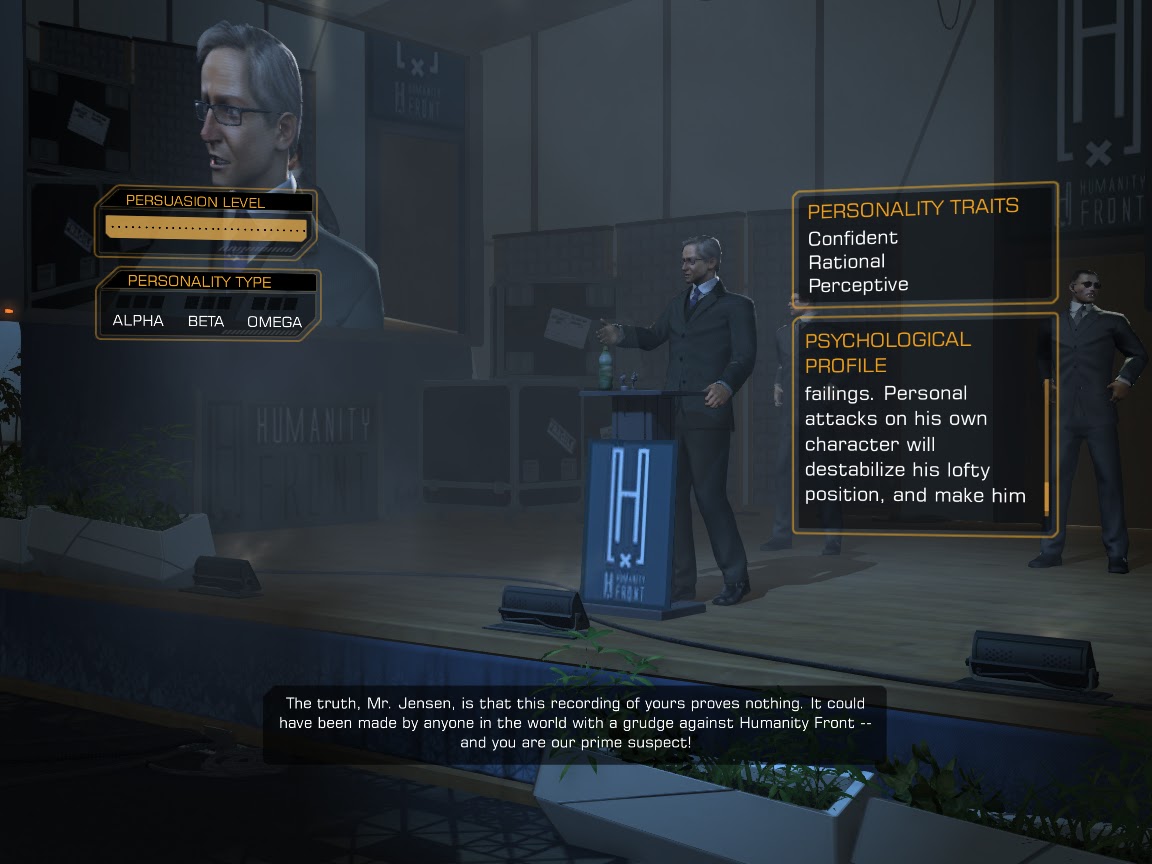
Choose your words with care, or he will pull the trigger.
Almost everything, from hacking to downing foes, earns XP. Practicing good stealth techniques, like silent takedowns and not triggering alarms, awards significantly more, but stealth gameplay is more time-consuming and challenging than straightforward combat. Exploration is always rewarded, and players who find themselves short on ammo should try to take on more of a scavenger mindset. Carefully cleaning out areas will net you the most loot and XP, but you’re never required to do so.

Even if you are planning on killing everyone in your path you usually have the luxury of scouting the area and planning your moves before the violence starts. This is good, because combat is a high damage, high lethality affair. Just a few bullets will drop most human characters, Adam included, so using the cover system is a must. Adam regenerates health up to a base 100%, but natural healing takes a while to kick in and works slowly. Healing items also add a buffer on top of your normal health levels, but even with maxed out defensive augments and buffer health you’re just not that durable. Running and gunning is tricky at best. Combat in Deus Ex is about stacking the odds with tactics like sniper strikes, strategically placed mines, and ambushes. Or you can crush them with a vending machine. Whatever works.

Ave Machina

The glowing nano-swords from the previous games were cool, but there were also a lot of worthless melee weapons. The melee skill and weapon class has been replaced entirely with a new and beautifully animated takedown system. Just get close enough to an enemy (or anyone), tap the appropriate button, and watch as Adam busts out an animated sequence that ends with the bad guy unconscious on the floor. Hold the button a bit longer and Adam guts his target with the retractable straight razors hidden in his arms. 


There’s actually not much incentive to use lethal melee takedowns, because non-lethal earns more XP and is completely silent. All melee takedowns consume chunks of the same energy bar that fuels your cloak and a few other powers so you can’t spam it indefinitely, but it’s still a powerful and satisfying ability. It’s also hard to resist unleashing it on random hobos or other bystanders just to watch Adam at work. The canned nature of the animations means ordinary civilians will sometimes display surprisingly skilled close combat moves even as Adam cracks their skulls with his metallic fists. The double-takedown upgrade is highly recommended.
 
Confrontations with major characters that don’t immediately turn violent are usually in the form of “conversation battles”. These are dynamic exchanges where you choose Adam’s attitude or response in an attempt to get information or assistance out of a character. They can feel a little random at first, but careful observation of how the other character behaves and reacts can help you figure out their buttons. There’s also an Augmentation that lets you better read and manipulate people, although some characters can tell you’re using it and will call you on it. 

It’s not a type of gameplay I’ve seen done well a lot, and it makes for some memorable encounters. Standouts include trying to talk down a cornered terrorist with a gun to the head of a hostage, and confronting your boss about information he’s been keeping from you. As always in Human Revolution it’s possible to fail these encounters and be left to deal with some interesting consequences, though this never stops you from progressing further through the game. 

The best showdowns in the game don't involve weapons.
The hacking mini-game is simple, but potentially extremely rewarding. It keeps a nice balance of tactical choice and tension that keep it from getting repetitive. This is good, because hack-able doors and computers are omnipresent, and you’re going to need to hack a lot of stuff on any but the most violent and straightforward playthroughs. I found myself hacking machines I already had the passwords for just to get at that sweet bonus XP and cash.

Six-Trillion Dollar Man

Money is plentiful but not very useful. There aren’t a lot of opportunities to buy stuff, and any player who checks all the drawers and gains a basic understanding of hacking will earn more than they can spend. You never see any sort of paycheck or stipend from your boss, but perhaps he’s putting that towards the cost of your surgery and robot arms. Even an option to buy low-end healing items or ammo from the vending machines everywhere would have been welcome. As it is you can only use them as bludgeoning devices or moveable cover. 

Character advancement has been simplified, but is still far more satisfying and complex than the barebones system in Invisible War. Every time Adam earns enough XP he gets to choose a different latent augment to unlock. Adam’s actually a pretty capable character right out of the box, and most augmentations open up new abilities or paths, (being able to move heavy objects or hack higher tier computers) or serve as quality of life improvements (being able to carry more stuff). A few, like the personal cloak and Typhoon Explosives System, are almost game breaking powerful. The Icarus landing System, which lets you leap from any height and land safely amid a flash of energy, is especially cool to watch. 

Adam's never afraid to go for the low blow.
No upgrades are mutually exclusive, and most don’t have a lot of levels. It’s more of a matter of choosing what abilities to get first rather than having to make character defining choices. By the end of the game I had about 80-90 percent of Adam’s augmentations unlocked. It’s rewarding to earn new abilities and upgrades, but you won’t find the same opportunities for serious character customization as in the first Deus Ex.  

Sunglasses at night

Almost every element of Human Revolution fits smoothly together except for certain major combat encounters. Whenever you finally run down one of the augmented mercenaries who wrecked Adam’s day in the prologue you’re locked together in a small arena. You can’t sneak past them, you can’t outmaneuver them, and you can’t escape. They’re immune to being knocked out, so all you can do is kill or be killed. 

I wasn’t surprised to find that Eidos contracted these out to an entirely different company, because they couldn’t be more out of place. Just to be clear, these aren’t badly designed fights. The bosses display the occasional interesting ability and there are plenty of supplies and environmental hazards scattered around to exploit. Even a player without any combat augs can probably fumble through with a few well placed stun grenades and some headshots. The Typhoon augment reduces the fights to speed bumps, and in any other action shooter they’d be perfectly functional if uninspired.

The boss fights are, however, completely out of character. Forcing the player into a lethal combat scenario with someone with a pile of hit-points and no way around them is counter to the design philosophy of Human Revolution and the rest of the series. You also never really have any idea who the hell these people are, aside from jerks. The fights don’t have any impact or depth. I don’t think you even learn any of the mercenaries’ names, unless they go by “guy with gun for an arm.”

Nice symbolism. Very... direct.
Boss fights in Deus Ex were with villains you could love to hate, or perhaps even felt a bit of sympathy for. They could be evaded or defeated without firing a shot under certain circumstances. Even the major encounters in Invisible War were with characters you’d been introduced to and been interacting with for big parts of the game. The bosses in Human Revolution could be cut completely for a net improvement in pacing and gameplay. 

Without giving any story details away Human Revolution’s final levels are a bit odd. The tactical stealth/action and exploration of the previous 15-20 hours give way to a sequence that would be more at home in the Left-4-Dead series. There’s an almost unintelligible final boss fight that I was able to flail through without actually understanding what was going on, and then you’re left to chose your desired ending with a single arbitrary button press from the Console-Of-Destiny. It all felt a bit unsatisfying, but I suppose one problem with prequels is that you can’t tamper with certain aspects of the world and core story too much.

Make your choices, deal with the consequences.
These unfortunate sections aside Human Revolution is still an amazingly rich, complex, and fun FPS/RPG. Eidos Montreal has managed to create a worthy successor to the original Ion Storm classic. It’s impossible not to recommend to anyone who enjoys more than the most light and casual gaming.

Reasons to play: Complex, satisfying gameplay with a multitude of paths and options. A deep and engrossing vision of a near future world. Punch hobos with robot arms.


Reasons to pass: Totally out of place boss fights. Final levels wildly break tone with the rest of the game.

Articles copyright James Cousar, games, images, and videos copyright their respective owners.