Difference

The difference between clever and cunning.

Monday, September 19, 2011

Kalani W. Streicher Interview

Kalani Streicher is a gaming industry veteran, with over twenty years experience in development, design, and production. He has credit in dozens of commercial games, including the classic Super Star Wars SNES Trilogy and X-Wing/Tie Fighter Series. He’s worked and produced games for such formative companies such as LucasArts, Activision, EA, Universal, Microsoft and has founded several of his own.
 
Thank you for taking a few minutes to speak with us today.

How did you find yourself in game development? Did anything in particular inspire or motivate you to go into the field? What skills or experience have you found most valuable?

Well, I didn’t really pursue getting a job in the games industry. I grew up in Germany and it is all about precision mechanics and fine German engineering. I did an apprenticeship in tool&die in my teens, though I knew then I wanted to get into computers and software. After that I studied computer science and precision mechanics at the Technical College in Frankfurt. At the time computers and computer graphics were just at its infant stages though I was very intrigued by it. I knew the best place to be part of computer graphics and visual effects production is in California. Therefore I move to San Francisco and started looking for a job in that field. Since I had a background in programming and was fluent in German my first contract job was translating C, C++ books from English into German for Microsoft. 

At the same time Lucasfilm Games was looking for someone that can port and localize all their story games for the European market. I was there at the right time and was responsible for the translations and ports of all the story games (Maniac Mansion, Zak McKracken, Loom and Indiana Jones and the Last Crusade, etc.) to languages such as German, French, Italian, Spanish and platforms such as PC, Amiga, Atari ST, Commodore64, etc. 


The skills and experience most valuable are having a good understanding of software technology, programming and logic. You have to be adaptive to the different platforms and input devices. Further, being highly creative, organized and having a passion for games is a must. 

  
What was working for LucasArts like? Was there anything you particularly enjoyed, disliked, or stands out in your mind?

It was incredible working at LucasArts. The culture and creative atmosphere is like no other place. The attention to detail and the combination of creativity and technology is amazing. Working at Skywalker Ranch was totally fun and it is amazing being surrounded by the most innovative and creative people in the film and games industry. 

You’ve worked with many different types of games over the years. Space sims, platformers, adventure games, and so on. Which have you most enjoyed creating, and why?

I enjoyed each one of them. I like the variety of the different genres with their intricate game mechanics I’m always hungry to learn, understand and evolve my design and development skills by building different games. I strongly believe future games will become a playground of the different game mechanics from different genres. We already see this trend with many games in merging different genres as well as embedding many mini-games or sections of the game with different play mechanics. 

How do you feel many of the classic games you were involved in, like the Super Star Wars and X-Wing/Tie Fighter series, have held up over time? If you were asked to remake them today what, if anything, would you do differently?

I believe they’ve held up relatively well. They are definitely considered some of the top classic games. Though game design has evolved since then and if I’d be given the opportunity to remake them today I’d keep the core essence of the game play and add many more new design features. For example, the Super Star Wars was aimed at the core to hard-core player. Back in the days that’s what all players were. We didn’t have a casual player. Therefore the game is tailored to be very challenging to play. Today I’d make the “Easy” and “Normal” difficulty modes a lot easier, though keep “Jedi” mode for the hardcore. I’d improve some of the level design and also add a better save game system. Back then you had to play a level over and over from the beginning after you died. I don’t think that would fly today. I’d add save points or some other save-game mechanism. I’d give it a graphical and aesthetics facelift, and lastly, I’d add a social and content creation component to the game similar to Little Big Planet.

With X-Wing/Tie Fighter I’d definitely upgrade the visual quality. Today PC or console platforms can make it look like the movie. You’d feel like being in movie. I’d focus on seamless integration of story content and game play. The AI of X-Wing/Tie Fighter is phenomenal and still holds up today, but this area has evolved over the years and I’d add better emergent and expert systems, adaptive AI, as well as more emotional depth.

You’ve recently started a company, Kalani Games, which seems to have a mobile focus. In the past you have also worked for a mobile company, MauiGames. Do you believe the industry is heading away from the traditional business model for big budget “AAA” games? Do you think we’re likely to see the bulk of the gaming industry’s growth in smaller, more agile to develop, social, mobile and “casual” games?
Kalani Games focuses on a variety of game genres and platforms. That is what I’ve done my entire career and will continue to do. Currently we are working on a Virtual Worlds/Casual MMO, DLC, Facebook, and iPad/iPhone/Android games.

Console games today are harder to get off the ground just because most of them are tied to big licenses, budgets and resources. These games are definitely approaching, if not surpassing, the budgets of films and movies. I don’t think console games will disappear in the near future, there is still a lot of room to improve and bring an even more immersive, visual and emotional experience to the player. Though the market and revenue growth will flatten off more over the years. We are approaching what the movie industry has been for the last decade and reaching a certain saturation point. I believe we’ll see additions of other new features such as social, 3D or sensory systems in the console games.

On the other hand, the social, mobile and casual game markets will grow at a more rapid pace over the next decades. There are still so many people that aren’t playing games and our goal as game designers is to capture everyone on Earth playing some sort of game on a device.


I believe these are the areas where game play will innovate the most over the next years. We’ve already seen different ways to engage the players with new interesting game play mechanics. People want to play games anywhere they go and socialize with each other. The new devices such as smart phones and tablets are paving the way. In addition, with the rapid technology development, new input mechanisms and faster Internet bandwidth will accelerate the quality of games. We’ll already see the 3D era on the tablets happening and the convergence of console, PC and tablets. The consoles are slowly becoming the “arcades” games of the past. Soon we’ll be playing console-like games on our mobile devices and be totally connected between various platforms.


Any brief words of advice for the next generation of game developers?

Work hard! Attention to detail! Innovate! Have Fun!


Do or do not. There is no try.

Thank you very much for your time!

You can visit Mr. Streicher’s company website here:

http://kalanigames.com/index.html

Articles copyright James Cousar, games and images copyright their respective owners.

Monday, September 5, 2011

Steel Storm: Burning Retribution Review


Indie games are an interesting breed. They don’t always have the resources and level of polish we’ve come to expect from AAA titles, but they an endless source of innovative new ideas. Pound for pound and dollar for dollar they’re also sometimes simply a better value.

The slightly awkwardly named “Steel Storm: Burning Retribution” doesn’t bring new ideas to the table, but it does provide a slice of frantic, old school, arcade-style fun. You steer a hover tank from a top-down perspective on a quest to explode everything that moves and most of what doesn’t. Don’t worry about story. You won’t be releasing the fire key long enough to read it anyway.

Kaboom!
The intense and tightly tuned combat is the highlight of the game and rightly so. Movement speed, enemy AI, and weapons are all just right. Your tank is fast enough to dodge or outrun most enemy attacks, and good use of the environment will let you avoid the rest. You can’t afford not to pay attention, because the sheer power and volume of incoming fire will destroy you in seconds if you’re careless.

Weapons scale up nicely, and are much of what make the combat fun. In the early levels you dance about groups of smaller enemy tanks, battering and herding them with your weak but continuously firing mini-guns. Later you unleash unrelenting devastation with missile swarms and spread weapons that would seem more at home in a bullet-hell game, laying waste to fields of enemies and rumbling mini-bosses many times your size. The “Finger of God” style beam cannon was my personal favorite.

You advance over dozens of burning enemy hulls, or not at all.
There’s no ammo to keep track of, and little reason to ever stop firing. Not that that’s a bad thing. It’s a rare moment where you’re not shooting at something, and staying still is one of the surest ways to die.

Almost everything explodes when shot enough, and looks good while doing so. The models are clean and attractive. For an indie game Steel Storm manages some very slick looking graphics and effects, although performance sometimes chugged when the action was really flying.

Least you come away with the impression that Steel Storm is nothing but a continuous scream of mindless explosions there are some elements that lend it welcome tactical depth.  Weapons aren’t all straight upgrades, and offer pros and cons worth considering when the chance comes to swap them out. For example the homing missiles are obviously useful and accurate, but lack the raw firepower and indirect fire abilities of the ballistic missile barrage. Insidious little repair turrets resurrect destroyed enemy tanks, forcing you to look for alternate paths or pick your way through a regenerating mob.

The best place to shoot someone is from safely around a corner.
There’s a decent variety on display among the level environments. The more open outdoor areas are definitely superior, and the levels that force you to slug your way through narrow linear corridors can start to grind. You’re generally there to hit some switches or blow something up, though Steel Storm tries to keep things interesting with the occasional time limit or escort mission. The friendly AI tanks aren’t very smart, but mercifully you’re never forced to keep them alive to complete the level, making them a minor feature rather than a major flaw. 

The levels themselves can get quite time consuming to complete. I’m not sure I agree with the choice. Steel Storm excels at brief bursts of frantic, arcade-style action and the game’s combat can become repetitive over time. There’s no in-level saves, just a limited number of extra lives. The system would seem to be perfectly suited for short, intense “coffee break” sized levels, but a few of Steel Storm’s can start to drag.

Even the indoor levels have some nice graphical effects.
The developers were clearly getting a handle on their tools by the second episode, which features more interesting environments and gameplay. There are a couple of tense fights against massive, powerful bosses. These brief, arena-style levels are a nice diversion from the longer slugfests, though you should expect to go through a few lives cutting these behemoths down.

Outside of actual gameplay the UI and Front-End are a bit rough, but functional. While Steel Storm is not a brutally complex or unintuitive game some form of tutorial, or even basic documentation, would not have gone amiss. I was stuck for a time on one early level just because I didn’t recognize what the game’s switches looked like yet.

There's a good looking "over the shoulder" camera, but it's too hard to dodge to make it practical to play in.
Co-op is a chaotic blast, provided you can find some people to play with. There’s also a map editor thrown in, if you want to try your hand at making your own levels. You can’t actually make new environments, but you can add in enemies, items, objects, weapons, and what-not. You’re free to string together your own custom campaigns. I was able to find a custom co-op campaign with an even higher enemy density than the core game, which was fun if punishing to the frame rate. Many players probably won’t bother with these features, but they’re a very nice touch, and a good step towards building and maintaining a community.

Reason to play: Intense arcade-style fun. Good indie value. Custom maps and co-op extend life. Splosions.

Reasons to pass: Levels can get a bit lengthy and repetitive. Old school levels and lives system not for everyone.

Articles copyright James Cousar, games and images copyright their respective owners.

Tuesday, August 16, 2011

Borderlands Review


Borderlands combines a potent mix of FPS action and RPG style looting and character development. The game puts you behind the guns of one of four mercenary “Vault Hunters”, searching for a hidden cache of alien technology on the desolate planet of Pandora. Story isn’t really Borderlands strongest feature, but it gets the job done.

First Person Looter

On its most basic level Borderlands plays like a First Person Shooter. Quick reflexes and accurate aim will serve you in good stead.  Beneath the FPS shell there’s a strong RPG backbone that draws its lineage from classic Diablo and World of Warcraft design philosophy.

Each of the four characters has access to a unique action skill that adds some useful tactical twist. The Soldier can deploy a turret for support, the Berserker can (as you would expect) go berserk for a massive boost to melee damage and health regeneration, and so on. Each class also has access to three skill trees that you put points into as you level up. 

The skill trees are lean but powerful

There aren’t as many skills as you might find in a meatier RPG, but almost all of them are interesting or useful in some fashion. Some augment a character’s action skill, like making the Soldier’s turret spit out ammo-packs, while others buff basic stats or add some specific bonus, like making shots pass through enemy shields.  Any character can use any weapon, although each class has skills that improve and modify their abilities with select types. The Soldier, for example, favors the combat rifle. You can re-spend your points at any time for a modest fee, so there’s plenty of fun to be had trying different builds and you’re never punished for experimenting.

Guns Guns Guns Guns Guns Guns Guns Guns

The meat of the game is loot. Guns, as you've likely picked up by now. You can’t move on Pandora without tripping over a firearm, and almost every single one is completely randomized. One shotgun might have a chance to set enemies on fire, another might add a bonus to your melee attack, and a third might have a sniper scope. A high end model might feature all three. A few unique firearms do truly crazy things, like regenerate ammo or fire a bouncing wave of energy. These are not realistic weapons and the rule of cool is in full affect.

Loot, loot, loot. And more loot.
The crazy combinations don’t end with your guns. You might find grenades that steal enemy health to heal you or a personal shield unit that sprays a ring of acid when it’s depleted. Obviously not every combination is useful, or even makes sense, but it’s hard to resist searching for the perfect shooter.

You’re continuously replacing your load-out. There’s no way to tweak, upgrade, or augment any item, so you need to take or leave each gun as you find them. You do earn XP and gain bonuses with general weapon categories, but since you’ve never invested anything in any particular weapon there’s no reason not to swap it out when you find something better or just want to experiment. Items have Diablo/Warcraft style level requirements and rarity color coding, and finding purple or above loot is always a rewarding moment.

Gun on Man Violence

Seeking out and sorting through heaps of guns is a big part of Borderlands appeal, but the game also provides worthwhile enemies to use those weapons on. While not trying to be realistic combat is fast paced and fun. Cover is useful, but the low accuracy of most weapons at long range and your regenerating shields encourage you to get in there and mix it up. There’s a decent variety of enemy species and behaviors on display, though you’ll kill a LOT of very similar bandits before the credits roll. The AI gets the job done but can have trouble dealing with snipers and players it lacks a clear path too.
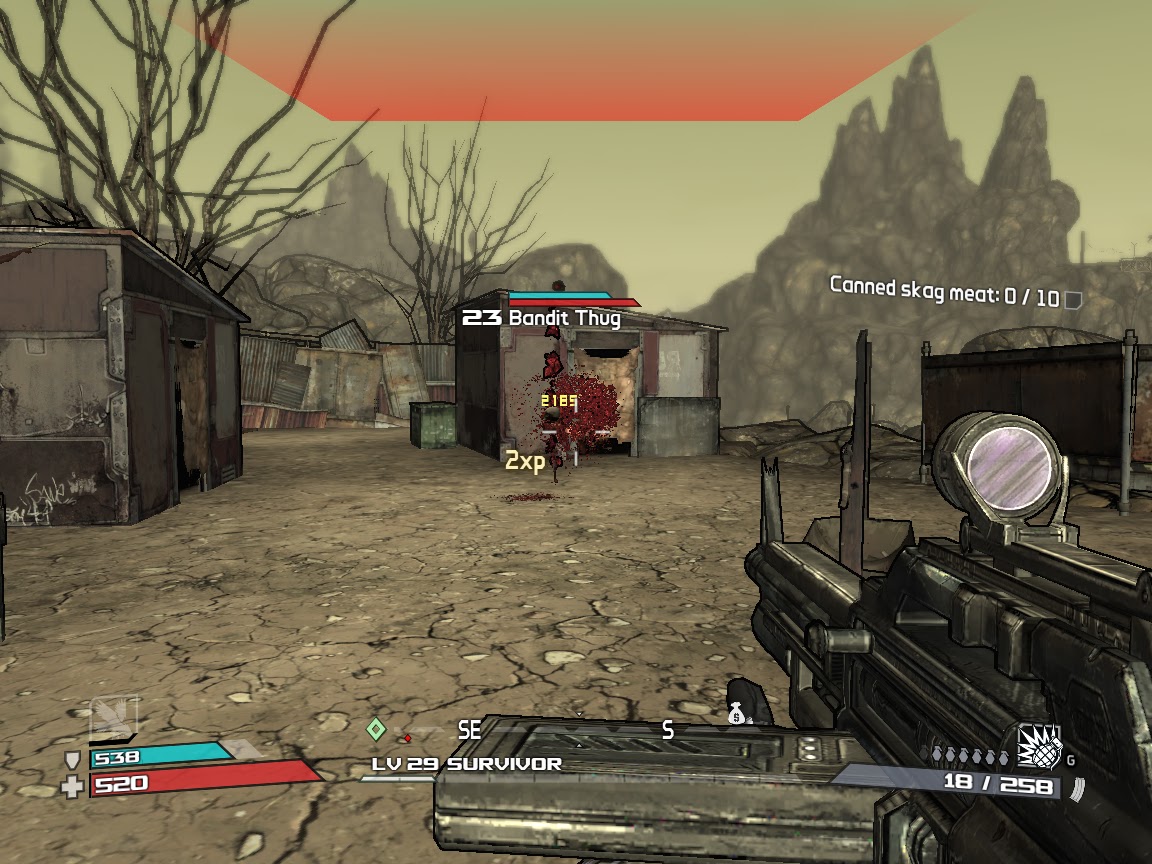
One of Pandora's countless endearingly crazy bandits, moments before perishing of mysterious severe cranial trauma.

If you do take too many bullets to the face Borderlands has neat mechanic. When your health drops to zero you drop to the ground and are given a last chance to kill any nearby enemy for a second wind. This can make for some very cool and dramatic last stands, and actually encourages you to keep a lot of enemies around. Co-Op allies can also scrape you off the ground if they reach you in time.

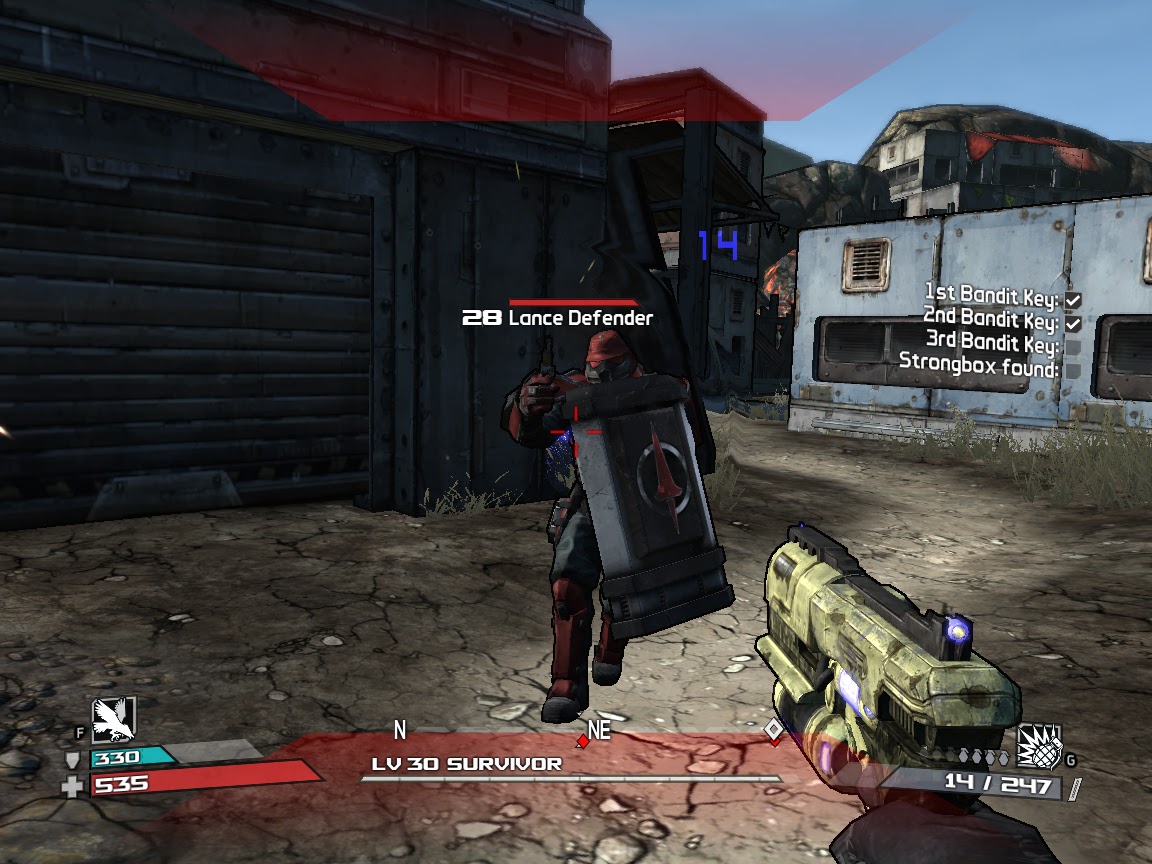
No matter your class or play style you’ll want to keep a spread of weapon and damage types to exploit enemy weaknesses and tactics. Almost every creature has weak points that can be targeted for an automatic critical hit, (like the head for humans, obviously) so finding and nailing these spots keeps battles interesting and encourages good aim. The over-the-top death animations and shower of loot that accompanies every slain foe are an entertaining payoff.
I'll give you a hint. The shield isn't his weak point.

Like Pulling a Trigger

While Borderlands does have some depth, such as the skill trees and the interplay between different enemy and damage types, it’s an easy game to pick up and start playing. If you understand the basics of FPS movement and combat then there’s very little barrier to entry. The tutorial takes great care to ease you into the game, going out of its way to introduce and explain even fairly intuitive concepts like using grenades and buying stuff from vending machines.

It’s always better to give the player too much support rather than too little, but the first hour or two of play doesn’t have a lot to interest experienced players, especially given that the game encourages you to try all the character types. The characters don’t begin to play any differently till you unlock their special skills at level five. I’d have put in an option to skip straight to level five and bypass the first few tutorial quests if the player has already completed the campaign once or has a character past level 30.

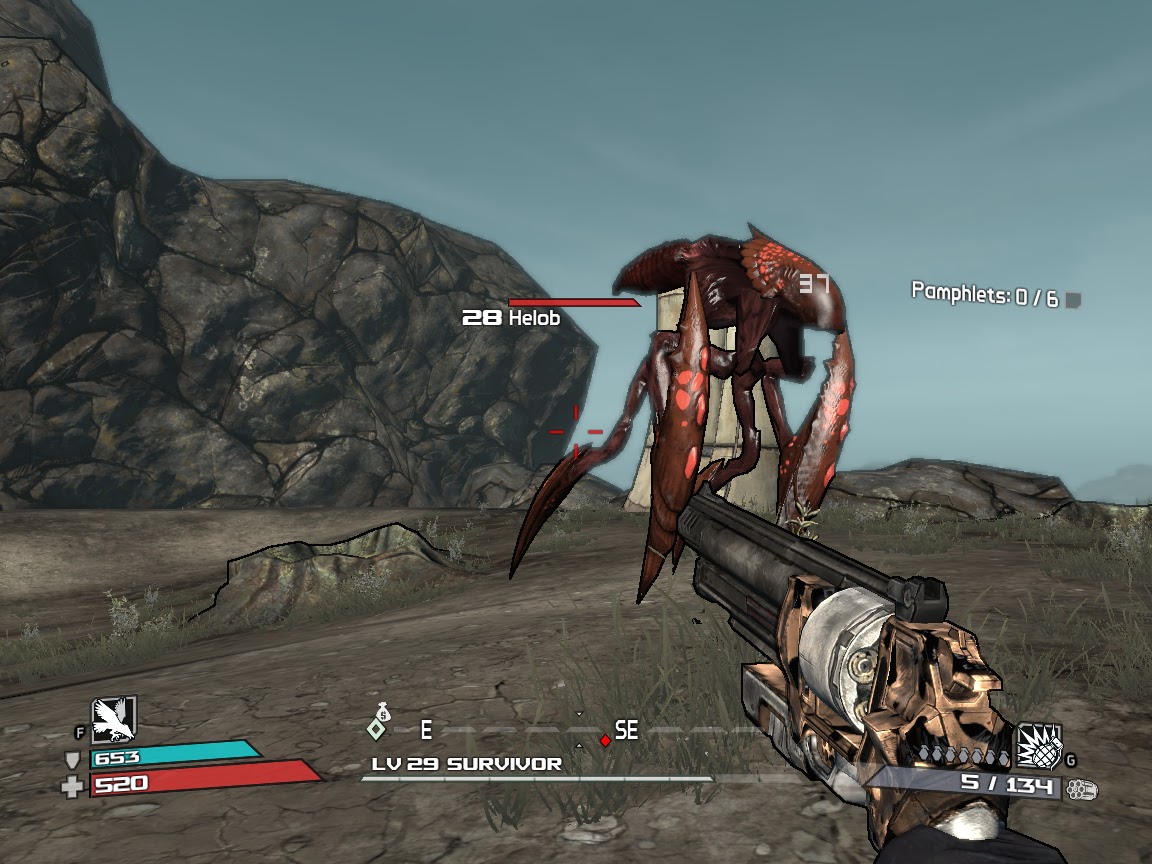
There are more exotic critters than bandits roaming the wastes.
Outdoor areas tend to be dominated by vehicular travel. Borderlands cars handle nicely enough and give you a formidable level of speed, durability, and firepower. If you manage to trash your ride the stations that spawn them are never too far away, and getting a new set of wheels is free. Running over enemies is a blast and you can just roll past most fights if you’re not interested. You’ll need to disembark to collect loot, and most major encounters are designed so they need to be completed on foot, but tearing across the wastes making road kill is a nice change of pace from fighting on foot. Having a co-op buddy man the turret is also a good time.

It’s hard to get annoyed at a game that’s this aggressively convenient and fun to play. Managing your inventory and accessing your various bits of info is intuitive and painless. Inventory space can get a bit tight although one of the downloadable content packs adds a storage bank. Realistically you’re always finding so many new toys that anything you store will be obsolete by the time you see it again. Loading screens are present but not excessive. I suspect they’re a necessary evil left over from the game’s console heritage. Borderlands simply doesn’t believe in punishing the player or even making them stop having fun for any longer than absolutely necessary.

Bullet Points

The quest structure pulls what narrative Borderlands needs forward, and ensures you always have something productive to do. The quests themselves are mostly standard fetch-this kill-that fare, but the chunk of cash and XP awarded for completing each makes them worthwhile. Enemies respawn quickly, so ticking off objectives and then heading back to turn them in goes a long way towards preventing a feeling of grinding or repetition. You still end up needing to shoot your way back through already cleared areas, but the fast travel system helps.
A fine red mist. Of jam. A Jaist?

There’s not much of a central narrative. The plot takes a while to get going, and doesn’t move very far or fast once it does. You’re mostly just moving from place to place dealing with a string of local bandit lords. There are a few twists late game that introduce some welcome new enemy types. The ending is weak, but Borderlands strength is very much in its gameplay rather than its story.

The world of Pandora is vivid although not a place where most people would want to live. There’s a strong “western-punk” theme in the art and characters. The piles of junk, ramshackle shanty towns, and dusty, hostile wastes would be at home in the Fallout series. The cell shading lends everything a slightly cartoony, stylized mood. The thumping soundtrack serves as an excellent accompaniment to the action, and the opening cutscene and closing credits songs are catchy enough to deserve special mention.

The voice acting is top notch, and frequently genuinely funny. It has a dark and sardonic sense of humor that fits the desolate world. The series of voice-records left by an archeologist as she slowly loses her mind are a standout.

No rest for the wicked

Ultimately Borderlands is an easy game to love and enjoy. It successfully taps into the “just one more” allure that keeps people playing its spiritual predecessors and brethren, like Diablo and Torchlight. Every action, from running someone over to killing them with a headshot, contributes to achievements with juicy XP rewards. Vending machines regularly carry powerful items and change inventory every twenty minutes, so you’re tempted to stop at everyone you pass, just in case.
Some of the Vistas are quite impressive.
While some sort of option to help players of different levels productively team up would have been nice, Borderlands is still a blast to play with friends and working voice chat. Even a total party wipe isn’t excessively punishing, and you’re never out of action long. Enemies scale up with the number of players and loot goes to whoever grabs it first, so you will definitely want to play with people with whom you share a degree of trust and basic communication.

Once you finish the main campaign there’s a number of Downloadable Content packs to extend the life of the game. I’ve only had the chance to play two, but I can definitely recommend “The Zombie Island of Dr. Ned.” which offers an entertainingly creepy setting, some top notch humor, and (as advertised) loads of zombies. “Mad Moxies Underdome Riot” is less an adventure and more of an endless arena-style battle, plus a bank to store stuff. It’s best played with a team of friends, but is still repetitive and surprisingly unrewarding compared to most of Borderlands gameplay. I’d start with the zombies.

Reasons to play: Addictive mix of FPS and RPG gameplay. Scads of randomized loot. Genuinely funny humor. Great soundtrack. Awesome co-op play.

Reasons to pass: You fight a lot of the same bandits, and they don’t get any smarter. Weak story.

Articles copyright James Cousar, games and images copyright their respective owners.

Tuesday, August 2, 2011

Daniel Erickson Interview

Daniel Erickson is the lead writing director at Bioware, perhaps best known for his work on Dragon Age: Origins, and the highly anticipated upcoming Star Wars: The Old Republic MMO. Mr. Erickson has also worked as a game critic for the now defunct Daily Radar website, and has production and design credit for the NBA Street and SSX series from EA sports.

Thank you for taking a few minutes to speak with us today

1. What’s the job of lead writer like? Do you mostly co-ordinate other writers and their work? Do you get to do much writing yourself?

Erickson: It varies from game to game. On Dragon Age and Mass Effect, for instance, the lead writers are critical path writers, contributing huge amounts of actual hands-on content to the game. With a writing staff the size of the one on The Old Republic I get to do a little writing here and there but most of the time I’m more of the guiding force behind the fiction content for the game. As a former lead designer, I’m also more involved in the senior design structure than I think is usual for a lead writer so my duties are a bit more eclectic.


2. How do you feel about working with a pre-existing Intellectual Property (Like Star Wars) as opposed to one that you’ve been able to build from the ground up? (Like Dragon Age) Do you have a preference?

Erickson: They both have advantages and disadvantages. I loved working on Dragon Age: Origins and being able to come up with a world the team owns is extremely rewarding. It’s also a ton of work and means you have to educate players on all the rules, expectations, etc. You can’t assume any familiarity with the content. With something like Star Wars you’ve got built in fan appeal and a huge amount of content to draw from so you can just jump in and get started which can save months or even years of time. That said, there are a huge amount of Star Wars experts out there so you better know you stuff and you don’t have the flexibility to change the way the world’s mythology works to get around a sticky design decision like you can with your own IP.


3. Have you found writing for games has challenges you didn’t expect?

Erickson: It can be difficult to work in an aspect of game design that’s so much in its infancy that many people still don’t understand why you’re there or see it as a necessary evil. I doubt programmers and artists have to justify their existence as much as writers do. Also, like design, it’s something everyone thinks they understand and can do/comment on.

4. You’ve been quoted as saying: “You can teach a writer to be a junior game designer. You cannot teach a junior game designer to be a writer.” Do you think the two disciplines should be taught and implemented together, rather than as separate aspects of game development?

Erickson: What I was saying there is that writing is a specialty discipline like anything else in games. You’re either a writer or you’re not and if you’re not, you’ll never be anything more than mediocre at it. If mediocre is fine for your game and nobody much cares about the writing than sure, give the writing tasks to a random designer who enjoys it and move on. In the same way I wouldn’t bring in a screenwriter, train them to do basic design and then ask them to balance my combat system! And yes, cross training is crucial so that all designers learn about the complexities of and respect each other’s specialties.


5. Do you have a favorite bit of Bioware writing? A particular conversation or narrative thread that you thought was exceptionally funny or epic or spot on in characterization?

Erickson: I don’t know about a specific line, but I’m proud of the city-elf origin in Dragon Age. I did a ton of research for that one; made sure I really understood the subject matter and tackled some issues rarely seen in videogames. And I tried to do it in a way that I felt was adult and mature in the actual sense of the words, not an excuse for juvenile titillation.


6. Any brief words of advice for the next generation of game writers/designers?

Erickson: Writers write. That’s how you know you are one. Run pen and paper RPGs. You’ll learn a ton about player agency and writing your stories for the audience instead of yourselves. Designers design. Make board games, make card games, learn to do basic programming and make web apps. Anything and everything you can do to test your ideas of what makes fun.

Thank you very much for your time!

Articles copyright James Cousar, games and images copyright their respective owners.

Wednesday, June 22, 2011

Strife Retro Review


This is will be the first in a series of retro-reviews, where we go back and take a look at classic games from days past. In addition to breaking down their gameplay we'll also be examining how they influenced the industry and later games.


The now venerable Doom engine defined the first generation of First Person Shooters. It wasn’t quite true 3D, and there were a lot of forgettable “Doom clones”, but the engine was responsible for an entire classic genre of play that hasn’t quite been replicated since. While limited by modern standards it’s fascinating to go back and play what was produced as mappers and developers first got to grips with the ability to carve out three dimensional space. Today we’ll be looking at a minor classic called Strife.

Strife was the last real commercial game produced on the Doom engine, back in 1996. It’s largely forgotten today because Quake came out less than a month later, with true 3D and a host of other technological advancements that left the aging engine in the dust. While Quake was a classic in its own right, with considerable impact on the industry, it was also a huge step backwards in some ways.

As a first generation game on a new engine Quake pared gameplay down to the very basics. Run, jump, shoot, hit the switch, etc… In many ways it was reminiscent of the first Doom. Both games were very reflexive and visceral. Levels could get quite abstract, and there wasn’t a lot of emphasis on story or world building.
Note that I'm lugging around an inventory of healing items, spare armor, and other goodies.
Strife, on the other hand, was produced on a mature engine. The developers had a lot of previous work and resources to draw from. They didn’t have to spend time learning the ins and outs of their tools, but could instead focus on pushing that engine to its very limits. What set Strife apart from both its other Doom engine brethren and the first generation of its true 3D successors (and what makes it warrant a look even today) were its features.

Strife could boast stuff that wouldn’t really be seen again until System Shock 2 and Deus Ex several years later. Strife had an actual story that advanced through the game, not a three paragraph blurb in the read me file. It had voice acting, cutscenes, and NPC conversations with relevant choices. There was light character advancement, an inventory system, weapons with more than one fire mode, and even crude stealth mechanics.

The premise, relayed via a colorful narrated comic slideshow on the main menu, has you working as a mercenary freedom fighter. You’re battling to overthrow a group of fanatical cyborgs called “The Order”, who manage to come off as surprisingly creepy. In addition to running missions for the resistance and storming Order bases you search for pieces of the ultimate weapon: The Sigil. 

Hints at the Order's nightmarish bio-technological experiments and other atrocities abound.
The game doesn’t just push you through an episode of maps full of enemies and pickups. Strife is laid out more like an adventure game than a traditional shooter. Most areas feature a hub where you can resupply and heal up between missions. You can always return to any area you’ve visited previously, although on rare occasions major plot points actually change an area. The resistance fighters abandon their old base once you take a bigger and better one from the bad guys, leaving behind rats and a few supplies for the careful scavenger.

The graphics are as blocky as you would expect, but the crisp art in the comic-book style cutscenes and character portraits really bring the world and characters to life. Voice acting is concise and not too hammy. Strife may have the distinction of being one of the first shooters with a “voice of mission control” constantly chiming in to feed you advice, objectives, and occasional humor. The warmly voiced Blackbird, your radio handler and spiritual ancestor of Alyx Vance, is easily the best character in the game.

Combat doesn’t feel quite like classic Doom, mostly because of the prevalence so many enemies with instant hit weapons. Even non-instant attacks move faster than pokey imp fireballs, so cover and line-of-sight is actually even more important than one might expect. Enemies themselves still move at the leisurely pace of most Doom engine creatures.

The weapon selection is satisfying, and the flamethrower is appropriately fun to use on enemy grunts. Strife has the distinction of the most terrifyingly dangerous grenade launcher I’ve ever seen, sending explosives bouncing in all directions with every pull of the trigger. You have about a 50/50 percent chance of blowing yourself up every time you use it. That’s before you break out the phosphorous grenades, which leave free-roaming jets of fire that can clear a room of enemies or toast you in a fraction of a second
Don't touch the flame.
As implied by the two types of grenades some of Strife’s weapons have alternate ammo types and firing modes. You still need to manually swap between them, but it opens up some cool tactical options. The signature maguffin, the Sigil, upgrades and changes its attacks as you claim more pieces. By the end of the game it’s able to drop most enemies in a single blast, mitigated only by the fact that it drains your own life.

The game has optional side missions and areas to reward careful exploration. Depending on which missions you accept and which characters you choose to side with you might not even see some sections. I suspect it’s because of the staggering expenses now involved in production, but I can’t think of a modern shooter that featured entire optional levels. Strife even has multiple endings depending on your choices and actions, adding a bit of replay value beyond bumping the difficulty level. 

You can load up on supplies at friendly shops.
Strife’s non-linear design is not without problems. It’s possible to get lost, confused, or forget what you were doing. The sewer level stands out as a pain to navigate, made worse by the limited number of protective suits available and the large number of areas that will damage you without one. Then there’s the truly bizarre choice of making the game un-winnable if you talk to the wrong characters and accept the wrong quests within the first hour of play. It’s possible to screw yourself out of being able to progress and not receive any indication you’ve done so till nearly an hour later.

Un-winnable dead ends are a cardinal sin of game design, especially in a game with an 8+ hour campaign like Strife. Fortunately it’s only possible to lock yourself into a dead end at one point, and only near the very beginning of the game. It’s still a bad design decision, but at worst you don’t lose too much progress. 
Slap down a teleporter beacon to call in a strike team of Resistance commandos.
 Least it seems like I’m being too critical, understand that this sort of flexibility is still one of the coolest things about Strife. Many of our painfully linear modern shooters could benefit from examining the more open flow of old school map design. Anything to get away from the lockstep of a series of rooms connected by corridors that you march through in rigid sequence.

The stealth mechanic is most notable in that it exists at all. The more human members of The Order generally don’t start a map hostile to you, and can be silently picked off with your punch dagger and limited supply of poison arrows. Your other weapons trigger alarms that send everyone after you and cause shopkeepers to cower behind shutters.

It’s a cool idea, but doesn’t hold up well. It’s impossible to “ghost” any area, because the numerous robot enemies attack you on sight and trigger alarms when they do. Your poison arrows only work on the weakest enemy types, whom watch listlessly as the goon right next to them takes one in the throat. Still, kudos for even trying on an engine clearly not built for this sort of thing.

Strife is worth checking out even today. Finding a copy and getting it running can be tricky, but a good place to start would probably be this source port: http://doom.wikia.com/wiki/SvStrife The game is a fascinating bit of FPS history with the bad luck to come out just in time to be overshadowed by a giant technological leap forward. Gameplay is rock solid and entertaining, and it’s a great way to see a lot of shooter features implemented before their time.

 Articles copyright James Cousar, games and images copyright their respective owners.

Saturday, May 7, 2011

Darksiders Review

Darksiders is an epic single player action/adventure that draws heavily, very heavily, from the God of War and Legend of Zelda games. We’ll go over this in more detail later, but it’s worth mentioning right from the start, because I can’t think of a better way to describe Darksiders in one sentence. 

I know I spend an inordinate amount of space in my reviews talking about what other games a particular game is like. Every piece of media draws on those that came before it. Tracking a game’s “lineage” is one of the best ways to describe and understand it. Understanding what games inspired the creators lets us better understand the game itself.


War atop Ruin, the Red Horse.
Darksiders is not a difficult game to understand, and most of its gameplay elements are rock solid. The slightly overwrought intro casts you as War, one of the Four Horsemen and enforcer to a group of lava breathing Tiki heads called the Charred Council. Darksiders pulls, loosely, from Apocalyptic Judeo/Christian themes, and the Charred Council serve as mediators and judges that enforce the truce between Heaven and Hell until the appointed time for the Apocalypse.

As Darksiders opens meteorites rain down on a large metropolitan city. Angels and demons erupt from the craters to battle in the streets. War, understandably, thinks the Apocalypse is underway and enthusiastically throws himself into the fight.
           
The game has a very bold presentation. The art team has created a cast that would be at home in Azeroth or the Warhammer 40k universe, with a dash of Todd McFarlane’s Spawn. Characters have overbuilt, visually complex bodies fit for a comic book cover, full of details and props. Demons trail colorful fire behind them, and angels flit through the air on glowing clockwork wings.

Beginning at the End

Fighting your way through the End-of-Days serves as a tutorial, although the extremely heavy emphasis on combat is misleading for the later parts of the game. War is the incarnation of focused aggression, and the first twenty minutes has you hacking your way through Angels, Demons, and tiny fleeing humans. Demonic growths erupt from the ground and the city burns around you. Darksiders makes it clear that War isn’t here to save anyone, much less the day. He’s here to kill anything and everything that moves.

The city won't be this intact for long
After a bit of plot and a fight with a building sized demon War finds himself stripped of his powers and called to account by the Charred Council. Apparently that was some other world-shattering confrontation he busted in on, and not the real Apocalypse. He’s blamed for kicking off the end of the world early, and, for reasons that honestly didn’t make a lot of sense to me, sent back to Earth a century later.
           
The world is now a charred, demon infested wreck, but on the plus side you now have Mark Hamill tagging along as the voice of the Watcher. Hamill’s character is a snarling sadistic shade that offers occasional gameplay hints and reminds you of your objectives between heckling you. He appears to be enjoying the chance to chew the scenery.

The game’s voice acting is bombastic and entertaining. It’s always a relief when the developers make the effort to hire professionals. For bonus points, see if you can tell which characters also did the voices of Illidan Stormrage and Samurai Jack.

A dish best served with a side of delicious ham.
War’s emotional range goes from murderous rage towards everything he can kill, to defiant surliness towards anyone he can’t, with flashes of mild confusion every time someone feeds him a plot point. That’s fine. War is the avatar of violent slaughter, not given to introspection. Other characters point him one way or another and he happily murders everything in his path to get there. He’s here to bludgeon, maim, and dismember, not talk. And to be fair, Link doesn’t really have much of a personality either.

Beg, Borrow, or Steal

One of the common criticisms leveled at Darksiders is that it’s not an original game. This is true, but it’s also missing the point. Darksiders draws iconic elements from a lot of other games. The combat, finishing moves, and chests full of souls would be at home in God of War. The exploration, dungeons, and puzzles follow the pattern established by the Legend of Zelda series. The bold art style and character design could be mistaken for Blizzard’s, with War himself a dead ringer for Warcraft’s Arthas. There’s even a portal gun, ripped from the research logs of Aperture Science.

Did you know you can hijack Griffins?
There’s nothing wrong with using elements from other games, so long as you do it well. Heck, Blizzard hasn’t had an original bone in their body for decades, but that hasn’t hurt them. Where Darksiders succeeds, for the most part, is in recapturing what made the elements it uses fun in the first place.

If you enjoyed God of War you’ll like Darksiders combat. If you’re a Zelda fan the dungeons and puzzles will satisfy you. If you couldn’t stand Portal then the corresponding game segment will probably annoy you. Darksiders doesn’t parody or mindlessly copy the elements it borrows. It feels more like homage to what are clearly some of the developer’s favorite games.

Blood-dimmed Tide

The combat system is fast and furious. It’s not the deepest, especially before you get the chance to buy a few additional moves, but it is intuitive, responsive, and tremendous fun. All the elements you would expect are here, such as blocks, aerial moves, charge attacks, and so on.  War, unsurprisingly, is really good at hurting things.

Some lesser enemies can be grabbed and instantly killed in satisfying fashion, but most foes need to be worn down before they become vulnerable to a God of War style finishing move. This doesn’t require any sort of mini-game or combo; you just tap the appropriate button and War takes care of the rest. These kills are entertainingly brutal, but a few more of them wouldn’t have gone amiss. You’ll see the same “chop the legs off the demon soldier” animation a lot before the end of the game. 

War knows his business.
Mowing through grunts is a blast, and many of War’s stronger attacks send them flying or smash them to the ground. Bigger mini-boss caliber enemies, (of which the game has quite a few) feel a little off though. Larger foes come with huge health pools and very strong attacks. There’s nothing wrong with big tough enemies, but most don’t offer a lot of feedback as to how close to death they are and you don’t gain attacks strong enough to stun or interrupt them for some time. I found myself spamming the ridiculously useful dash-attack to dart in and land a hit. Enemy health bars would have helped pace these fights.

Darksiders can be unforgiving when it comes to health resources, although you’re never punished too hard for dying. Outside of non-respawning health chests and extremely expensive consumables there aren’t a lot of ready sources of healing, and I found the dash-attack such a reliable way to fight while avoiding damage that it almost breaks combat. To spice things up there’s also a “wrath” bar that powers a few special abilities, and War eventually gains the power to turn into an invincible burning demon for a few seconds, for those times when you don’t feel like messing around.

The first hour or two of gameplay is extremely combat heavy, which is actually a bit misleading. The game’s other major element is Zelda style exploration and puzzle solving, which becomes apparent as soon as you reach the first dungeon.

Dungeon Crawling

The maguffins you’re after this time are Demon Hearts, held by a collection of massive, bestial bosses. To reach each of them you’ll need to venture inside their lairs, and complete an assortment of environmental puzzles. You flip switches, rotate platforms, flood and drain areas, and so on. Some of these puzzles can be quite challenging, at least until you’re able to understand the mechanics and what you’re trying to accomplish in an area. It’s surprisingly cerebral, and makes for a nice change of pace between hewing down demons.
This place looks safe enough.
Each dungeon just happens to hold a new inventory item which is critical for solving the dungeon’s puzzles, as well as ultimately defeating the boss at the end. Some items, such as the boomerang-like “Crossblade” can be used in general combat, but others, like the aforementioned portal gun, are restricted to specific puzzles and areas. These items are also used for opening new routes and recovering hidden powerups in the overworld. Expect a fair amount of backtracking if you want to find all the goodies.

The boss-kill cinematics are suitably epic.
The boss battles are one of the game’s highlights. Each pits you against an impressive and intimidating creature. In true Zelda style you’re never just hacking away at a pile of hit points. You inevitably need to observe and understand their attack patterns, and then use whatever item you gained in that dungeon to make them vulnerable. Once you finally bring them down the kill cinematic are spectacular.

Darksiders environments are another stand out element. This is no generic fantasy world, but the wreckage of modern day Earth. The game takes place in the ruins of a massive city, and War swims through flooded subway tunnels and swings between the heights of skeletal skyscrapers. Despite the demonic invasion some places are surprisingly lush and verdant. The combination of ruined human structures, demonic corruption, and nature slowly reclaiming parts of the earth makes for some striking and lovely vistas.

Some locations are surprisingly attractive.
Rough Beast

While combat, exploration, and puzzle solving are all solidly implemented, Darksiders does suffer from a certain amount of blatant filler. Some sections make you slog through a series of identical mini-arenas with conditions like “defeat five enemies while in the air”. These would have made perfect bonus objectives or side-quests, but feel like a grind when they slow your progress.

There’s also a mandatory late game scavenger hunt that has you revisiting a bunch of old areas that I thought killed the building momentum. Darksiders is already a meaty piece of work, clocking in at about 8-10 hours if you just push through and don’t explore. I’m not convinced it needed these contrivances to bulk up its playing time.

Darksiders didn't need padding.
The way-point system that lets you warp from place to place is handy, but having to manually run through the paths of the travel dimension every single time quickly becomes tiresome. I realize it’s probably giving the game time to load the next area; and I suppose it’s still more interesting than staring at a loading screen. While I’m listing complaints I also encountered an odd bug where the sound became muffled, with some effects and tracks obviously missing. It took a restart to fix, but only occurred in one particular area. Aside from that there were no obvious tech problems and performance was smooth.

Combat and environmental puzzles make up the bulk of gameplay, but there are a few sections that introduce something new. There’s a rail shooter early on, and you eventually recover War’s fiery steed, Ruin, allowing you to gallop across open stretches of terrain and hack down enemies from horseback. The animation of Ruin erupting out of the ground when War mounts up is exceptionally cool.

The best alternate gameplay sections have you looting a heavy weapon from your enemies and using it to mow them down by the dozens. These guns are so heavy that they slow even War down, but give him massive ranged firepower. Riddling demons with exploding javelins takes a long time to get old.

Kaboom!
Reasons to play: A polished action/adventure. Fun combat and satisfying puzzles. Cool environments and bold visual style. Makes good use of the elements it borrows.

Reasons to pass: A few repetitive elements. While it doesn’t detract from gameplay, story does a weak job of explaining itself.

Articles copyright James Cousar, games and images copyright their respective owners.