
Dead Space was a third person survival horror game that drew heavily on (and understood) the best parts of Resident Evil 4 and System Shock 2. Much of the gameplay wasn’t revolutionary, but it was atmospheric, bracingly gory fun. So gory that perhaps we should include the Evil Dead films and Peter Jackson’s Dead Alive somewhere in that pedigree.
Dead Space took the unsettling theme of dismemberment and ran with it, incorporating limb and body-part removal into the core of its combat. The brand new IP (Intellectual Property) introduced a nicely fleshed out sci-fi setting with some intriguing mysteries, then flooded it with ravening space zombies (AKA “Necromorphs”.) I’m going into this review assuming you haven’t played Dead Space, but if you played it and liked it you will probably like this game too. The two are very similar but I’ll try to point out the significant changes between the two games as well.
The inevitable sequel, Dead Space 2 (DS2), stumbles a little before even giving you the opportunity to select “New Game.” I’ve already gone through the trouble of sitting through the install process, and having to create a superfluous EA account just to play is wasted time and one more password to remember that I don’t need. The $60 price tag is also high, even for a brand-new big budget “AAA” title. I don’t mind paying that kind of cash for a special edition, but for a vanilla game I’m going to be expecting a LOT.
 |
| Welcome to Titan Station, aka "The Sprawl" |
There’s an optional recap video you can view for a refresher on the story, which is a nice touch in a sequel, but once all the fussing is out of the way Dead Space 2 wastes no time. The first 30 seconds consist of a Necromorph grabbing you, shaking you, screaming in your face, and spraying eyeballs everywhere; just to soothe any doubts you may have had that they feature in the game.
 |
| Necromorphs do not respect the personal space bubble. |
“Hi there!” he says. “I hope you weren’t expecting some sort of dramatic build up before we showed up again!”
Wave of Mutilation
After that welcoming hug back you’re off, sprinting (literally) through the center of a vortex of madness, chaos, death, and (of course) dismemberment, as a Necromorph outbreak consumes the hospital you’ve been being held at.
You once again play as Isaac Clark, space engineer with a sci-fi homage name and a generous helping of Civil War era emergency amputation skills. It’s been three years since Isaac survived the incident aboard the planet cracker ship Ishimura, and he has apparently spent the intervening time enjoying a relaxing bout of insanity. Isaac has somehow ended up on “The Sprawl”, a giant space station built around fragments to Saturn’s moon, Titan. There’s a fresh wave of Necromorphs running amuck, and the humans still in possession of all their bits (for the moment) are showing signs of the same sort of madness and hallucinations that plagued the Ishimura.
Isaac finally has a voice, and possesses a believable mix of weariness and level headedness. He is, after all, an engineer trying to fix a problem that never would have happened if people had followed common sense and safety protocols. Isaac is still haunted by hallucinations of his girlfriend who perished in the first game, and she shows up to heckle you whenever the ambient crazy level dips too low. Isaac is that very special kind of crazy that recognizes he’s crazy, and knows he can’t trust his senses, which I found an amusing part of his characterization. The rest of the cast is tolerable to good, with a few nice lines and nothing cringe inducing. You never need to escort or baby-sit another character.
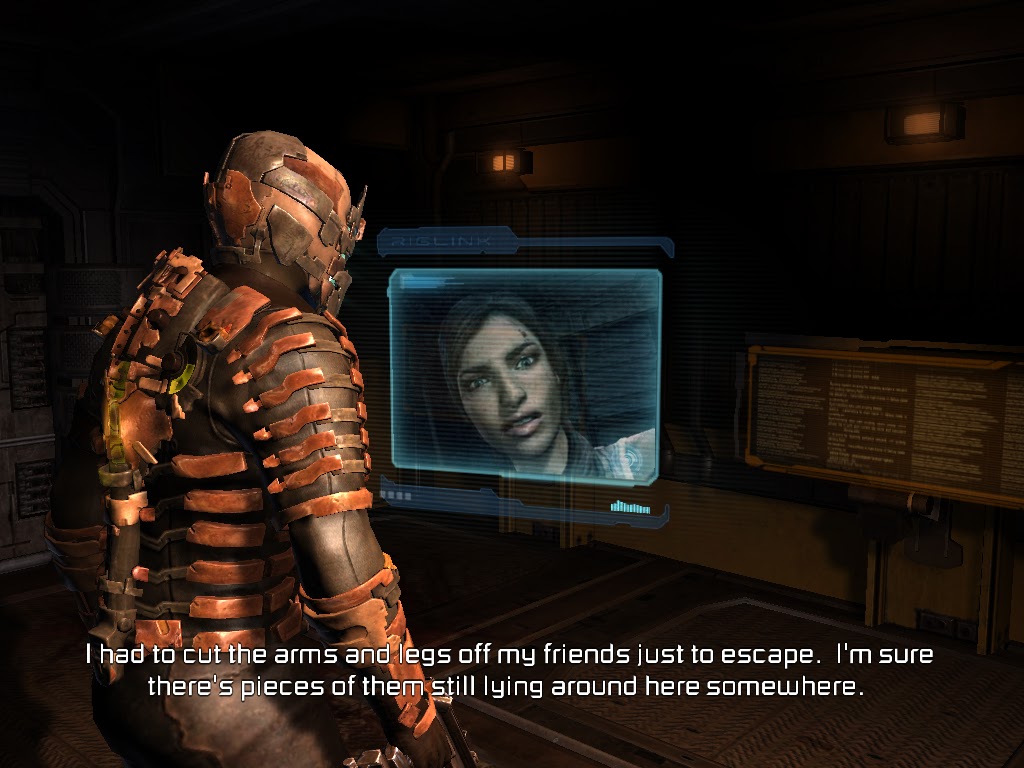 |
| Nobody likes a complainer, Ma'am. |
The hospital tutorial does a good job of establishing the plot, setting the scene, and reintroducing you to all of Isaac’s abilities. You can once again remotely grab, move and fling objects with Kinesis, which is handy for snagging distant goodies and puzzle solving. Kinesis has been upgraded to be more powerful in combat, and there are plenty of impalement hazards laying around waiting to be put to good use. Isaac can also freeze objects and creatures in place with Stasis, which is obviously useful for lining up shots against charging foes, and is required for some environmental puzzles. Stasis has limited uses, but now slowly regenerates, making it a valuable tactical resource that you can still use freely.
The game creates some mysteries early on involving the origin of this new Necromorph outbreak, and the government’s attempts to kill you on top of everything else, and there are a few interesting twists along the way. The story doesn’t really pick up till the last few chapters, but there’s plenty to see and do in the meantime as you try to survive and navigate Titan Station. The world of “The Sprawl” is nicely fleshed out, and many of the places you visit, such as apartment complexes and schools, are full of little touches that reinforce that this was a place where a lot of people lived and worked up until a few hours ago.
 |
| They didn't escape. |
Limb from limb
As you’ve probably guessed, and already know if you played the first game, DS2 is not for those with a low gore threshold. A lot of very bad things can happen to the human body before, during, and after death, and that’s before you factor in the mutagenic undead plague. You will see most of these bad things graphically demonstrated over the course of the game. You will do the rest of these bad things yourself with an assortment of weapons and environmental props.
The Necromorphs are endlessly inventive in perverting flesh and bone into warped killing machines. Just as a litmus test, know that fending off an onslaught of exploding zombie babies with a high speed rotating saw is a standard encounter. Little in the game really bothered me, but then I’m powered by a combination of caffeine, the internet, and general malice. If this all sounds like a little much, this may not be a game for you.
 |
| Necromorphs treat flesh like clay. For sculpting murder. |
Combat is a quick and brutal affair, especially on higher difficulties. As before, body shots do only minimal damage to the Necromorph’s already dead flesh. To stop them, you need to knock enough parts off, and doing so changes enemy movement and behavior. Take off a leg, slow them down. Take off a head, watch them flail blindly. If they have a limb that’s swollen into a glowing bio-explosive bomb, you should probably just shoot that. Dealing with multiple enemies that require different tactics and weak points is as tense and entertaining as in the first game.
Most of the creatures and all of the weapons from Dead Space return. The aforementioned power saw is still just as awesome to use in close combat, and I found myself leaning heavily on it. New standouts include a clever raptor-like breed of Necromorph that stalks you from cover, charging when you’re most vulnerable, and the satisfying Javelin gun, which pins opponents to walls with explosive harpoons.
DS2 tries to take itself seriously, but the gore approaches over-the top levels. The inhabitants of Titan Station are apparently packed with jam and low on calcium. Any application of force towards the numerous human and once human forms scattered about produces generous sprays of fruit preserve and sends limbs tumbling in all directions. This sort of visual feedback helps in combat, but when you’re constantly brushing stray legs off your shoulders and scraping torsos off your boots it can start to lose a little impact.
 |
| Isaac's deceased Ex-Girlfriend just won't leave him alone. |
Subtle this game is not. Dismemberment works its way into gameplay at every opportunity. You can use your Kinesis power to yank the pointy bits off slain Necromorphs and fling them at their lurching buddies. A well heaved corpse is the preferred way to disarm mines and booby traps. Necromorphs apparently have a taste for ammo and health kits, because almost every enemy carries useful supplies in their body that require a good cadaver stomping to shake free. When Isaac’s health bar empties you’re treated to a graphic cut scene of the Necromorphs responsible disassembling him. No one dies quietly in DS2. There’s a lot of noise.
In space, no one can hear you button mash
Just to be clear, DS2 is startling, and at times gross and even disturbing, but I didn’t find it truly frightening. Monsters ambushing you through air vents have been done before. Done a lot, in fact. Real fear is tricky, and DS2 never quite pins it down. At its core the game is about taking threatening monsters apart, piece by piece. As such you never quite feel the level of vulnerability necessary for fear. It’s hard to hold this against the game, because it’s a lot of fun, but it’s important to understand DS2 is more about action than true terror.
The only part of the game that reduced me to a gibbering wreck was the quicktime events. Scripted sequences and certain Necromorph attacks prompt you to hammer the E key to survive.* After dying a dozen times to a quicktime early in the game, I had to check the forums to discover that by “press E rapidly” what they actually meant was “press E and F”. Why this wasn’t corrected at some point for a $60 AAA title boggles the mind, because DS2 is otherwise a very polished, high production value game.
 |
| Isaac's not fond of quicktime challenges either. |
I’ve never been particularly fond of a game mechanic that requires you to beat the hell out of your own hardware. Quicktime challenges may have their place on console games, but this wasn’t a problem in the first Dead Space. Surely there must have been a smarter way to implement this on the PC? I know it seems like nitpicking, but this honestly pissed me off more than anything I can remember in a game for a long time, especially because I had been enjoying it so much up to that point.
Basic gameplay in DS2 hasn’t changed too much from the established formula, but it is well paced. The distinct, titled chapters of the first game have given way to a single, continuous world. You move through narrow corridors dealing with ambushes and jump scares, which are broken up by large scale battles against waves of Necromorphs in bigger areas. Periodically some device needs fixing, usually via swapping parts around with Kinesis or a mini-game. It’s not bad, although not terribly original. You will jump at the jump scares and fight frantically to survive the larger battles. DS2 is linear and heavily scripted, but the atmosphere is tense and the combat fun.
 |
| Rocket Man |
The more predictable set pieces are broken up by some very cool action movie sequences. Scripted events have Isaac holding on for dear life against the pull of hard vacuum or some undead monstrosity, with scant seconds to shoot a critical target or weak point. I felt these were a lot more fun than the obnoxious quicktime events. I particularly enjoyed the cinematic moments where you fall and maneuver through sections of space filled with exploding, hurtling debris.
Severance Pay
Supplies and ammo are precious commodities, especially on the higher difficulty levels. You can buy more at automated stores, but it’s important to manage resources intelligently and make every shot count. I recommend playing at least on hard, to preserve the tension and challenge of your first play through. Careful scavenging and using kinesis and the environment to your advantage is always rewarded.
As before weapons can be upgraded, although doing so is expensive. You will only be able to afford to tune up two or three guns over the course of the game. Ammo drops change depending on what you’re carrying, so any you’ll be able to get by with almost any load out, but your weapon selection and upgrade investments are important tactical and strategic choices.
 |
| Isaac maneuvers through Zero-g with surprising grace. |
Isaac’s protective suit once again allows him to deal with zero gravity and vacuum, sometimes both at the same time. You can fly freely about zero-g areas now, which is tremendous fun. The ability to orient yourself towards the ground keeps it from getting too confusing, and these brief flights add a sense of freedom and scale to the otherwise constrained environments. Vacuum essentially acts as a time limit, though many areas feature air stations that refresh your supply. In a nice touch vacuum muffles all sound, making it hard to hear Necromorphs sneaking up on you. They don’t need to breathe.
DS2 is full of call backs to the first game, even as it expands the Dead Space universe. One chapter functions as a “Best of Dead Space” tribute, taking you back through familiar scenery. While DS2 is hardly revolutionary, it manages to keep what made the first game fun and tense while improving a few of the gameplay elements. In particular, there are more large scale brawls and epic challenges than traditional boss fights.
 |
| Isaac revisits some familiar locations. |
I haven’t gotten a chance to play the game’s multiplayer mode much. It’s an interesting decision, considering the Dead Space series has been based around tense single player action up to this point. Multiplayer borrows a lot from Left-4-Dead, not that that’s a bad thing, pitting human players with powerful ranged weapons against respawning Necromorph players. The human team tries to complete an objective; the Necromorph team tries to kill them along the way. It’s an interesting enough diversion, though hardly why I bought the game.
After you complete the 10-12 hour campaign you can replay it with all the items and upgrades you’ve earned previously. Tearing through Necromorphs with fully upgraded weapons is fun, but knowing where all the ambushes are and having powerful weapons negates most of the tension. “New Game +” is not a bad feature, but a campaign as linear and scripted as DS2’s doesn’t actually have a lot of replay value. Finishing the campaign also unlocks a “Hard Core” mode that only allows three saves, for the truly cocky.
 |
| You lay out precious Power Nodes on a grid to upgrade equipment. |
Dead Space 2 is a polished and fun game, but just barely matches its hefty $60 price tag. If you enjoyed the first Dead Space, or are a fan of survival horror and third person shooters, you will enjoy this limb-strewn jaunt through The Sprawl. Everyone else may want to wait for the price to drop before checking it out.
Reasons to play: Tense, atmospheric gameplay. Visceral, satisfying combat. Awesome action sequences. High production values.
Reasons to pass: Linear and highly scripted campaign. Game based more around action than real fear. ** Gore level may exceed some comfort zones. Infuriating Quicktime events.
*Note: This is a review of the PC version of Dead Space 2. This issue may not be relevent on the console versions.
** This section edited after a discussion on the EA forums regarding fear VS horror, and general feedback on the review. Pretty sharp, those guys. You can view the dialog here: http://forum.ea.com/eaforum/posts/list/5349361.page#12825887
Articles copyright James Cousar, games and images copyright their respective owners.


