
If you’re even peripherally aware of gaming you’re already familiar with Valve’s Portal. The 2007 game made good use of its original titular mechanic to create unique puzzles and give the player new ways to hurtle around the ole underground lab. For what could have been a glorified tech demo it also had a great story and sharp humor. At the very least you’ve probably been exposed to the memes the game spawned often enough to get tired of them. As such I’m giving my word I’ll leave out any references to cakes or lies for the duration of this review.
Valve has managed to find time between adding more hats to Team Fortress 2 and not finishing the next Half Life Episode to make us a sequel. I’ll be operating on the assumption you’ve played the first game, or are at least familiar with the basics of premise and mechanics. Portal 2 is also a very story heavy game, so I’ll do my best to minimize spoilers.
Thinking with sequels
That said you’re doubtlessly curious as to how Portal 2 starts, give that everything seemed to have exploded at the conclusion of the first game. As the game opens it becomes clear that you’re still trapped in the Aperture Science Enrichment Center from the first game, though an indefinite amount of time has passed and large sections of the facility have fallen into disrepair. It’s not too long before you get your hands on another portal gun and set out to escape once more.
 |
| A lot has changed since you last confronted GLaDOS. |
The recently reviewed Borderlands had something to the order of a million possible guns. Portal 2 has only one, and the portal gun functions more or less the same this time around, with the minor welcome change of being able to see your portal through walls and obstacles. The portal gun is a versatile tool, but most of its abilities are dependent on what’s in the environment for you to work with.
Valve’s single player offerings have always excelled at easing the player into learning new mechanics, sometimes without even letting the player catch on that they’re being coached. Portal 2 puts this to good use with a slew of new mechanics that it builds its puzzles and environments around. This is no mere map pack or expansion, recycling stuff we’ve already seen. As you work your way from test chamber to test chamber and beyond you encounter lasers, jump pads, and bridges of solid light, all of which you’ll need to use in conjunction with your portals to progress. You still get to put the occasional crate on top of a giant red button, so if that’s what you were looking forward to, never fear.
 |
| Lasers offer superior button pressing power though. |
All the things we learned
Valve takes it’s time, letting you get familiar with each new device and all the ways they can be manipulated before “testing” you on what you’ve learned and letting you combine these devices in new and interesting ways. The standout is the colorful “repulsion gel”, which you can spray the walls and ceilings with, allowing you to move faster, jump farther and even apply portals to newly covered surfaces. Flinging and bouncing yourself through increasingly complex Rube Goldberg like setups is a joy.
 |
| Many of the best puzzles force you to combine different mechanics. |
The puzzles are immensely satisfying to complete, and can grow quite challenging later in the game. I only ever found myself stuck a handful of times, and it was usually because I hadn’t noticed some aspect of the environment or had forgotten something the game had already taught me. There’s so much new stuff introduced It’s even possible to find yourself stymied just because you’ve forgotten, for the moment, that you can shoot portals. You will die a number of times just through trial and error.
Loading times in Portal 2 feel just frequent and long enough to start to get on your nerves, but aren’t crippling. They’re definitely more of an annoyance than in the first Portal. Actual game performance and stability was fine.
The science gets done
The first Portal was short, although you could argue that it was no longer than it needed to be. Portal 2 is significantly longer. There’s a clearly defined three act structure, separated by Valve’s signature first-person rides. These major changes in setting and tone were a good decision, because a whole eight hour game of nothing but test chambers could have started to wear. Portal 2 is extremely linear but it is tightly paced, largely thanks to its level design. You’re rarely unable to see where you’re heading, and the fun largely comes from figuring out how to get there. Areas and mechanics manage not to overstay their welcome.
 |
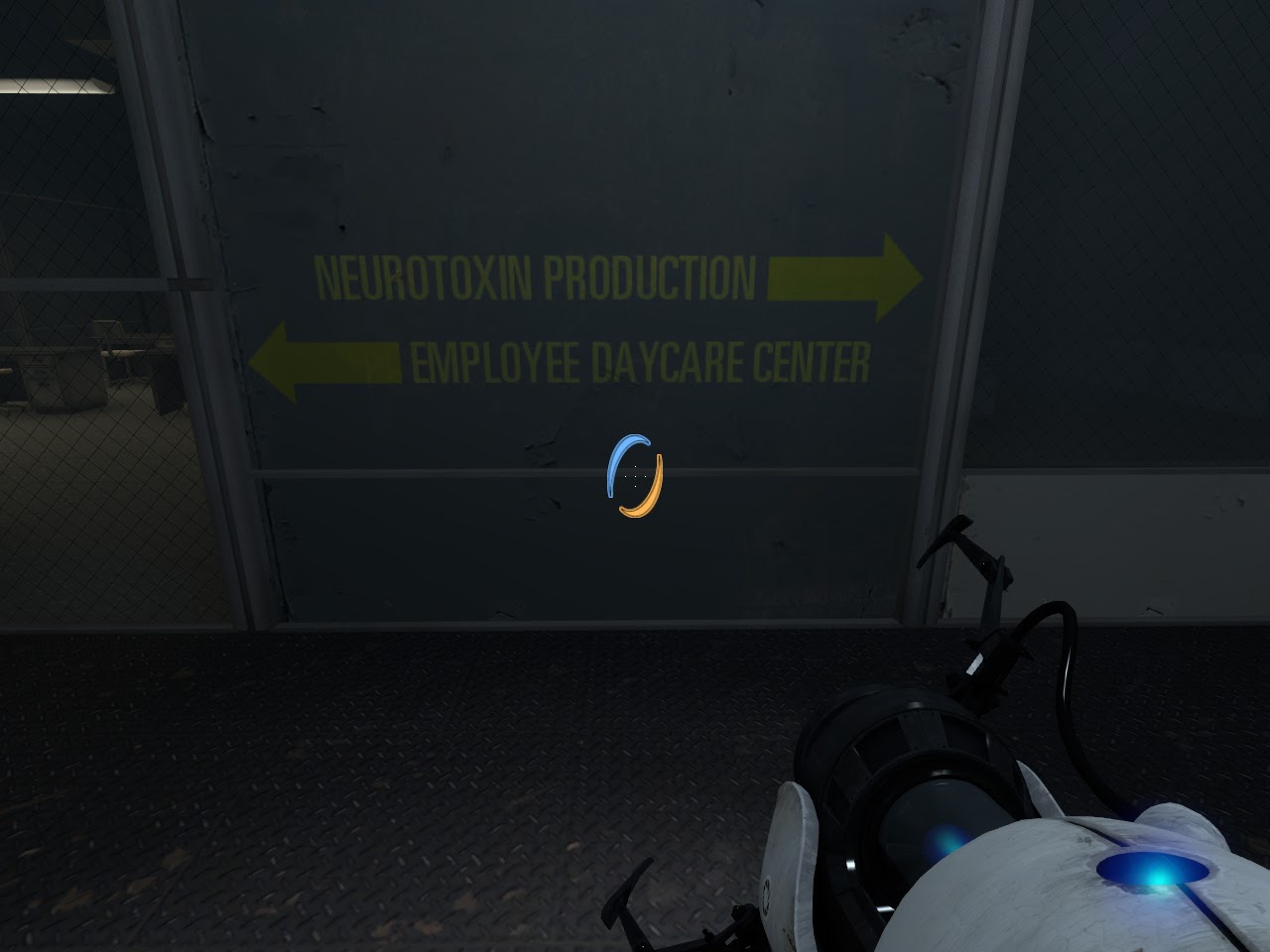
| The Enrichment center goes down for miles. |
The environments are more varied this time around. You will see your fair share of testing chambers, but you also get to spend plenty of time “behind the scenes” crawling around in the Aperture Science infrastructure. These excursions outside the ordered test chambers reveal the terrifyingly macroscopic scale and modular nature of the facility, only hinted at in the first game. Some of the most memorable environments can be found in the games second act, down in the forgotten depths of the Enrichment Center, along with plenty of tidbits of information about the origin and history of Aperture Science.
Some of these giant arenas feel almost wasted, given that you can cross them in seconds with the use of the portal gun. They’re not pretty in the conventional sense, but the sheer scope and scale of the facility never fails to impress. This wasn’t a place built with human frailty or limitations in mind and you will, unsurprisingly, need the portal gun to cover any ground.
Doing what we must (Because we can)
For a game in which you are the only living human Portal 2 has great characters and hilarious writing. GLaDOS returns of course, though significantly angrier, sharper, and perhaps more human than you might remember. This makes sense given that you scrambled her personality cores in the finale of the first Portal and, as she’s never slow to remind you, did kind of murder her.
 |
| Not that she's bitter or anything. |
GLaDOS’s dialog drips with a level of terrifying, barely contained menace directed towards you personally, with more than a hint of mean-spirited sarcasm. While she’s the primary antagonist for significant parts of the game a lot about her personality and origin gets uncovered, and you may even end up feeling just a touch sorry for the homicidal AI. You get to see her react to some highly unusual situations, and it’s always fun when she’s threatening or addressing you directly.
Wheatley, on the other hand, crackles with barely contained panic and frantic energy. The little blue AI sphere wakes you from stasis at the start of the game and serves as your guide and source of narrative exposition for much of the first act. Wheatley’s a constant stream of ideas, most of them bad. Sporting a British accent and an extremely expressive and lovingly animated eye he rarely stops talking, and everything he says is hilarious.
 |
| What could possibly go wrong? |
Rounding out the cast is a series of voice recordings left by Cave Johnson, the original founder of Aperture Science. His relentless enthusiasm and total lack of concern for safety or ethics makes his speeches at least as fun as the rest of the cast. It certainly goes a long way towards explaining how Aperture Science became the place it is today. He syncs perfectly with the rich vein of dark, at least slightly sadistic humor that runs through the game. And make no mistake, Portal 2 is consistently, deliciously funny.
Companions without cubes
The single player game is a complete experience in and of itself, with a great finale for the payoff. The ending song isn’t quite up to the level of the first Portal’s “Still Alive”, but what is? If you want more gameplay there’s a challenge mode where you compete on leader boards for speed and least portals used, but the best addition is the co-op mode.
 |
| Being able to see yourself through your own portals is as cool and disorienting as ever. |
Portal 2 Co-op is definitely something you’ll want to do with a friend, rather than some random internet scrub. It’s as cerebral as the single player game, and good communication and cooperation is a must to make any progress. The little robots you control are endlessly reconstructed when one or the other of you inevitably dies, which helps keep the frustration to a minimum. The unlock-able animations of the robots interacting and GLaDOS’s constant heckling and commentary are more high points. You can do a lot of cool stuff with four portals and two bodies at your disposal, and the co-op campaign does as good a job as the single player campaign of educating you on the implications.
The part where I sum things up
In conclusion it’s hard not to recommend Portal 2. The game displays a level of wit and humor not often seen, while offering excellent mechanics and well polished puzzle gameplay. As much as I wish Valve would curb their hat-lust long enough to finish the third Half-Life episode, I can’t complain too much if games like Portal 2 are what they’re going to be doing in the meantime. It’s an extremely worthy successor to its predecessor while improving on the foundation laid by the first Portal in nearly every way.
Reasons to Play: Hilarious humor. Top notch writing and great cast of characters. Deeply satisfying puzzle gameplay with a constant stream of fun new mechanics.
Reasons to Pass: Slightly annoying loads. Extremely linear, for those who prefer more open games.
Articles copyright James Cousar, games and images copyright their respective owners.


