Difference

The difference between clever and cunning.

Saturday, January 29, 2011

In Soviet Russia, Zone Alienates You


The Stalker series of First Person Shooters has always had potential. For those of you unfamiliar, the premise holds that something strange and terrible happened in Chernobyl after the reactor melted down, creating a so called “Zone of Alienation” where natural laws are warped or suspended entirely. Enterprising adventurers, known as Stalkers, brave the dangers of the Zone to hunt for the pseudo-magical artifacts that form there.  Unfortunately the first two entries in the Stalker series (“Shadow of Chernobyl” and “Clear Sky”) have had a reputation of being held back by bugs and general lack of polish. In Call of Pripyat the series has finally found its groove.

The story has you, an agent of the Ukrainian Security Service, sent into the Zone to investigate the mysterious crash of a flight of military helicopters. You’re undercover as a Stalker, one of the titular freelance adventurer/scavengers, and more or less on your own. Tracking down each chopper crash and any survivors provides a basic overall mission structure, and an excuse to turn you lose in the Zone to thrive or perish.

The skies above the Zone can be breathtaking.
Gameplay is a tightly tuned version of the FPS/RPG hybrid already established by the Stalker series. The game builds a credible open world and then gives you interesting and difficult choices to make in it. While better guns certainly help, you’re dependant on your own aim and reflexes to get your bullets where you want them. Combat and movement function as a First Person shooter, but like any good RPG Call of Pripyat lets you choose where to explore, how to interact with the characters and creatures you meet, and what gear to equip and tweak.

The game world is split across three expansive areas. That doesn’t sound like a lot, but each area has its own distinctive terrain and hazards. Locations of interest are marked on your map. You’re free to visit or ignore them in any order, though many of the Zone’s dangers can prove lethal without proper equipment. The levels feel large, but you’re rarely more than a five minute sprint from home base.

Each area features a central hub populated by friendly NPCs where you can resupply, repair and upgrade your gear, and pick up optional missions.  These run the gamut from standard kill-this-fetch-that, to hostage rescues, to sneaking through a lair full of sleeping mutants. Stealth and/or negotiation are occasionally options. A few missions offer opportunities to align yourself with one group or another. There’s not really a “Faction war” mechanic like in Clear Sky, but your actions do determine which characters live or die.
Flocks of crows circle overhead. What draws them to the Zone?

World of Desolation

The world of the Zone remains a terrifying and desolate place. Buildings and objects crumble and rust from exposure and neglect. Natural (and unnatural) forces slowly reclaim the works of man. The skyscape overhead is breathtaking and moody, even on clear days, and is frequently home to dozens of ominously circling crows. In quiet moments you hear the baying of dogs in the distance, and sometimes what sounds like the whisper of far-off voices.

Like the rest of the Stalker series, Call of Pripyat manages to be truly frightening at times. Even when there’s nothing lurking in the dark the abandoned buildings and tunnels across the Zone are intensely creepy. The empty city of Pripyat itself is especially eerie, with rows of vacant housing blocks, blind empty windows, and wind-swept playgrounds.  Night in the Zone is pitch black, lit only by the circle of your flashlight or the washed out green of Night vision. After a nocturnal encounter with hunting mutants I found myself heading back to the nearest friendly camp when it started to get dark.

You never know what might come lunging out of the dark...
Day or night, the Zone pulses with a life of its own. Even without your presence the people and creatures that live there pursue their own goals. Stalkers band together for protection and search for Artifacts, bandits attempt to prey on the un-wary and mutant packs forage for food. It’s common to come across encounters between different groups already in progress. You can pick a side, opportunistically loot the fallen, or just keep moving, but you’re constantly reminded that the world isn’t reacting to you and you alone.

Life and Death in the Zone

Combat is a tense, high risk affair. Human opponents reward use of cover, headshots, and long range accuracy. Both you and all but the most heavily armored characters are fairly fragile, and the AI is good at trying to creep around to flank you. Call of Pripyat has decent stealth mechanics, but Bandits and Mercenaries are almost improbably alert, even in the dead of night. While hard to take by surprise, enemy aim and grenade use never feels unfair. Speaking of which, the Stalker series really needs to get with the times and include a hotkey to toss grenades while keeping your current weapon equipped. I understand this isn’t intended to be Halo, but switching back and forth remains clunky at best and suicidal at worst.

Battling mutants is less tactical and more visceral, often boiling down to waiting for just the right moment to unload your shotgun at whatever is bearing down on you. The unnatural creatures birthed by the Zone are a diverse and disturbing lot. Packs of blind dogs circle you, yelping to draw your attention and charging when you turn away. Ghoulish once-humans crawl across the floor, still wearing tattered gas masks, before flinging themselves at your throat from across the room. Squid-faced abominations stalk you unseen, cloaked by some mysterious power, becoming visible a moment before they strike. And then there’s the really dangerous and horrible things found in the deepest depths of the Zone.

Shhh. They're sleeping. Don't make any noise.
The creature design is top notch. Whatever happened to the people and animals taken by the Zone looks painful, disturbing, and at times even surprisingly biologically plausible. Mutants drop nothing of value when slain. Given how dangerous and resilient many specimens are a clever player will learn to evade and escape, rather than stand and fight every radioactive monstrosity they meet.

The Things You’ll Carry

The game strikes a nice balance between challenging realism and concessions to smooth gameplay. You need to eat and sleep periodically or face increasing penalties to accuracy and endurance, but not so frequently that it is obnoxious or disruptive. You’re vulnerable to bleeding wounds and radiation sapping your health, but convenient and customizable inventory hot slots let you slap on a bandage or gulp anti-rad drugs and forge ahead. Medkits heal you quickly but not instantly. The more weight you carry the less you can sprint, so balancing your inventory is an ongoing tactical choice. Those extra pounds of loot aren’t going to help if they let hungry mutants run you down.

The sheer variety of weapons and equipment you can scavenge and buy is almost daunting. Most are modeled after real world firearms, and all have pros and cons that make picking your arsenal a complex decision. The relationship between weight and endurance ensures every ounce is important. Do you go with a steel helmet to deflect bullets or a gas mask to better cope with toxic and radioactive hazards? That heavy shotgun is great for fending off mutants in tunnels, but will be so much dead weight in an open field skirmish against bandits. A silenced pistol is light and easy to find ammo for, but won’t help against heavily armored foes.

Upgrades are cheaper if you ply the technician with enough Vodka first.
Guns and armor can be upgraded, provided you have enough cash and have brought the technician NPC the appropriate tools. The system works like an RPG style skill tree, each upgrade unlocking the next tier. Many upgrades are mutually exclusive, forcing you to choose between two tempting options. Some enemies and attacks can knock the gun out of your hands, and it’s always fun to have to decide between combing through toxic mud for a prize weapon and making a break for it. That mutant boar won’t give you much time to think.

Breaking the law (of physics)

The Artifacts that drew everyone to the Zone are closely tied to the Anomalies that pose one of the Zone’s greatest dangers. Anomalies are highly localized areas of un-natural heat, electrical activity, radiation, and other lethal forces. No two are alike. Fireballs swirl around a searing hot ring of baked dirt at the aptly named Circus Anomaly. Gravitational distortions create surreal bulges and depressions in the toxic water of a swamp. A perfectly straight scar gouged a hundred meters into a hillside hums with brain melting Psi activity. Each Anomaly poses a distinct hazard that you can prepare for with the right protective gear and supplies. Most are marked on your map, and the Artifacts that are your best source of wealth and unusual abilities are only found inside.

In gameplay terms navigating an Anomaly requires patience, close observation, and reflexes. Most Anomalies slowly drain your health and damage your armor as long as you stay in them, and contain intensely dangerous points that cripple or kill directly. You can throw metal bolts to find a safe rout, and hand-held detectors help you track down Artifacts and warn you by beeping and crackling as you approach a dangerous spot.

Braving an Anomaly is always tense and dangerous, but Artifacts are valuable. In addition to being worth a lot of cash they have unique properties, like increasing your strength and endurance, protecting you from specific types of damage, or satisfying hunger. It’s not quite super-powers, but Artifacts allow yet another layer of customization and tactical choice. Each armor suit only has a limited number of slots to equip Artifacts, and most of them slowly irradiate you in addition to whatever benefit they offer, so making use of them is always a trade off.

As if the Zone needed more ways to kill you there is also the threat of Emissions, spectacular and dangerous events that occur about once a day. When one begins the air crackles with energy, and humans and mutants alike flee. You only have a few minutes to reach a cave or sheltered building, because anything caught outside when the Emission reaches its peak will die. The nearest shelter is marked on your map as soon as an Emission starts, although there’s no telling what might already be living inside or follow you in seeking cover.

If the sky turns this color, get indoors.
Whatever the case, it’s preferable to being outside during an Emission. The earth rumbles and the sky turns a steadily darker shade of red. As the Emission builds the screen rocks and fills with static, and then there is a blinding flash, followed by the patter of dead birds dropping out of the sky.

Ghosts and Echoes

Call of Pripyat has a generally high level of polish. Its stark environments looked good and ran well on my machine. I didn’t encounter any of the weird event and scripting bugs that plagued the first game. When the story had me fighting alongside NPC allies they kept up and did a good job of defending themselves. The only technical complaint I can think of is that a few optional areas had very tight geometry that made it possible to get stuck. While we’re quibbling, the ability to put my own notes and navigation beacons on the map would have been nice too.

Most of the game takes place in the larger free-roaming environments, but a few story missions send you into more scripted and linear areas. Stand outs include leading a team of Stalkers through a network of tunnels flooded with toxic gas, and an underground lab that’s been warped into a nerve wracking radioactive haunted house. I found these an interesting and challenging change of pace, but other players may find them frustrating as your options to evade enemies and resupply are limited.  
The city of Pripyat, abandoned playgrounds and all.

Call of Pripyat suffers from a weak central plot, but that’s hardly crippling. As mentioned previously, it’s mostly an excuse to turn you lose in the Zone and spur you to travel deeper in. The numerous side quests and characters feel like the meat of the narrative anyway. Things pick up in the last hour or two, tying the story back in with the rest of the Stalker series. The final mission is a frantic running battle across the city of Pripyat, and is one of the highlights of the game. Hopefully you’ve been keeping the other characters alive, because you’ll want all the supporting firepower you can get. In a nice touch you can choose to keep exploring in Free Roam mode after finishing the last mission.

I was also pleasantly surprised by Call of Pripyat’s epilogue. Far too many games end with a two minute cut scene that doesn’t resolve anything and jump to credits. The epilogue goes into detail about what happened to each of the areas, factions and characters you met in your adventure, and how your actions (or lack thereof) affected them. It wraps up the story nicely, and reinforces that the choices the player made have consequences in the world of the Zone, for better or worse.

Reasons to play: The vivid, terrifying world of the Zone. The game constantly presents the player with interesting and meaningful choices. High level of polish and fun.

Reasons to pass: Weak core story. Players who prefer a more linear, trimmed down shooter may find themselves lost and frustrated.


Monday, December 27, 2010

I'm in a Mine. Crafting.


It's appropriate that I review Minecraft shortly after I covered the World of Warcraft expansion. Aside from both having the word “craft” in their name, the two games are polar opposites. Each encompasses a radically different philosophy in game design. WoW is (as has been stated before) a theme park. Theme parks can be a tremendous amount of fun, but people understand they’re in for a structured, controlled experience. Minecraft isn’t a theme park. Minecraft is a sandbox.

When you start a new game of Minecraft the player is plopped down, empty handed, in the middle of an infinitely vast, randomly generated world. You can pick a random direction and walk for hours and Minecraft will continue to procedurally generate more terrain, shifting from snowfields to forests to island chains as you pass through different biomes. Everything in this world is made of blocks. The trees, the mountains, the deserts, and the oceans, all made of blocks. Every block can, with some effort, be removed and replaced according to your whims.

The view from the mountain over my base. The world goes on forever.
(As always, click to enlarge the pictures)


The controls are quick and intuitive. If you’ve ever played Doom you can move comfortably and if you’ve ever played Diablo managing the inventory and crafting interface is a snap. Minecraft has proven relatively stable, only crashing once or twice, although the recent Beta updates caused some frame rate issues for a while. Music is sparse and moody, and the audio feedback of your tools and footsteps on different surfaces fills out the world nicely.

For a game with such primitive graphics… No, primitive is the wrong word. Basic. Modular. Anyhow, Minecraft’s world is full of life and atmosphere. Water runs, grass and trees grow, and harmless cows and pigs wander across the terrain, waiting to be converted into leather and ham. Fire, if carelessly unleashed, rips through forests and wooden structures. The sun moves slowly through the sky overhead. This is important, because once the sun goes down the formerly peaceful world floods with giant spiders, zombies, and exploding cactus monstrosities.

Sun's going down. Better hurry home...

Your first goal is obviously survival. I’d recommend watching some of the excellent YouTube tutorial videos on surviving your first night, because this is that kind of game. There is no instruction manual or tutorial. (To be fair the game is, as I mentioned previously, only just now entering Beta. More on that later.) Knowing some basic information, like how to build first tier tools and that light prevents monsters from spawning, is invaluable and helps prevent the otherwise likely death-by-spiders.

Minecraft can be an unforgiving, reminiscent of the earliest generation of MMO’s. The monsters do a lot of damage, especially before you are able to craft armor, and aren’t shy about ganging up on you. The game saves constantly, so there’s no going back and loading up a previous save if you make a terrible mistake. When you die you re-appear at the same spawn point you first started at, no matter how far away you were. Every single item you were carrying is dropped back where you died, and dropped items disappear forever in five minutes. Minecraft also lacks any sort of built in map function, and it’s quite easy to lose your bearings and become hopelessly lost.

The light of dawn makes the undead burst into flames.

The game’s environment is hostile, but that’s fine, because Minecraft is all about changing the environment to suit your needs. Every single brick can be manipulated. Carve a shelter out of a mountainside and set up a perimeter of torches to ensure safety at night. Leave behind a series of markers to let you find your way back to your camp.  If you keep falling down a hole, pave it over. If a river blocks your path, build a bridge over it.

There is no part of the world that is beyond your power to change, and this is a large part of what makes Minecraft such a unique experience. Don’t like a mountain? Remove it and build a better one in its place. Or a castle. Or an elaborate maze. Or whatever you please. Only a few block types (like sand) are even affected by gravity, so you can build that floating fortress you’ve always wanted.

It’s possible to play without ever leaving the open sky, but it’s also possible to dig down and never look back. Iron and diamond and other valuable ore can only be found past a certain depth, so it’s tempting to dig greedily and dig deep. It’s even possible to grow wood and food resources underground, with the right combination of light, water, and space, so there is nothing stopping a determined player from going “full dwarf” and becoming completely independent from the surface.

The underground is hazardous. It’s easy to accidentally dig into a sandfall, rushing underwater river, lethal fall or lava. The only light comes from your torches, and monsters can come from any area that’s dark. There are huge pitch black cave systems that stretch under every Minecraft world. You can break into them by accident, but you frequently hear monsters roaming the lightless depths nearby as you mine. It’s delightfully creepy, and showcases the game’s excellent sound design. The sound of running water and monster groans are the only hint of danger you get before you tunnel right into it. Exploring the world below is dangerous, rewarding and a lot of fun.

Lava and water beneath the earth.

Your nameless character is the first and only man in this brave new world. There is no plot to follow, no quests to undertake, and no missions to complete. There are no characters to talk too or otherwise interact with. The only NPC’s are harmless wildlife and the hordes of nocturnal monsters. There are no levels or stats. You can craft a variety of weapons, armor, and tools, of varying levels of effectiveness, but everything eventually wears out and must be replaced. Your abilities are solely defined by what you happen to be carrying at the moment, and the changes you have made to the world.

Minecraft is less a conventional game than a toy. This is gaming at its most freeform, the polar opposite of the linear, six-hour, First Person Shooter, graphics spectaculars that the industry has adopted as its figureheads. Your objective is whatever you wish, from construction to exploration, provided you can locate the resources and craft the equipment and construction material you need. No other game I’ve encountered before lets you change the environment to anything like the same degree.

Aside from exploring the surface and endless underworld, Minecraft’s great joy is building things. Every player will want to carve out a home base or fort, if only to have a safe place to weather the nights, and seeing your little speck of custom civilization spring up amid the endless wilderness is truly rewarding. You’re Robinson Crusoe in squarish pixels.

A modest but cozy home base.
It’s obviously quick and intuitive to grasp how to build something out of square blocks. Anyone who has ever seen a Lego instantly understands the concept. If you can imagine it, you can likely build it. Once you move beyond stacking blocks there are a lot of cool features to master, from doors and ladders to working mine-carts on tracks and even a sort of primitive circuitry to power buttons and levers. Players have done amazing things with the running water, lava, and the host of other, ever expanding tools and features built into the game.

The community is impressive, and simply seeing people showcase their projects and engineering feats on YouTube is a pleasure. The official forums and wiki are a great resource. I was able to find plans for a protected and efficient greenhouse design to aid my crop growing experiments. If you ever need help making one of your ideas work, or simply want to see cool stuff other people have built, the forums and wiki are highly recommended. 

The randomly generated worlds are cool, and it is always tempting to load up a new one just to see what it looks like, but they can contribute to Minecraft’s barrier to entry. For every ideal spawn point it’s equally possible to get one without access to important first tier resources, like coal. Watching a tutorial video is highly recommended, and an intro world or sequence would go a long way towards easing new players into the game before letting them take their chances with the random generator. It’s entirely possible something like this might be added in the future, because Minecraft literally isn’t complete yet.

It feels a little odd to be “reviewing” a game that just moved from Alpha to Beta as I wrote this entry. It is important to understand that the Minecraft available today is not a finished product, and may not be for some time.  It is constantly being tuned, updated, and gaining new features. What we end up with may be very different than what I’ve discussed today, for better or worse.
Can you spot the exploding cactus abomination lurking in the dark?

Minecraft’s strengths are also its weaknesses. It isn’t a monopoly board, but a giant bag of Legos, a blank page rather than a finished novel. If you want to enjoy a cinematic story or blast through a meticulously tuned action sequence you will not find them here. You drive the action and shape the world in Minecraft, not the other way around. If the types of exploration, crating, and building I’ve described don’t sound appealing, this is likely not a game you will enjoy. At least check out the explosives video I’ve included at the bottom of this entry though, because it is pure awesome.

While not perfect Minecraft is a triumph of indie gaming, and an amazing toy in its own right. I’m eager to see what features are added in the future as the game continues to evolve. The game continually surprised me. For example: returning from a long mining expedition, I found the decorative saplings I had planted in my indoor greenhouse had grown into towering trees that blocked out the sunlight and killed the smaller plants around them. While hardly crippling it was still very cool to see the world react to my changes in unexpected ways.

Reasons to play: Amazing freeform toy. Limitless options to explore, build, and experiment.

Reason’s to pass: Punishing death penalty. Some barrier to entry. Players who crave a focused, cinematic experience may find themselves bored.

Note: This is primarily a review of the single player Alpha and Beta on Normal difficulty. Minecraft does have a free “classic” version where you have unlimited blocks of every sort and no enemies.  It also features a multiplayer mode where people can co-operatively build together (or grief each other’s structures). Finally the game has a “Peaceful” difficulty setting where no monsters appear. If the experiences I’ve described seem a bit intense, know that there are more relaxed and more social ways to enjoy the game.

Minecraft Resources


Awesome Minecraft Explosives video (Showcases how dramatically you can change the world): http://www.youtube.com/watch?v=VFZKtvHQSNY

Monday, December 13, 2010

It's the End Of The World

Ah Blizzard. One day you’ll stop messing around. One day you’ll hook electrodes directly into my brain’s pleasure centers and convert me into a hideous but docile cybernetic drone. Every time I complete some mundane and repetitive task, like breaking rocks or hunting down one of the surviving free humans, I’ll receive a jolt of pure sense-of-accomplishment directly to the cortex.

That's the stuff.

I can’t wait, but until that glorious day there is WoW, and today there is the Cataclysm expansion.

The last days before a new expansion hits an MMO have a decidedly apocalyptic feel. Madmen rave from every street corner, the economy lies in shambles, and the nervous masses grasp at every scrap of news and whispered rumor. Guild leaders and moderators struggle to ease the troubled minds of their charges, but can they hide their own quiet doubts? They cannot, and the people sense it, and they fear…

Everything that is known and loved and loathed is put to the question. All the power and treasure and glory we have labored to amass are held cheap and tawdry. Is the Great Nerfing upon us, like the mad-eyed prophets say? Will everything be ruined, ruined forever? Will the servers melt into molten slag and all ones returned to zeroes? My god, what will happen to my character, my class, my guild?! Will I be spared? Will anyone?

Wait. Is that it? Is that the expansion I see coming now? What is that light? So bright as it breaks through. Illuminating. Burning. Beautiful and terrible… I can see it! I can see forever! And it sees us… (Transmission lost)


Can't you see it? Hear it? Feel it? Coming for us...

There is nothing on this earth like being in the first wave as an expansion goes live. The servers go up. New zones come online for the first time. All is quiet, peaceful, and perfect. Then a solid mass of berserk players arrives, and nothing will ever be ok again.

Imagine Omaha beach. No, imagine the first twenty minutes of Saving Private Ryan. Except there are five hundred Allies of every nation, rank, and uniform pouring off the boats and only twenty Axis soldiers evenly spaced across the beach, each blithely patrolling their own little sector. And your commanding officer won’t let you advance until you’ve killed ten Axis soldiers and blown up five sections of barbed wire.

Soon there are giant piles of hundreds of dead Axis soldiers all across the beach, the Russian and American soldiers have begun fighting one another, and someone keeps shouting over and over that they can’t find the Bangalore torpedoes while everyone else mocks him. So it’s actually not like Omaha beach at all. I wouldn’t have missed it for anything.

This isn’t meant to be a comprehensive review of the Cataclysm expansion. That is beyond our scope. One could argue that it isn’t really possible to review an MMO. One would be wrong, but one could argue it. This is just intended to be a combination of my personal experiences going in face first, and some thoughts on Blizzard’s design philosophy and how it’s evolved. Plus some cool screenshots. (As always, click to see them full sized)

The first thing I noticed about the new zones, aside from how awesome they looked, was how linear they are. Blizzard has refined it’s “theme park” design school to an art. That isn’t necessarily a bad thing. You’re stuck on rails yes, but the rails make up a roller coaster. The game shuttles you neatly and efficiently from one quest hub to another. Great use is made of the “phasing” technology that was introduced in Wrath of the Lich King to give the illusion of progress and a world that changes based off your actions.

A host of cutscenes help move the story along.


One series of early quests in has you rallying and equipping a group of stranded, shipwrecked survivors. Just as you’re finally getting them back on their feet, an enemy attack wipes out the tiny outpost and sweeps you along to the next area. The campaign in the Mt. Hyjal zone has you aiding the druids in slowly pushing the enemy down the mountain. Enemy forces are actually driven out of areas and whole sections of forest re-grown based as you succeed. Of course, everyone else sees the exact same story as you, with little variation, but that's the price we pay for this level of dynamism in a theme-park style MMO.

There are even a few encounters with Deathwing himself.

This is, beyond any doubt, really cool. One of the most annoying things about MMO’s is that, by their very nature, it is hard to feel like you’re making any impact on the world. The dragon you slew needs to be there for the next person to slay, which makes your own victory seem just a little hollow. Seeing zones change and the story move forwards from stuff you did is extremely rewarding.

This level of linearity is not without problems. In my personal experience a single NPC didn’t appear in one of the early Cataclysm zones, which meant you couldn’t complete the quest they were related too, and progress through the entire zone was held up. Because of a single missing character, dozens of quests were completely inaccessible. The problem was fixed in 24 hours, and to be fair this was an incredibly smooth launch considering the sheer scale involved, but the linear nature of the new zones means they bottleneck very easily. If even one quest is bugged or broken it can be very hard to keep moving forward.

Fix. The. Bugs.


On a side note Blizzard appears to have dispensed with the idea of group content anywhere outside an instance. It’s a good change. These quests could be fun, but finding a group could also be an aggravating roadblock. Their removal streamlines the leveling process nicely. You still take on some impressive and powerful opponents, but you usually have NPC backup or some other quest specific way of evening the odds.

Blizzard's sense of humor can be found everywhere.


The new zones are well worth the price of admission. They are huge, and full of cool features. The underwater Vashj’ir zone is so big it’s practically an expansion all on its own, and the sea life and underwater vistas look amazing. There’s always some cool to see, and while there are plenty of bread and butter kill-this-fetch-that quests, there are also plenty of memorable moments and fun new mechanics. Questing through these new areas never felt grindy or boring to me.

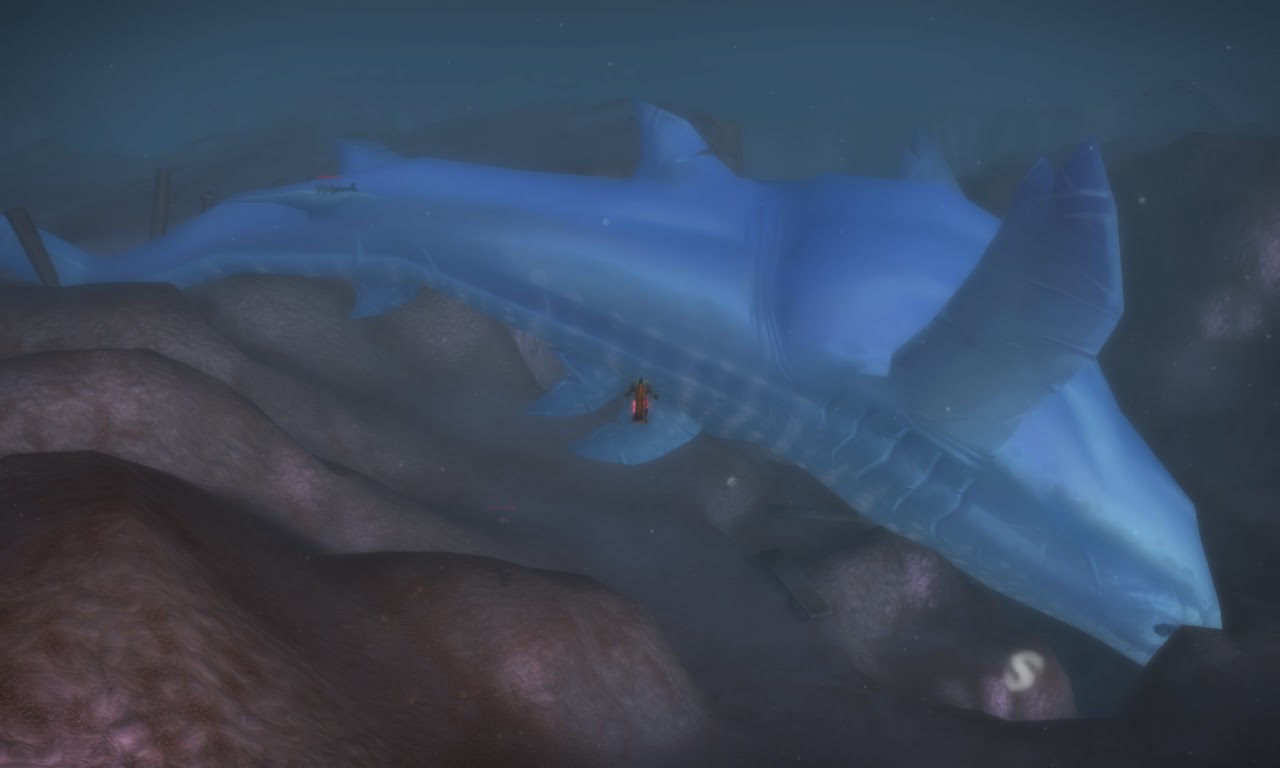
That's a Whale, to give you a sense of scale. You actually go inside the creature behind it.


Before I let you go, I realize this blog has been a little WoW heavy lately. For this you may, unsurprisingly, blame the expansion. While Wow coverage and commentary is certainly intended to be an element of this blog, with “Azeroth” right there in the name, please don’t come away with the impression that we’re only a WoW blog. As riveting as I find making my Internet Numbers bigger, in my experience there are few things less interesting than hearing someone talk about an MMO you do not play.

If you also play the same MMO, given what we’ve discussed today, I suspect our experiences in the new zones would be, by their very design, quite similar. So you probably wouldn’t find it very interesting either. In fact, you’re probably busy playing right now rather than reading this carefully crafted and insightful masterpiece. Ingrate.

To the pit with you!


But fear not, gentle reader. We have more of the same thoughtful reviews and fascinating industry commentary you’ve come to depend on coming down the pipe quite soon. A man has to do something besides play WoW. Until the brain electrodes get installed, I mean…

Tuesday, November 30, 2010

It's that time of year again

Hey out there. I hope you all had a good Thanksgiving. Or at least survived it. The holidays can be a hectic time for many people. Sometimes it feels like the world is coming apart at the seams.
(Click to enlarge the pictures. Many of them need to be seen at full size to appreciate.)


Travel can be stressful, and just doesn't feel safe these days.

Still less traumatic than flying commercial.
If you get along with your relatives that's fortunate, but avoid inviting people from work if you can. Some seem to get a little bit crazier every year. It's even worse if they've somehow been successful and moved up in spite of themselves.

All the other faction leaders at least wear a shirt or something. I'm just saying...
The food is usually good. That's what makes the whole mess worthwhile.

That's Steve on the table. Dear friend, and delicious to the end.
Leftovers can be a hassle once the meal is over. There is just no place to store them, and it feels like they'll never be finished.

The seafood side dish seemed like a good idea at the time.

With any luck we'll all survive till Christmas. Not likely though. Can you hear the thundering hooves of the riders of the holiday apocalypse drawing nigh?

Can you not see his fiery hoof-prints? Can you not hear his terrible gobbles?

Wednesday, November 24, 2010

Dear Billy,

(If you play World of Warcraft this needs no explanation. If you do not, I have no excuse. Nowhere do people seem to fear change more, and take things more personally, than in online games.)

          Dear Billy,

          This is Flurry Entertainment, makers of the popular Massively Multiplayer Online Role Playing Game: “Planet of the Battlemakers.”

          We note that, while a longtime veteran of our game, you don’t seem to be entirely happy.  You have started multiple threads in our official forums and engage in prolonged arguments in general chat, all to the effect that you don’t feel the game is balanced. That it is being ruined. You seem concerned that there might even be some… favoritism at work. We find these accusations distressing, and would like to take the opportunity to address your concerns.

          You’ve stated that we here at Flurry must love the opposing in-game faction, the Buddy Nations, more than we like yours, the Rampaging Mob. You state that they have more interesting zones, better designed capitol cities, and cooler quests and rewards. You’ve complained extensively that the battlefield maps give the Buddy Nations an unfair advantage, and that Player VS Player combat is hopelessly imbalanced in their favor.

          You also appear to feel your Race and Class combination, the Road Ogre Facepuncher, is at a severe disadvantage; especially compared to the Scantily Clad Pixy chosen by sixty percent of Buddy Nations players. You’ve raised repeated complaints about everything from the poorly fitting and unattractive graphics for the Road Ogre armor; to the severe “nerfs” you state have ruined the Facepuncher class. We were particularly impressed by the many, many charts and graphs you produced to support your arguments.

          These are valid concerns, and we here at Flurry Entertainment feel we owe you an explanation.

          Billy, these issues with your faction, race and class do not stem from the inherent complexity of the game. We have already carefully considered and taken into account each of the hundreds of possible factors that affect gameplay and balance for a dozen classes, dozens of character builds, a score of races, fifty zones, PvP and PvE combat between two opposing factions, hundreds of spells and abilities, and millions of players.

          Every single interaction has been finely tuned and should be considered as working exactly as intended. Every…single…one. After all, as you repeatedly pointed out, we make tens of millions of dollars every month from subscription fees. Our experienced and hard drinking technical and QA departments systematically eliminate any bugs and unintended issues long before they have a chance to affect our players.

          You see Billy; the reason for the issues you have encountered is hatred. Our searing, undying, tightly focused hatred for you, everything you stand for, and everything you have ever, ever loved. We go to bed ever night with our hatred burning inside like the heart of a new born star. We wake up every morning from dreams of a world that exists solely to make you miserable beyond description. We spend every day working to make those dreams a reality.

          We at Flurry Entertainment hate you Billy. We hate you more than words can ever tell.

          Now, to be fair, we despise pretty much every other element of Planet of the Battlemakers as well. We hate both the Buddy Nations and the Rampaging Mob. Next patch we plan to move player item storage for both factions out of the major cities and into an underwater minefield. There is no race and class combination that we can honestly say we like. We’ve systematically worked to try to render every race and class from Brain-Ape Stomper to Dirt-Gnome Appliance Repairman as painful as possible to play .

          But you Billy, our hate for you is something rare and special.

          We leave nothing to chance. We continually analyze your play style so we can make it less viable. We record what spells and powers you like to use so we can make them worthless. Every time you missed with an attack, didn’t get the item you wanted, or were ambushed by a monster? That wasn’t bad luck. That was us, and you were right to curse our name as it happened.

          Every time you enter a battlefield, the Buddy Nation players see a giant beacon over your head and receive a message that you are worth triple points. Our monster AI is programmed to seek you out from across the zone and attack when your health is low. Our server team spends their days crowding around a large red switch, pulling it to disconnect you from the game at the worse possible moment. They take a shot every time they do. It isn't a bad connection Billy. It is deliberate malice.

          Every single time.

          We appreciate you taking the time to contact us Billy. We hope we have been able to answer some of your questions. Best of luck on your adventures in Planet of the Battlemakers!

Sincerely,
Flurry Entertainment.

Thursday, November 18, 2010

Game On Follow Up


          As promised I was able to make the Game-On event. It was worth attending, and not just for the booze and free sandwiches.  Austin is home to a lot of talented game companies, and they took the opportunity to show off their latest releases.

          The focus of the event was on console games, as one might expect. Gaming consoles lend themselves to “party style” play, being easier to set up, pick up and start playing, and arrange a multiplayer match on. I’m all but exclusively a PC gamer. The last console I owned was an old N64.

          This is not out of any sort of misguided elitism or the weird factionalism that sometimes afflicts our hobby. Some time ago I came to the conclusion that I have a sadly finite pool of money, leisure time, and energy, and settled on the PC as my main gaming platform. My crippling WoW addiction may have also had something to do with it. Anyhow, it was cool to see some console games that wouldn’t normally cross my radar. These aren’t intended to be full reviews, just my thoughts on what I was able to see in the limited time I had with what was on display.

         
          The star of the show was definitely The Force Unleashed 2. They had the Wii version, from Red Fly Studio, available for play. Being a Stormtrooper continues to be one of the most hazardous jobs in existence, with a disturbingly high chance of being choked, electrocuted, crushed by telekinetically thrown objects, or sliced to pieces. Red Fly has captured much of the charm of the old Jedi Outcast series: the pure joy of using the power of the force to do very bad things to people in identical white armor.

          The level I was seeing demoed seemed to center around keeping one step ahead of Darth Vader, destroying bridges and elevator shafts and jamming doors to keep him from being able to pursue. This is a good use of the character rather than just tossing him into boss fight after boss fight. Vader is, after all, someone you run away from.

          I was able to join in the multiplayer tournament, and even survived past the first bracket by courageously hiding in the corner till my opponents had worn one other down. The multiplayer mode is a 2D brawler that draws a lot of inspiration from the Smash Bros series. Many of the levels feature hazards like giant monsters and rising lava that are at least as dangerous as the enemy players, and power ups spawn at random that let you unleash special attacks. The characters have a good spread of abilities and play styles. For example: Bobba Fett lacks a real melee attack but can actually fly with his jetpack and not just do that Force double-jump all Jedi come equipped with.


          My personal favorite was Comic Jumper, from Twisted Pixel. These are the same guys who brought us such quirky games as ‘Splosion Man. The game combines classic 2d brawling and shooting with a snarky and intensely self-aware sense of humor that I enjoyed. As the name would indicate Comic Jumper has you fighting through parodies of different comic book genres, each with a distinct art direction. Unfortunately it is for the 360 only. Here’s hoping they get around to making a PC port at some point.

          The best twist on an old idea present was what I can only describe as “some sort of inverse dueling mode Tetris” called Opposites. It’s easier to see than describe, and visually striking. Blocks alternate falling from right and left towards the center of the screen, rebuilding your opponent’s side. Go take a look at it here to see what I mean: http://dannobot.com/index.html.


          Finally there was a program called Gamesalad being demoed, which described itself as an “advanced game creation tool for non-programmers.” It used a drag-and-drop interface for putting together sets of conditions and commands. The program looked fascinating, but unfortunately for me it is a Mac exclusive. Steve Jobs! (Shakes Fist)

          Now that I’ve undermined my previous comment on factionalism, I can say I had a good time. If the event comes around again, and you find yourself in Austin , make sure to show up. I’m looking forward to SXSW Interactive event this March, and the accompanying Screenburn Arcade. I will be covering both, so keep checking back.

Monday, November 15, 2010

Game On

Despite the fact that our planet orbits a ball of radioactive fire I do periodically leave my house, and not just to buy more bottled water and 20 pound sacks of rice. As you may or may not already know I live in Austin, Texas. Austin is an unspeakably cool city. One of the many reasons for this is the SXSW music, film, and interactive festival that rolls around once a year, causing the already tenuous parking situation to dissolve into mass hysteria.

The best part about SXSW is the Screenburn free arcade. Austin is home to a host of game companies, (Bioware, return my calls! Or at least revoke that court order…) and Screenburn gives them and others a chance to show off. They’re getting started a few months early this year with an event called Game On, which is also free, and takes place tomorrow.

Local rag The Chronicle has a quick write up here: http://www.austinchronicle.com/gyrobase/Market/GameOn

Yours truly will be in attendance. I’ll be letting you know what the event was like afterwards, and of course writing up the actual games demoed. Should be exciting.