Difference

The difference between clever and cunning.

Saturday, May 7, 2011

Darksiders Review

Darksiders is an epic single player action/adventure that draws heavily, very heavily, from the God of War and Legend of Zelda games. We’ll go over this in more detail later, but it’s worth mentioning right from the start, because I can’t think of a better way to describe Darksiders in one sentence. 

I know I spend an inordinate amount of space in my reviews talking about what other games a particular game is like. Every piece of media draws on those that came before it. Tracking a game’s “lineage” is one of the best ways to describe and understand it. Understanding what games inspired the creators lets us better understand the game itself.


War atop Ruin, the Red Horse.
Darksiders is not a difficult game to understand, and most of its gameplay elements are rock solid. The slightly overwrought intro casts you as War, one of the Four Horsemen and enforcer to a group of lava breathing Tiki heads called the Charred Council. Darksiders pulls, loosely, from Apocalyptic Judeo/Christian themes, and the Charred Council serve as mediators and judges that enforce the truce between Heaven and Hell until the appointed time for the Apocalypse.

As Darksiders opens meteorites rain down on a large metropolitan city. Angels and demons erupt from the craters to battle in the streets. War, understandably, thinks the Apocalypse is underway and enthusiastically throws himself into the fight.
           
The game has a very bold presentation. The art team has created a cast that would be at home in Azeroth or the Warhammer 40k universe, with a dash of Todd McFarlane’s Spawn. Characters have overbuilt, visually complex bodies fit for a comic book cover, full of details and props. Demons trail colorful fire behind them, and angels flit through the air on glowing clockwork wings.

Beginning at the End

Fighting your way through the End-of-Days serves as a tutorial, although the extremely heavy emphasis on combat is misleading for the later parts of the game. War is the incarnation of focused aggression, and the first twenty minutes has you hacking your way through Angels, Demons, and tiny fleeing humans. Demonic growths erupt from the ground and the city burns around you. Darksiders makes it clear that War isn’t here to save anyone, much less the day. He’s here to kill anything and everything that moves.

The city won't be this intact for long
After a bit of plot and a fight with a building sized demon War finds himself stripped of his powers and called to account by the Charred Council. Apparently that was some other world-shattering confrontation he busted in on, and not the real Apocalypse. He’s blamed for kicking off the end of the world early, and, for reasons that honestly didn’t make a lot of sense to me, sent back to Earth a century later.
           
The world is now a charred, demon infested wreck, but on the plus side you now have Mark Hamill tagging along as the voice of the Watcher. Hamill’s character is a snarling sadistic shade that offers occasional gameplay hints and reminds you of your objectives between heckling you. He appears to be enjoying the chance to chew the scenery.

The game’s voice acting is bombastic and entertaining. It’s always a relief when the developers make the effort to hire professionals. For bonus points, see if you can tell which characters also did the voices of Illidan Stormrage and Samurai Jack.

A dish best served with a side of delicious ham.
War’s emotional range goes from murderous rage towards everything he can kill, to defiant surliness towards anyone he can’t, with flashes of mild confusion every time someone feeds him a plot point. That’s fine. War is the avatar of violent slaughter, not given to introspection. Other characters point him one way or another and he happily murders everything in his path to get there. He’s here to bludgeon, maim, and dismember, not talk. And to be fair, Link doesn’t really have much of a personality either.

Beg, Borrow, or Steal

One of the common criticisms leveled at Darksiders is that it’s not an original game. This is true, but it’s also missing the point. Darksiders draws iconic elements from a lot of other games. The combat, finishing moves, and chests full of souls would be at home in God of War. The exploration, dungeons, and puzzles follow the pattern established by the Legend of Zelda series. The bold art style and character design could be mistaken for Blizzard’s, with War himself a dead ringer for Warcraft’s Arthas. There’s even a portal gun, ripped from the research logs of Aperture Science.

Did you know you can hijack Griffins?
There’s nothing wrong with using elements from other games, so long as you do it well. Heck, Blizzard hasn’t had an original bone in their body for decades, but that hasn’t hurt them. Where Darksiders succeeds, for the most part, is in recapturing what made the elements it uses fun in the first place.

If you enjoyed God of War you’ll like Darksiders combat. If you’re a Zelda fan the dungeons and puzzles will satisfy you. If you couldn’t stand Portal then the corresponding game segment will probably annoy you. Darksiders doesn’t parody or mindlessly copy the elements it borrows. It feels more like homage to what are clearly some of the developer’s favorite games.

Blood-dimmed Tide

The combat system is fast and furious. It’s not the deepest, especially before you get the chance to buy a few additional moves, but it is intuitive, responsive, and tremendous fun. All the elements you would expect are here, such as blocks, aerial moves, charge attacks, and so on.  War, unsurprisingly, is really good at hurting things.

Some lesser enemies can be grabbed and instantly killed in satisfying fashion, but most foes need to be worn down before they become vulnerable to a God of War style finishing move. This doesn’t require any sort of mini-game or combo; you just tap the appropriate button and War takes care of the rest. These kills are entertainingly brutal, but a few more of them wouldn’t have gone amiss. You’ll see the same “chop the legs off the demon soldier” animation a lot before the end of the game. 

War knows his business.
Mowing through grunts is a blast, and many of War’s stronger attacks send them flying or smash them to the ground. Bigger mini-boss caliber enemies, (of which the game has quite a few) feel a little off though. Larger foes come with huge health pools and very strong attacks. There’s nothing wrong with big tough enemies, but most don’t offer a lot of feedback as to how close to death they are and you don’t gain attacks strong enough to stun or interrupt them for some time. I found myself spamming the ridiculously useful dash-attack to dart in and land a hit. Enemy health bars would have helped pace these fights.

Darksiders can be unforgiving when it comes to health resources, although you’re never punished too hard for dying. Outside of non-respawning health chests and extremely expensive consumables there aren’t a lot of ready sources of healing, and I found the dash-attack such a reliable way to fight while avoiding damage that it almost breaks combat. To spice things up there’s also a “wrath” bar that powers a few special abilities, and War eventually gains the power to turn into an invincible burning demon for a few seconds, for those times when you don’t feel like messing around.

The first hour or two of gameplay is extremely combat heavy, which is actually a bit misleading. The game’s other major element is Zelda style exploration and puzzle solving, which becomes apparent as soon as you reach the first dungeon.

Dungeon Crawling

The maguffins you’re after this time are Demon Hearts, held by a collection of massive, bestial bosses. To reach each of them you’ll need to venture inside their lairs, and complete an assortment of environmental puzzles. You flip switches, rotate platforms, flood and drain areas, and so on. Some of these puzzles can be quite challenging, at least until you’re able to understand the mechanics and what you’re trying to accomplish in an area. It’s surprisingly cerebral, and makes for a nice change of pace between hewing down demons.
This place looks safe enough.
Each dungeon just happens to hold a new inventory item which is critical for solving the dungeon’s puzzles, as well as ultimately defeating the boss at the end. Some items, such as the boomerang-like “Crossblade” can be used in general combat, but others, like the aforementioned portal gun, are restricted to specific puzzles and areas. These items are also used for opening new routes and recovering hidden powerups in the overworld. Expect a fair amount of backtracking if you want to find all the goodies.

The boss-kill cinematics are suitably epic.
The boss battles are one of the game’s highlights. Each pits you against an impressive and intimidating creature. In true Zelda style you’re never just hacking away at a pile of hit points. You inevitably need to observe and understand their attack patterns, and then use whatever item you gained in that dungeon to make them vulnerable. Once you finally bring them down the kill cinematic are spectacular.

Darksiders environments are another stand out element. This is no generic fantasy world, but the wreckage of modern day Earth. The game takes place in the ruins of a massive city, and War swims through flooded subway tunnels and swings between the heights of skeletal skyscrapers. Despite the demonic invasion some places are surprisingly lush and verdant. The combination of ruined human structures, demonic corruption, and nature slowly reclaiming parts of the earth makes for some striking and lovely vistas.

Some locations are surprisingly attractive.
Rough Beast

While combat, exploration, and puzzle solving are all solidly implemented, Darksiders does suffer from a certain amount of blatant filler. Some sections make you slog through a series of identical mini-arenas with conditions like “defeat five enemies while in the air”. These would have made perfect bonus objectives or side-quests, but feel like a grind when they slow your progress.

There’s also a mandatory late game scavenger hunt that has you revisiting a bunch of old areas that I thought killed the building momentum. Darksiders is already a meaty piece of work, clocking in at about 8-10 hours if you just push through and don’t explore. I’m not convinced it needed these contrivances to bulk up its playing time.

Darksiders didn't need padding.
The way-point system that lets you warp from place to place is handy, but having to manually run through the paths of the travel dimension every single time quickly becomes tiresome. I realize it’s probably giving the game time to load the next area; and I suppose it’s still more interesting than staring at a loading screen. While I’m listing complaints I also encountered an odd bug where the sound became muffled, with some effects and tracks obviously missing. It took a restart to fix, but only occurred in one particular area. Aside from that there were no obvious tech problems and performance was smooth.

Combat and environmental puzzles make up the bulk of gameplay, but there are a few sections that introduce something new. There’s a rail shooter early on, and you eventually recover War’s fiery steed, Ruin, allowing you to gallop across open stretches of terrain and hack down enemies from horseback. The animation of Ruin erupting out of the ground when War mounts up is exceptionally cool.

The best alternate gameplay sections have you looting a heavy weapon from your enemies and using it to mow them down by the dozens. These guns are so heavy that they slow even War down, but give him massive ranged firepower. Riddling demons with exploding javelins takes a long time to get old.

Kaboom!
Reasons to play: A polished action/adventure. Fun combat and satisfying puzzles. Cool environments and bold visual style. Makes good use of the elements it borrows.

Reasons to pass: A few repetitive elements. While it doesn’t detract from gameplay, story does a weak job of explaining itself.

Articles copyright James Cousar, games and images copyright their respective owners.

Saturday, April 9, 2011

Shape of things to come


Hey folks. Today we’ll be branching out a little bit from reviews. This will be the first of a series of three short articles reviewing some of the topics discussed at SXSW. Later we’ll discuss how gaming is beginning to affect the world, and how we might begin to harness the power behind gaming’s underlying principles. Today we’re going to take a look at the changing nature of the gaming industry itself, where it stands now and where its future might lie.

What has become clear is that the gaming industry’s center of gravity is shifting. This came up at last year’s SXSW a few times, but this year confirms it. I suspect many of the people reading this have already picked up on this to some degree, but the current format for game development and distribution has reached its maximum growth potential.

Today, when a company sets out to develop a “triple A” title, they’re committing to a major investment. By “triple A” I mean expensive, high production value games like the Call of Duty series. Games that even non-gamers think of first when games come to mind. AAA titles take years, teams of dozens (or more), and budgets of hundreds of thousands to millions of dollars (at least) to complete.

Pictured here: Not nearly enough money to make a new Halo game.

This is a high risk business model. With that kind of an investment you need to move a lot of $50 copies to break even. If your game isn’t part of a well established franchise, like Halo or Call of Duty, or at least being developed by a highly respected company, like Valve or Id, you have the potential to lose a tremendous amount of your investor’s money.

The state of the conventional gaming industry is reminiscent of Hollywood. Both movies and games are so expensive and resource intensive to produce that developers are reluctant to take risks. A studio would rather dreg up an ancient or marginal franchise with the slightest hint of name recognition before trying something new or original. (I can’t think of any other reason why that live action Yogi Bear movie could exist) Big budget games and movies can live or die by their opening weekend, gambling years of work and millions of dollars on their ability to hold the fickle public’s attention with what combination of hype, media attention, and word of mouth they can muster.

At some point someone thought making this movie was a good idea. We must find this person and hit them repeatedly with sticks


We managed to speak briefly with Mr. Stojsavljevic of Jet Set games (a mobile developer, btw http://jetsetgames.net/ ) after a SXSW panel. He told us (slightly paraphrased) that “I have a friend who’s part of a 100 person art team. With budgets in the millions, conventional games are just too expensive to develop.”

In their defense, the current generation of conventionally developed and published games can be highly polished, highly playable experiences. I’ve played them, enjoyed them, and reviewed them for this blog. It’s entirely possible to build something off an already existing franchise and have it be awesome, such as with the highly lauded Batman: Arkam Asylum. Predictably though, given the costs involved, these games not often what one could call revolutionary. Gameplay mechanics and elements that proved successful and popular in the past are used and re-used again and again, to varying degrees of success.

All is lost! (Well, no, not really)

The trend I’ve been picking up on is that conventionally developed games have reached the limits of their expansion. Now, I’m not saying “The PC is dead! The console is dead! Trample your loved ones in frenzied animal panic!” That sort of hyperbole has already been tossed around entirely too much, and it’s both stupid and inaccurate. Traditionally developed games will continue to make money and enjoy popularity for some time to come, but they’re not likely to see dramatic growth or innovative ideas. They find themselves in a situation not unlike Arcades did years ago, facing the rise of consoles and home computers. 

The Rise of Agile Development

Traditional PC and console games are hardly in danger if dying out, and there will always be an audience for them, but they are not where the future of the industry can be found. New gamers and new ideas are going to come from other sources. The future of the industry lies down several branches: Social, Mobile, and Indie.

Small, but agile.

The advantage that all these paths have is that they’re agile. By necessity and design they’re much quicker and cheaper to develop than traditional games. They generally won’t have as much raw content, but the shorter development cycles, lower price points, and alternate means of generating revenue make the next generation of games less risky and more resistant to piracy than their $50 brethren.

The next generation of mobile and social games isn’t being targeted at “Hard Core” gamers. Gamers who are willing to sit down at a PC or console and play for hours at a time already have a wealth of franchises and companies to cater to their tastes. They’re an already established market. The people new Facebook games are being developed for have neither the time nor the inclination for traditional gaming. They’re not interested in paying $50 to experience an eight-or-more hour single player campaign or to slug it out online. They want to play, (dare I say it) casually. 

And you know what? There’s nothing wrong with that. Social games (by which, I suppose I should clarify, I mean games that are hosted on and that serve as an extension of social networking websites) aren’t in competition with traditional games. They pull from different pools of players, time, and money. Many social gamers may have never looked at a PC or console game before they found themselves happily clicking away on Facebook. The two types of games occupy such different “ecological niches” that there’s no danger of them cannibalizing the same player base, like you might see with competing online shooters or MMO’s.

We’re also going to continue to see the number of agile social games grow, because like it or not, casual sells. There are a lot more people with fifteen minutes to spend playing something quick and simple than there are able to spend hours mastering an involved and intensive experience.

Quick. Simple. Fun. Sold 12 million copies.

Mobile development has very similar strengths, when people aren’t already enjoying Social games on a Mobile platform. While I’m sure you could put together a deep and immersive eighty hour epic for the iPhone mobile games lend themselves to gameplay that can be enjoyed in bite-sized chunks, and that can be picked up and put down at a moment’s notice. The very definition of casual.

Now, we’ve had dedicated portable gaming platform for decades (Game Gear, Game Boy, etc). What’s changed is that we now have portable devices built to be phones and PDA’s and a host of other functions (frequently at the same time) that can also play games just as well, if not better, than those platforms. This means that people who would never consider buying a dedicated gaming platform are exposed to games through the tools they use for everyday communications and organization. Mobile developers might not be selling $50 units, but an impulse-buy, fifteen minutes of fun app costs a lot less time and money to make.
  
Future so bright I gota wear shades...

“So that’s the future?” you might say. “A handful of 100 million dollar franchises pumping out sequels for diehard fans, and a billion other people playing Farmville on their cell phones? Sounds dull.” If you were the type to speak aloud to yourself while reading internet blogs. Perhaps you are. I’m not here to judge. Judge you, anyway.

But no, we’ll see plenty of new and innovative games in the future. These will come from the most agile of sources, Indie developers.  Sure, there are a lot of bad Indie games out there. There are a lot of bad games of every kind, and a lot of bad Indie art, music, and other media.  That’s the nature of the beast. 

Seriously, go download and play this if you haven't already.
        But Indie developers can afford to take risks that others can’t or won’t. Sometimes those risks pay off, and we get amazing new ideas like Minecraft, or polished gems like Iji. (http://www.remar.se/daniel/iji.php) Just read our write up of some of the games IndiePub demoed at SXSW this year. Our thriving Indie scene is one of gaming’s greatest assets right now. Their ideas will provide the force to push gaming forward. Those ideas will then, of course, be endlessly copied, imitated, and co-opted, but that’s the circle of life. They have to come from somewhere.

Articles copyright James Cousar, games and images copyright their respective owners.

Monday, March 14, 2011

ScreenBurn Arcade Coverage


Hey folks. SXSW Interactive has been hitting me pretty hard, which may have something to do with all the free alcohol they keep passing out. If you’ve been able to attend, then you know what I mean. I’ve certainly gathered no shortage of topics for us to discuss, but today was the last day of the free ScreenBurn arcade, discussing the highlights. I can’t claim to have had time to see and give a comprehensive overview of everything, so this is only the tip of the iceberg, but I’ll cover what caught my eye.

There were plenty of AAA titles on display, as one would expect. I was able to play a few minutes of Insomniac Game’s much anticipated Resistance 3. The single player portion of the demo took place in a seriously wrecked American town, and it looks like the human race is continuing to lose ground to the invading Chimera aliens. Insomniac has made some interesting design tweaks from the second game in the series. Health no longer regenerates, and weapons can now be leveled up through use.

THQ’s Homefront was also on display, although I didn’t get to spend quite as much time with it. It felt very polished and very much in the style of modern shooters like Call of Duty. The brief segment where you drive around a little military robot was fun.

Guns are fine, but sometimes you just need to decapitate a few dozen Orcs. The Lord of the Rings: War in the North aims to provide you with those Orcs in the form of an action heavy RPG. The level I was able to play had a team of three heroes (Human ranger, dwarf warrior, elf spell caster) fighting their way up a suitably epic snowy mountain while a vast army marched past below. You’ll apparently always be in control of this mini-fellowship, with the AI stepping in to control them if human co-op players aren’t available.

Less traditional gaming tools and systems could be found if you looked. Poptank studios were showing off a fascinating program that involved plugging a real guitar into a computer. You then play a Rockband like game on the computer, through the actual guitar, not a stylized controller. I’m not heavily musically inclined, but I imagine this could make long hours of instrument practice a lot more enjoyable. This also ties nicely into the subject of “Gamification”, which we’re not going to get into quite yet, but was a major topic in one of the keynote speeches and a number of panels.


I’d have to say my favorite booth was the one run by indiePub Games. indiePub is an community of independent developers, and they were showing off the finalists for their Independent Propeller Awards, with a grand prize of $50k for the winning entry. One of the themes of this year’s Interactive fest is that the future of gaming is going to be in smaller, more agile games. Mobile, social, and indie games can take risks and do things that a 20 million budget AAA project simply can’t, and I’d say the sheer level of talent and creativity on display at the indiePub booth proved this beyond any doubt.

Doing each entry justice would take more time and space than we have, so I’m just going to give a brief description of the standouts and provide links with more information and videos of the games in action.

“Deep Sea” is a purely audio experience that involves wearing a terrifying gas-mask like sensory deprivation helmet.

“The Uncanny Fish Hunt” has an utterly gorgeous hand drawn/cardboard cut-out art style that has to be seen in action to be appreciated.

Moving onto dry land “Tiny and Big - Grandpa's Leftover”  combines a robust physics engine with an awesome laser tool that lets you slice entire Mesas apart to make your way across the desert.

My personal favorite was “Chewy”, a charming and elegant little game that has you maneuvering a living piece of gum through giant environments by exploiting your sticky and stretchy properties.

Finally GLiD took home the $50k grand prize, with a beautifully ambient adventure about controlling a tiny crawler robot with insect like powers.

Most of these games are available for free on the indiePub website, and I strongly recommend spending a few minutes to check it out. The more support we can possibly give Indie gaming the better.


Last but certainly not least, Azeroth to Zork was able to get a preview of an upcoming space adventure/exploration MMO based off the venerable Traveller pen-and-paper RPG. Traveller AR (Augmented Reality) looks to be one of the first IPhone based MMO’s, and takes advantage of the hardware platform to do some very cool things.

You physically move the phone around to control your point of view, and the ships appear to be designed around following real world rules of physics and inertia in space, as opposed to the WW2 prop-plane mode used by many space combat games. This means you can, for example, boost away from an enemy ship at high speed, and then spin you craft (and the IPhone) around to face backwards and fire on your pursuer.

The “Augmented Reality” feature is fascinating, and I predict we’ll be seeing a lot of similar implementations in the near future. The game allows you to project gameplay over the live images of the real world that appear on the Iphone’s screen, which meant I got to see the convention hall flooded with ships, space stations, and planets. Apparently your real world home city and determines your characters home world, and physically traveling around our planet moves your ship through the game universe. (Although there are other ways to get around in-game than hopping on a real world bus or train = P)

It’s exciting stuff, right on the edge of science-fiction, appropriately enough. The Traveller AR project is ambitious, boasting tens-of-thousands of unique star systems, and a host of viable gameplay styles and options, from trade, to combat, exploration and more. The game is slated to come out summer 2011. I’m certainly looking forward to seeing more of the AR feature in action.

I think we can declare this year’s ScreenBurn event a success. I almost wish they would schedule it before or after the rest of SXSW, so I wouldn’t have to keep leaving to attend the panels I want to see. I’ll be attending the remaining days of SXSW Interactive, and we’ll have plenty more to talk about. Make sure to keep checking back at Azeroth to Zork for more coverage!

Bonus Links

indiePub: http://www.indiepubgames.com/ (You can search for the games mentioned by name)

You can see the complete results of the Propeller awards, including who won what and details on the other contestants, here: http://sxsw.com/node/7004

More info on the Traveller AR MMO and beta sign-up: http://www.traveller-ar.com/#

Articles copyright James Cousar, games and images copyright their respective owners.

Thursday, March 10, 2011

This Years SXSW


Hey folks. The South-By-South-West festival is coming to Austin, as it does every year.

I'll be there attending the Interactive portion of the fest. It starts tomorrow, and I'll try to have something up every evening or so. Last year they had some great panels about the future of gaming, so I'm curious to see what they have to say this time around.

If you're in Austin you should at least consider hitting up the Screenburn Free-Play arcade, at the Austin convention center. It's been tremendous fun in the past, and doesn't require any sort of ticket or pass. Make sure to check back at Azeroth-to-Zork for our coverage.

Articles copyright James Cousar, games and images copyright their respective owners.

Wednesday, March 2, 2011

Dead Space 2 Review


Dead Space was a third person survival horror game that drew heavily on (and understood) the best parts of Resident Evil 4 and System Shock 2. Much of the gameplay wasn’t revolutionary, but it was atmospheric, bracingly gory fun. So gory that perhaps we should include the Evil Dead films and Peter Jackson’s Dead Alive somewhere in that pedigree.

Dead Space took the unsettling theme of dismemberment and ran with it, incorporating limb and body-part removal into the core of its combat. The brand new IP (Intellectual Property) introduced a nicely fleshed out sci-fi setting with some intriguing mysteries, then flooded it with ravening space zombies (AKA “Necromorphs”.) I’m going into this review assuming you haven’t played Dead Space, but if you played it and liked it you will probably like this game too. The two are very similar but I’ll try to point out the significant changes between the two games as well.

The inevitable sequel, Dead Space 2 (DS2), stumbles a little before even giving you the opportunity to select “New Game.” I’ve already gone through the trouble of sitting through the install process, and having to create a superfluous EA account just to play is wasted time and one more password to remember that I don’t need. The $60 price tag is also high, even for a brand-new big budget “AAA” title. I don’t mind paying that kind of cash for a special edition, but for a vanilla game I’m going to be expecting a LOT.

Welcome to Titan Station, aka "The Sprawl"
There’s an optional recap video you can view for a refresher on the story, which is a nice touch in a sequel, but once all the fussing is out of the way Dead Space 2 wastes no time. The first 30 seconds consist of a Necromorph grabbing you, shaking you, screaming in your face, and spraying eyeballs everywhere; just to soothe any doubts you may have had that they feature in the game.

Necromorphs do not respect the personal space bubble.

“Hi there!” he says. “I hope you weren’t expecting some sort of dramatic build up before we showed up again!”

Wave of Mutilation

After that welcoming hug back you’re off, sprinting (literally) through the center of a vortex of madness, chaos, death, and (of course) dismemberment, as a Necromorph outbreak consumes the hospital you’ve been being held at.

You once again play as Isaac Clark, space engineer with a sci-fi homage name and a generous helping of Civil War era emergency amputation skills. It’s been three years since Isaac survived the incident aboard the planet cracker ship Ishimura, and he has apparently spent the intervening time enjoying a relaxing bout of insanity. Isaac has somehow ended up on “The Sprawl”, a giant space station built around fragments to Saturn’s moon, Titan. There’s a fresh wave of Necromorphs running amuck, and the humans still in possession of all their bits (for the moment) are showing signs of the same sort of madness and hallucinations that plagued the Ishimura.

Isaac finally has a voice, and possesses a believable mix of weariness and level headedness. He is, after all, an engineer trying to fix a problem that never would have happened if people had followed common sense and safety protocols. Isaac is still haunted by hallucinations of his girlfriend who perished in the first game, and she shows up to heckle you whenever the ambient crazy level dips too low. Isaac is that very special kind of crazy that recognizes he’s crazy, and knows he can’t trust his senses, which I found an amusing part of his characterization. The rest of the cast is tolerable to good, with a few nice lines and nothing cringe inducing. You never need to escort or baby-sit another character.
 
Nobody likes a complainer, Ma'am.

The hospital tutorial does a good job of establishing the plot, setting the scene, and reintroducing you to all of Isaac’s abilities. You can once again remotely grab, move and fling objects with Kinesis, which is handy for snagging distant goodies and puzzle solving. Kinesis has been upgraded to be more powerful in combat, and there are plenty of impalement hazards laying around waiting to be put to good use. Isaac can also freeze objects and creatures in place with Stasis, which is obviously useful for lining up shots against charging foes, and is required for some environmental puzzles. Stasis has limited uses, but now slowly regenerates, making it a valuable tactical resource that you can still use freely.

The game creates some mysteries early on involving the origin of this new Necromorph outbreak, and the government’s attempts to kill you on top of everything else, and there are a few interesting twists along the way. The story doesn’t really pick up till the last few chapters, but there’s plenty to see and do in the meantime as you try to survive and navigate Titan Station. The world of “The Sprawl” is nicely fleshed out, and many of the places you visit, such as apartment complexes and schools, are full of little touches that reinforce that this was a place where a lot of people lived and worked up until a few hours ago.

They didn't escape.

Limb from limb

As you’ve probably guessed, and already know if you played the first game, DS2 is not for those with a low gore threshold. A lot of very bad things can happen to the human body before, during, and after death, and that’s before you factor in the mutagenic undead plague. You will see most of these bad things graphically demonstrated over the course of the game. You will do the rest of these bad things yourself with an assortment of weapons and environmental props.

The Necromorphs are endlessly inventive in perverting flesh and bone into warped killing machines. Just as a litmus test, know that fending off an onslaught of exploding zombie babies with a high speed rotating saw is a standard encounter. Little in the game really bothered me, but then I’m powered by a combination of caffeine, the internet, and general malice. If this all sounds like a little much, this may not be a game for you.

Necromorphs treat flesh like clay. For sculpting murder.


Combat is a quick and brutal affair, especially on higher difficulties. As before, body shots do only minimal damage to the Necromorph’s already dead flesh. To stop them, you need to knock enough parts off, and doing so changes enemy movement and behavior. Take off a leg, slow them down. Take off a head, watch them flail blindly. If they have a limb that’s swollen into a glowing bio-explosive bomb, you should probably just shoot that. Dealing with multiple enemies that require different tactics and weak points is as tense and entertaining as in the first game.

Most of the creatures and all of the weapons from Dead Space return. The aforementioned power saw is still just as awesome to use in close combat, and I found myself leaning heavily on it. New standouts include a clever raptor-like breed of Necromorph that stalks you from cover, charging when you’re most vulnerable, and the satisfying Javelin gun, which pins opponents to walls with explosive harpoons.

DS2 tries to take itself seriously, but the gore approaches over-the top levels. The inhabitants of Titan Station are apparently packed with jam and low on calcium. Any application of force towards the numerous human and once human forms scattered about produces generous sprays of fruit preserve and sends limbs tumbling in all directions. This sort of visual feedback helps in combat, but when you’re constantly brushing stray legs off your shoulders and scraping torsos off your boots it can start to lose a little impact.

Isaac's deceased Ex-Girlfriend just won't leave him alone.


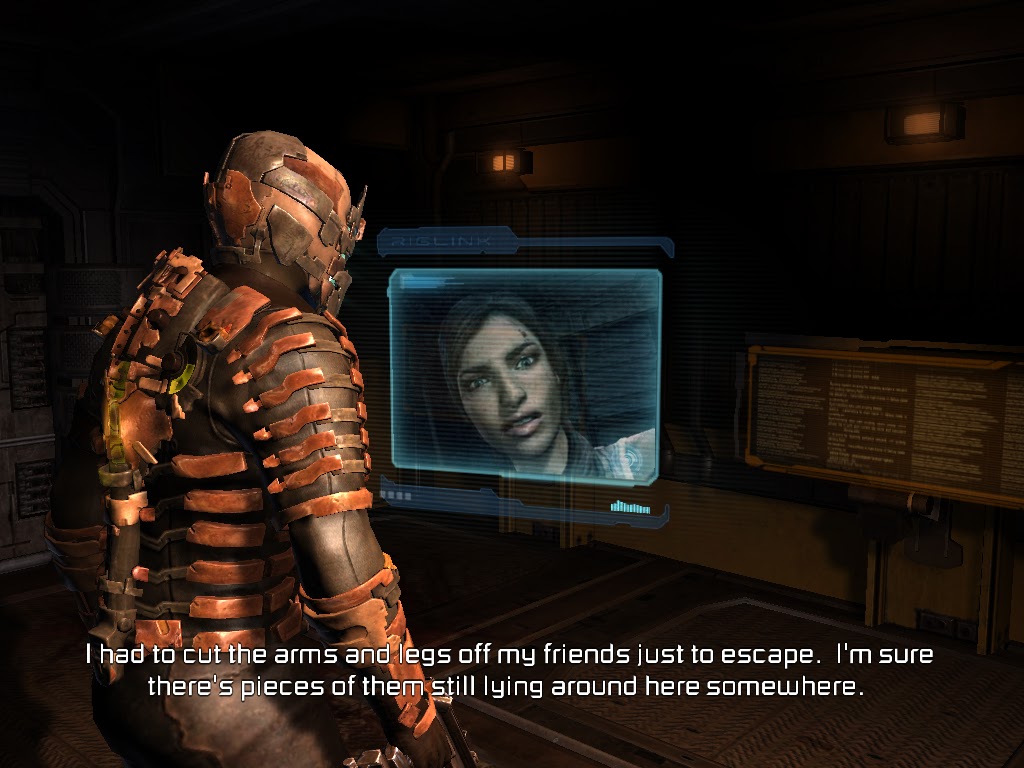
Subtle this game is not. Dismemberment works its way into gameplay at every opportunity. You can use your Kinesis power to yank the pointy bits off slain Necromorphs and fling them at their lurching buddies. A well heaved corpse is the preferred way to disarm mines and booby traps. Necromorphs apparently have a taste for ammo and health kits, because almost every enemy carries useful supplies in their body that require a good cadaver stomping to shake free. When Isaac’s health bar empties you’re treated to a graphic cut scene of the Necromorphs responsible disassembling him. No one dies quietly in DS2. There’s a lot of noise.

In space, no one can hear you button mash

Just to be clear, DS2 is startling, and at times gross and even disturbing, but I didn’t find it truly frightening. Monsters ambushing you through air vents have been done before. Done a lot, in fact. Real fear is tricky, and DS2 never quite pins it down. At its core the game is about taking threatening monsters apart, piece by piece. As such you never quite feel the level of vulnerability necessary for fear. It’s hard to hold this against the game, because it’s a lot of fun, but it’s important to understand DS2 is more about action than true terror.

The only part of the game that reduced me to a gibbering wreck was the quicktime events. Scripted sequences and certain Necromorph attacks prompt you to hammer the E key to survive.* After dying a dozen times to a quicktime early in the game, I had to check the forums to discover that by “press E rapidly” what they actually meant was “press E and F”. Why this wasn’t corrected at some point for a $60 AAA title boggles the mind, because DS2 is otherwise a very polished, high production value game.
 
Isaac's not fond of quicktime challenges either.

I’ve never been particularly fond of a game mechanic that requires you to beat the hell out of your own hardware. Quicktime challenges may have their place on console games, but this wasn’t a problem in the first Dead Space. Surely there must have been a smarter way to implement this on the PC? I know it seems like nitpicking, but this honestly pissed me off more than anything I can remember in a game for a long time, especially because I had been enjoying it so much up to that point.

Basic gameplay in DS2 hasn’t changed too much from the established formula, but it is well paced. The distinct, titled chapters of the first game have given way to a single, continuous world. You move through narrow corridors dealing with ambushes and jump scares, which are broken up by large scale battles against waves of Necromorphs in bigger areas. Periodically some device needs fixing, usually via swapping parts around with Kinesis or a mini-game. It’s not bad, although not terribly original. You will jump at the jump scares and fight frantically to survive the larger battles. DS2 is linear and heavily scripted, but the atmosphere is tense and the combat fun.

Rocket Man

The more predictable set pieces are broken up by some very cool action movie sequences. Scripted events have Isaac holding on for dear life against the pull of hard vacuum or some undead monstrosity, with scant seconds to shoot a critical target or weak point. I felt these were a lot more fun than the obnoxious quicktime events. I particularly enjoyed the cinematic moments where you fall and maneuver through sections of space filled with exploding, hurtling debris.

Severance Pay

Supplies and ammo are precious commodities, especially on the higher difficulty levels. You can buy more at automated stores, but it’s important to manage resources intelligently and make every shot count. I recommend playing at least on hard, to preserve the tension and challenge of your first play through. Careful scavenging and using kinesis and the environment to your advantage is always rewarded.

As before weapons can be upgraded, although doing so is expensive. You will only be able to afford to tune up two or three guns over the course of the game. Ammo drops change depending on what you’re carrying, so any you’ll be able to get by with almost any load out, but your weapon selection and upgrade investments are important tactical and strategic choices.

Isaac maneuvers through Zero-g with surprising grace.

Isaac’s protective suit once again allows him to deal with zero gravity and vacuum, sometimes both at the same time.  You can fly freely about zero-g areas now, which is tremendous fun. The ability to orient yourself towards the ground keeps it from getting too confusing, and these brief flights add a sense of freedom and scale to the otherwise constrained environments. Vacuum essentially acts as a time limit, though many areas feature air stations that refresh your supply. In a nice touch vacuum muffles all sound, making it hard to hear Necromorphs sneaking up on you. They don’t need to breathe.

DS2 is full of call backs to the first game, even as it expands the Dead Space universe. One chapter functions as a “Best of Dead Space” tribute, taking you back through familiar scenery. While DS2 is hardly revolutionary, it manages to keep what made the first game fun and tense while improving a few of the gameplay elements. In particular, there are more large scale brawls and epic challenges than traditional boss fights.

Isaac revisits some familiar locations.
Bits and Pieces

I haven’t gotten a chance to play the game’s multiplayer mode much. It’s an interesting decision, considering the Dead Space series has been based around tense single player action up to this point. Multiplayer borrows a lot from Left-4-Dead, not that that’s a bad thing, pitting human players with powerful ranged weapons against respawning Necromorph players. The human team tries to complete an objective; the Necromorph team tries to kill them along the way. It’s an interesting enough diversion, though hardly why I bought the game.

After you complete the 10-12 hour campaign you can replay it with all the items and upgrades you’ve earned previously. Tearing through Necromorphs with fully upgraded weapons is fun, but knowing where all the ambushes are and having powerful weapons negates most of the tension.  “New Game +” is not a bad feature, but a campaign as linear and scripted as DS2’s doesn’t actually have a lot of replay value. Finishing the campaign also unlocks a “Hard Core” mode that only allows three saves, for the truly cocky.

You lay out precious Power Nodes on a grid to upgrade equipment.

Dead Space 2 is a polished and fun game, but just barely matches its hefty $60 price tag. If you enjoyed the first Dead Space, or are a fan of survival horror and third person shooters, you will enjoy this limb-strewn jaunt through The Sprawl. Everyone else may want to wait for the price to drop before checking it out.

Reasons to play: Tense, atmospheric gameplay. Visceral, satisfying combat. Awesome action sequences. High production values. 

Reasons to pass: Linear and highly scripted campaign. Game based more around action than real fear. ** Gore level may exceed some comfort zones. Infuriating Quicktime events.

*Note: This is a review of the PC version of Dead Space 2. This issue may not be relevent on the console versions.

** This section edited after a discussion on the EA forums regarding fear VS horror, and general feedback on the review. Pretty sharp, those guys. You can view the dialog here: http://forum.ea.com/eaforum/posts/list/5349361.page#12825887

Articles copyright James Cousar, games and images copyright their respective owners.